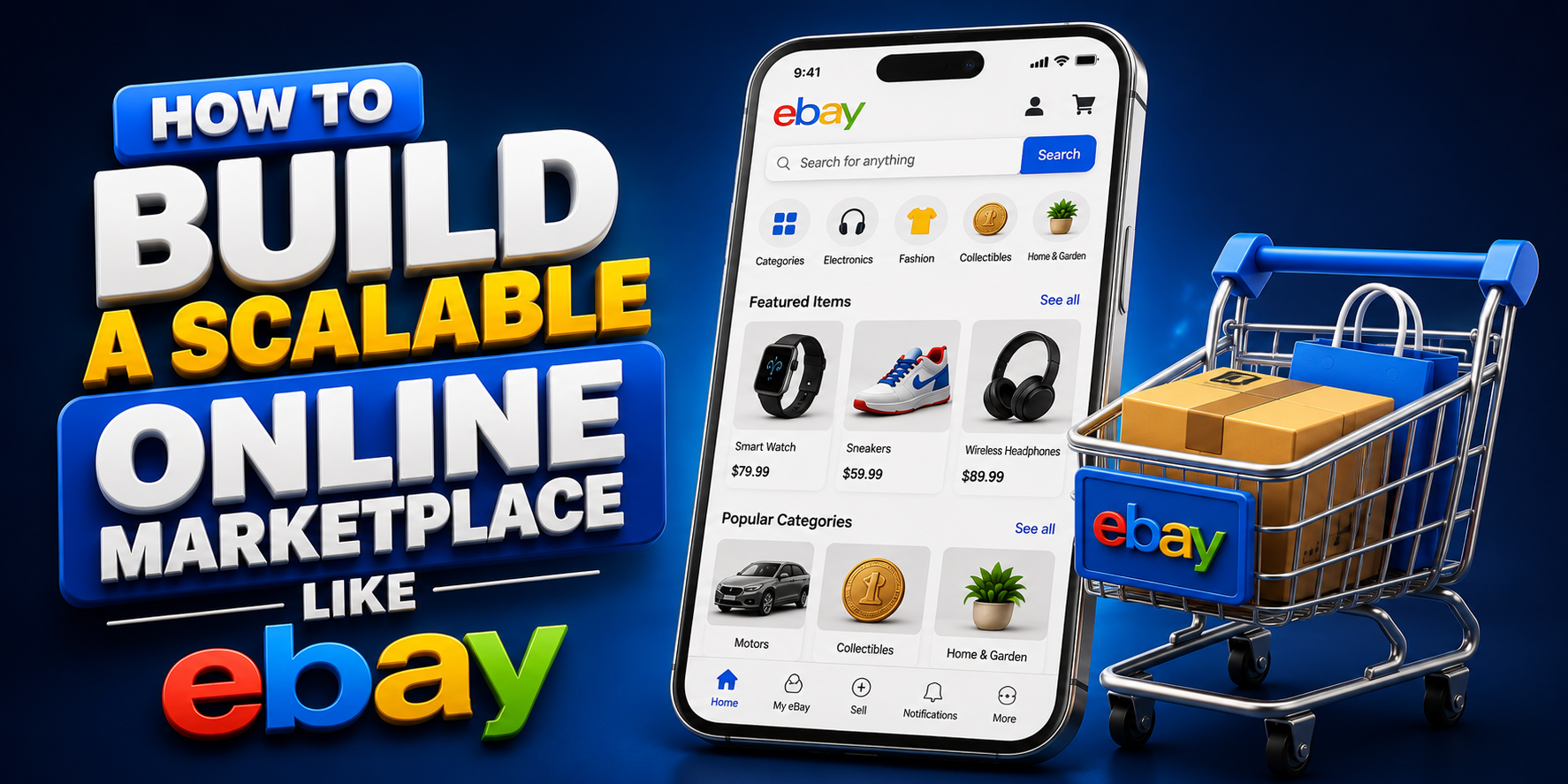
How to Build a Scalable Online Marketplace Like eBay
Related Content
best-marketplace-development-companies
The marketplace economy continues to grow at an unprecedented pace. Industry leaders like Amazon, eBay, and Etsy process billions of transactions annually, connecting millions of buyers and sellers worldwide. At the same time, niche and industry-specific marketplaces are rapidly gaining traction, creating new opportunities for entrepreneurs to launch platforms that cater to targeted audiences.
However, building a marketplace that simply goes live is very different from building one that can scale successfully. As your platform grows, you'll need to manage increasing traffic, expanding product catalogs, more vendors, complex transactions, and evolving customer expectations. Without a scalable architecture and the right technology foundation, even promising marketplaces can struggle with performance issues, operational bottlenecks, and rising maintenance costs.
This comprehensive guide explores everything you need to know about building a scalable online marketplace in 2026. From understanding marketplace business models and essential features to choosing the right development approach, you'll learn the key strategies for creating a future-ready marketplace that supports sustainable growth and long-term success.
Online Marketplace Industry Overview
Online marketplaces have transformed the global eCommerce landscape, becoming the preferred destination for both consumers and businesses. According to Euromonitor International (2025), online marketplaces accounted for 62% of global retail eCommerce sales in 2024, generating nearly $2.4 trillion in gross merchandise value (GMV). This dominance is expected to continue as more retailers embrace multi-vendor business models and consumers seek greater product variety, competitive pricing, and seamless shopping experiences.
Today's buyers expect more than just access to products. Features such as verified seller ratings, secure payment processing, easy product comparisons, and centralized order management have become standard expectations. Supporting this trend, DHL's Marketplace Trends Report 2025 found that 98% of global online shoppers have made purchases through an online marketplace, highlighting the growing trust and reliance consumers place on marketplace platforms.
Mobile commerce is accelerating this shift even further. According to Statista (2025), mobile devices now account for approximately 59% of global eCommerce sales, making mobile-first design a critical requirement rather than an optional enhancement. Modern marketplaces must deliver fast, responsive, and intuitive experiences across smartphones and tablets to meet evolving customer expectations.
Another significant trend is the rapid growth of niche marketplaces. While established platforms like Amazon and eBay continue to dominate overall transaction volume, specialized marketplaces focused on sectors such as B2B commerce, handmade goods, automotive parts, healthcare, fashion, and local services are attracting highly engaged audiences. Euromonitor International notes that vertical marketplaces are gaining momentum by offering curated product selections, industry-specific features, and personalized customer experiences.
As the marketplace ecosystem evolves, technologies such as AI-powered product recommendations, intelligent search, automated fraud detection, and integrated logistics are quickly becoming standard capabilities instead of premium differentiators. For entrepreneurs planning to launch a marketplace in 2026, building on a scalable, future-ready technology foundation is essential to capitalize on this rapidly expanding opportunity.
Understanding the Marketplace Business and Revenue Model
Before selecting a marketplace software, it's essential to understand how an online marketplace operates and, more importantly, how it generates revenue. A well-defined business model serves as the foundation for every decision you'll make, from platform features and pricing strategies to vendor onboarding and long-term scalability.
An online marketplace is a digital platform that connects multiple independent sellers with buyers, enabling transactions within a single ecosystem. Unlike a traditional eCommerce store, where one business owns and sells all products, a multi-vendor marketplace allows numerous vendors to list their products or services while the marketplace owner oversees platform operations, manages policies, facilitates transactions, and delivers a consistent customer experience.
The marketplace ecosystem consists of three primary participants. Buyers browse, compare, and purchase products or services. Sellers create listings, manage inventory, fulfill orders, and interact with customers. The marketplace administrator is responsible for vendor onboarding, commission management, payment processing, dispute resolution, and maintaining the overall quality and security of the platform.
One of the biggest advantages of the marketplace model is the network effect. As more sellers join, the platform offers greater product variety, attracting more buyers. In turn, a growing customer base encourages additional sellers to participate, creating a self-reinforcing cycle that drives marketplace growth.
Successful marketplaces generate revenue through one or more monetization models, including:
- Commission on Sales: The marketplace earns a percentage of every successful transaction. This is the most widely adopted revenue model because the platform's earnings grow alongside vendor sales.
- Vendor Subscription Plans: Sellers pay recurring monthly or annual fees to access the platform or unlock premium features, making it ideal for B2B marketplaces and professional sellers.
- Listing Fees: Vendors are charged for publishing product or service listings, a model commonly used by classified and high-volume marketplaces.
- Featured Listings and Advertising: Sellers can pay to promote products through sponsored placements, banner advertisements, or featured search results, creating an additional revenue stream.
- Payment Processing Fees: Many marketplaces earn a small margin by facilitating secure online payments through integrated payment gateways.
The ideal monetization strategy depends largely on your marketplace type. B2C marketplaces often rely on commissions and advertising, B2B marketplaces frequently combine subscriptions with commissions, while C2C marketplaces commonly generate revenue through listing fees, transaction commissions, and premium promotional services. Choosing the right revenue model early ensures your marketplace remains financially sustainable while delivering value to both buyers and sellers as it scales.
Essential Features of a Scalable Marketplace
The success of an online marketplace depends not only on attracting buyers and sellers but also on providing an experience that keeps them engaged. A scalable marketplace should offer intuitive, reliable, and feature-rich functionality for every stakeholder. While specific requirements may vary by industry, certain features are essential for supporting long-term growth and operational efficiency.
Features for Buyers
A positive buyer experience is the foundation of marketplace growth. The platform should provide a quick and hassle-free registration process with support for social logins and profile management. Powerful product discovery tools—including advanced search, category-based navigation, filters for price, location, availability, and seller ratings—help users find relevant products quickly.
Other essential buyer features include wishlists, product comparisons, secure shopping carts, multiple payment methods, guest checkout, and real-time order tracking. A comprehensive ratings and reviews system further enhances transparency and builds trust by allowing customers to make informed purchasing decisions. Personalized product recommendations and AI-powered search can further improve user engagement and increase conversions.
Features for Sellers
A marketplace can only grow if it enables sellers to manage their businesses efficiently. An intuitive vendor onboarding process with document verification and guided setup reduces entry barriers and encourages faster adoption.
Sellers should have access to a centralized dashboard where they can manage product listings, inventory, pricing, orders, returns, and shipping from a single interface. Features such as bulk product uploads, inventory synchronization, discount management, promotional campaigns, sales reports, and performance analytics help vendors optimize their operations and improve profitability. Integration with shipping providers and payment gateways further simplifies fulfillment and financial management.
Features for Marketplace Administrators
The admin panel serves as the operational backbone of a multi-vendor marketplace. It should provide complete visibility and control over platform activities without requiring frequent developer intervention.
Key administrative capabilities include vendor approval and verification workflows, commission and payout management, product moderation, category management, customer and order oversight, dispute resolution, refund management, content management, and platform-wide reporting. Real-time analytics dashboards help administrators monitor marketplace performance, track revenue, analyze buyer and seller behavior, and make data-driven business decisions.
Features That Support Scalability
Beyond user-specific functionality, a scalable marketplace should include capabilities that support future growth. These include multi-language and multi-currency support, responsive mobile design, advanced security measures, automated notifications, SEO-friendly architecture, and role-based access controls.
By implementing these essential features from the outset, marketplace owners can create a platform that delivers an exceptional user experience, streamlines operations, and remains capable of supporting increasing traffic, expanding vendor networks, and evolving customer expectations as the business grows.
How to Build a Scalable Marketplace: Step-by-Step
Building a successful online marketplace requires much more than developing a website where buyers and sellers can interact. It involves choosing the right business strategy, selecting scalable technology, creating an exceptional user experience, and continuously optimizing your platform as it grows. The following step-by-step process provides a roadmap for launching and scaling a marketplace that is built for long-term success.
Step 1: Identify Your Marketplace Niche
The most successful marketplaces rarely begin by targeting everyone. Instead, they solve a specific problem for a well-defined audience. Rather than competing directly with established giants, identify an underserved market, product category, geographic region, or industry where you can deliver unique value.
Start by researching your target audience to understand their buying behavior, pain points, and expectations. Analyze competitors to identify feature gaps, pricing opportunities, or service limitations that your marketplace can address. Validate your idea through customer interviews, surveys, landing pages, or a minimum viable product (MVP) before making significant investments.
A focused niche not only reduces competition but also makes marketing, seller acquisition, and customer retention far more effective during the early stages of growth.
Step 2: Define Your Revenue Model
Your marketplace's monetization strategy should align with your business objectives and target audience. Choosing the right revenue model early ensures sustainable growth while delivering value to buyers and sellers alike.
Some of the most common marketplace revenue models include:
- Commission-based model – Earn a percentage of every successful transaction.
- Vendor subscription plans – Charge recurring monthly or annual fees for marketplace access or premium features.
- Listing fees – Allow sellers to pay for publishing product or service listings.
- Featured listings and advertising – Generate additional revenue by offering sponsored product placements and promotional opportunities.
- Transaction or payment processing fees – Earn a small margin by facilitating secure online payments.
Many successful marketplaces combine multiple revenue streams. However, avoid introducing excessive fees during the launch phase, as minimizing seller friction is critical for building marketplace liquidity.
Step 3: Choose the Right Marketplace Development Approach
Selecting the right development approach is one of the most important decisions you'll make. It directly impacts your budget, development timeline, scalability, and future maintenance costs.
There are two primary options:
Custom Marketplace Development
Custom development offers complete flexibility, allowing businesses to design every workflow, feature, and integration according to unique business requirements. This approach is often suitable for enterprises with highly specialized operational needs or innovative marketplace concepts.
However, custom development typically requires substantial investment, longer development cycles, continuous maintenance, and dedicated technical teams for future upgrades and scalability.
Ready-Made Marketplace Software
For startups, SMBs, and most growing businesses, ready-made e commerce marketplace software provides a significantly faster and more cost-effective alternative. Modern marketplace solutions include essential capabilities such as multi-vendor management, product catalog management, payment gateway integrations, order processing, vendor dashboards, mobile responsiveness, SEO tools, and advanced administrative controls out of the box.
Instead of building core functionality from scratch, businesses can customize branding, workflows, integrations, and business logic while significantly reducing development time and risk. This enables entrepreneurs to launch faster, validate their business model, and focus resources on customer acquisition and marketplace growth.
Step 4: Customize Your Marketplace
Once you've selected your development approach, tailor the platform to reflect your business identity and operational requirements.
Customize your marketplace by:
- Applying your brand identity through logos, colors, typography, and layouts.
- Configuring payment gateways that support your target markets.
- Integrating shipping providers and logistics partners.
- Setting tax rules, currencies, and localization preferences.
- Defining marketplace policies, vendor guidelines, and return procedures.
- Adding custom workflows or third-party integrations based on your business model.
A professional, intuitive, and trustworthy interface significantly improves buyer confidence and encourages vendor participation.
Step 5: Test Your Marketplace Thoroughly
Launching without proper testing can negatively impact user trust and damage your brand reputation from day one.
Before going live, perform comprehensive testing across every critical workflow, including:
- User registration and authentication
- Seller onboarding and product listing
- Product search and filtering
- Shopping cart and checkout
- Payment processing
- Order management and notifications
- Shipping workflows
- Performance under heavy traffic
- Mobile responsiveness
- Security and vulnerability testing
User Acceptance Testing (UAT) involving real buyers and sellers can uncover usability issues that internal teams often overlook.
Step 6: Launch and Build Marketplace Liquidity
One of the biggest challenges every new marketplace faces is balancing supply and demand. Buyers expect a wide selection of products, while sellers want access to an active customer base.
To overcome this "chicken-and-egg" problem, focus on onboarding high-quality vendors before your public launch. Offer incentives such as reduced commissions, free subscriptions, marketing support, or featured listings to attract early sellers.
Ensure that every vendor completes a verification process to maintain marketplace quality and trust. Help sellers optimize product listings with detailed descriptions, professional images, and competitive pricing before inviting buyers to the platform.
Your initial marketing efforts should target your niche audience through content marketing, social media, search engine optimization (SEO), paid advertising, partnerships, and community engagement.
Step 7: Scale and Optimize Your Marketplace
Launching your marketplace is only the beginning. Sustainable growth requires continuous optimization, data-driven decision-making, and investments in technology.
As your marketplace grows, focus on:
- Expanding vendor acquisition strategies.
- Improving customer retention and loyalty programs.
- Enhancing marketplace SEO through category pages, product content, and educational resources.
- Leveraging analytics to optimize conversions and user behavior.
- Migrating to scalable cloud infrastructure capable of handling increasing traffic and transactions.
- Expanding into new regions with multi-language and multi-currency support.
- Launching dedicated mobile applications to improve customer engagement.
The most successful marketplaces continuously evolve based on customer feedback, technological advancements, and market demand. By combining the right niche, business model, scalable technology, and long-term growth strategy, you can build a marketplace that not only launches successfully but also continues to attract buyers, sellers, and revenue for years to come.
How Ready-Made Marketplace Software Helps You Scale Faster
Launching a marketplace is only the beginning. As your business grows, you'll need technology that can handle increasing traffic, expanding product catalogs, more vendors, and higher transaction volumes without compromising performance. This is where ready-made marketplace software provides a significant advantage.
Instead of spending months building core marketplace functionality from scratch, businesses can leverage a solution that's already optimized for growth. Key benefits include:
- Faster Time-to-Market: Launch your marketplace in weeks instead of spending months or even years on custom development, allowing you to validate your business idea sooner.
- Built for Scalability: Ready-made marketplace platforms are designed with scalable architecture, optimized databases, and cloud compatibility to support growing numbers of users, vendors, products, and transactions.
- Streamlined Vendor Onboarding: Automated registration, verification workflows, and dedicated seller dashboards reduce onboarding friction, making it easier to attract and retain vendors.
- Pre-Built Marketplace Features: Essential capabilities such as multi-vendor management, product catalogs, inventory management, order processing, payment gateway integrations, shipping management, and admin controls are available out of the box.
- Automation of Routine Operations: Built-in automation handles repetitive tasks such as commission calculations, tax management, payout processing, order notifications, and inventory synchronization, improving operational efficiency.
- Lower Development and Maintenance Costs: Regular software updates, security patches, performance improvements, and feature enhancements are provided by the software vendor, reducing long-term development expenses.
- Easy Third-Party Integrations: Connect with popular payment gateways, shipping providers, CRM tools, marketing platforms, ERP systems, and analytics solutions without extensive custom development.
- Focus on Business Growth: With the technical foundation already in place, your team can dedicate more time to acquiring customers, onboarding sellers, optimizing user experience, and expanding into new markets.
For startups, SMBs, and growing enterprises, ready-made marketplace software offers the fastest and most cost-effective path to launching and scaling a successful online marketplace. It minimizes technical complexity while providing the flexibility and performance needed to support sustainable long-term growth.
Build Your eBay-Like Marketplace Faster with Yo!Kart
If you're looking to launch a scalable eBay-like marketplace without investing heavily in custom development, Yo!Kart offers a powerful ready-made solution. Designed specifically for multi-vendor marketplaces, it provides the essential tools needed to build, launch, and scale your platform while significantly reducing development time and costs.
Why Choose Yo!Kart?
- Purpose-Built for Multi-Vendor Marketplaces: Yo!Kart is a white-label, self-hosted marketplace software designed to support B2B, B2C, C2C, and service-based marketplace business models.
- Complete Ownership: Unlike SaaS platforms, Yo!Kart comes with a one-time license, giving you complete ownership of the software, full control over hosting, and access to the source code for customization.
- Rich Feature Set: The platform includes everything required to launch a modern marketplace, including:
- Multi-vendor management
- Advanced product catalog management
- Buyer and seller dashboards
- Multiple payment gateway integrations
- Order and inventory management
- Native mobile apps for buyers and sellers
- Multi-language and multi-currency support
- Built-in SEO features
- Commission and vendor payout management
- Powerful admin dashboard etc.
- Highly Customizable: Businesses can tailor workflows, user interfaces, payment methods, shipping integrations, and other functionalities to meet unique marketplace requirements.
- Faster Time-to-Market: Instead of spending 12–18 months building a marketplace from scratch, Yo!Kart enables businesses to launch much faster ( 2-3 weeks) by providing a production-ready foundation.
- Built for Growth: Its scalable architecture supports increasing numbers of vendors, products, customers, and transactions, making it suitable for businesses planning long-term expansion.
- Lower Total Cost of Ownership: With regular product updates, robust security, and pre-built marketplace capabilities, businesses save significantly on development, maintenance, and ongoing operational costs.
Whether you're validating a new marketplace idea, launching a niche eCommerce platform, or expanding an established business, Yo!Kart provides the flexibility and scalability needed to support every stage of growth. By combining enterprise-grade features with complete ownership and extensive customization options, it enables entrepreneurs to build an eBay-like marketplace faster, reduce technical complexity, and focus on growing their business rather than building infrastructure from scratch.
Conclusion
Building a scalable online marketplace like eBay requires more than just launching a website it demands a clear business model, the right technology foundation, and a long-term growth strategy. By choosing a niche, implementing essential marketplace features, and investing in scalable architecture, entrepreneurs can create a platform that supports increasing users, vendors, and transactions without compromising performance.
While custom development offers complete flexibility, it often comes with higher costs, longer timelines, and ongoing maintenance challenges. For businesses looking to launch faster and scale efficiently, ready-made marketplace software provides a practical alternative. Solutions like Yo!Kart combine enterprise-grade features, complete ownership, extensive customization, and a scalable architecture, enabling businesses to build and grow an eBay-like marketplace with significantly less development effort. Whether you're launching a niche marketplace or expanding into a global multi-vendor platform, choosing the right technology today can set the foundation for long-term success.