How to Build a Multi Restaurant Delivery App in 2026: Step-by-Step Guide
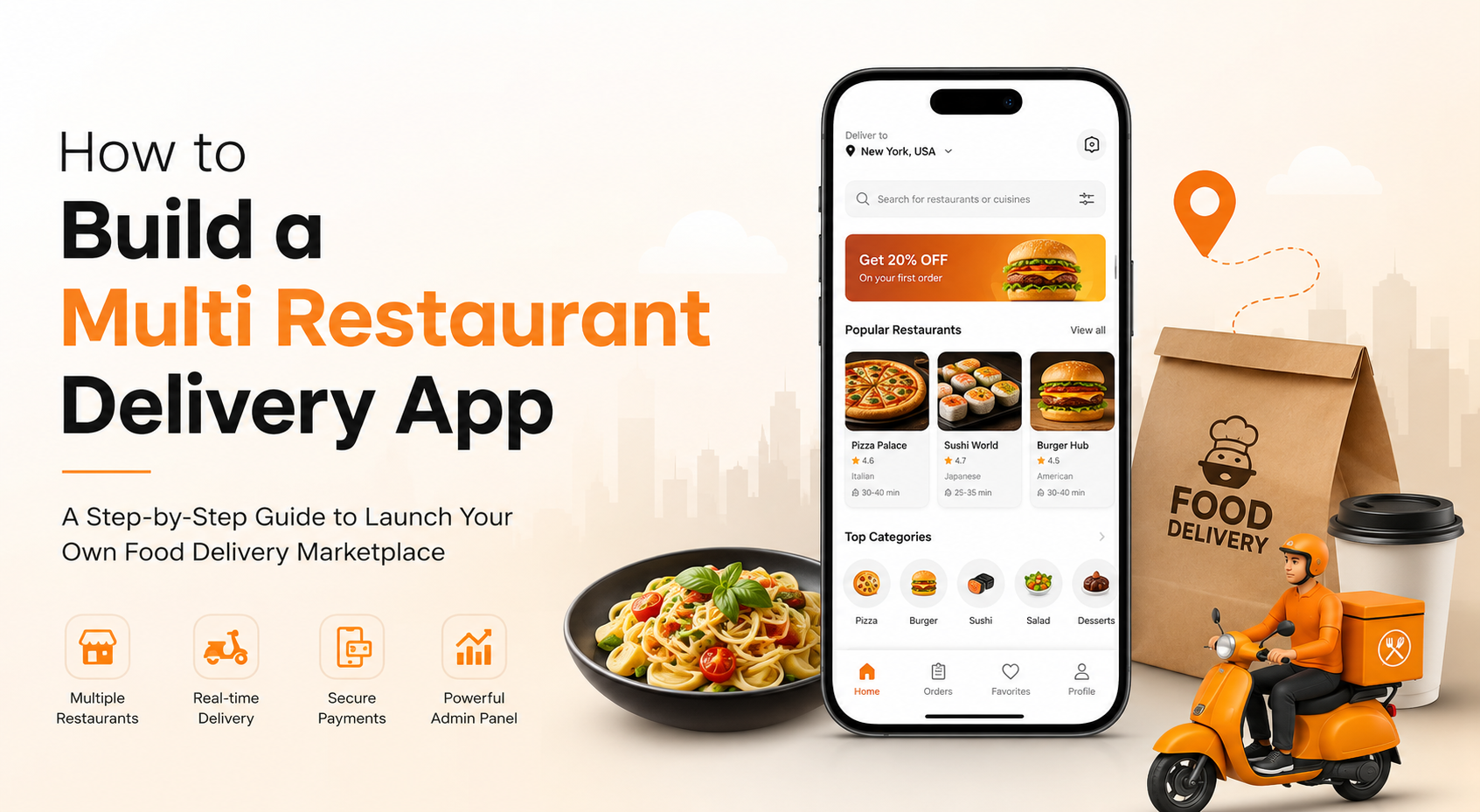


Online food delivery has moved from a convenience to a habit. Consumers now expect to browse dozens of restaurants, compare prices, track their order in real time, and have a meal at their door in under 30 minutes all from a single app. This shift has been fueled by the rise of quick commerce, changing urban lifestyles, and a growing preference for local dining experiences delivered straight to the home or office.
For entrepreneurs, this presents a clear opportunity. Rather than building a single-restaurant ordering system, many founders are choosing to launch multi restaurant delivery apps platforms that aggregate multiple restaurants under one marketplace, similar to Uber Eats, DoorDash, or Zomato. These platforms generate revenue at scale, are more attractive to investors, and create long-term value by owning the customer relationship rather than a single restaurant's order flow.
This guide walks through what a multi restaurant delivery app is, why 2026 is a strong year to invest in one, how the business model works, and a practical step-by-step process for building and launching your own platform including why a ready-made solution may be the smartest path forward.
What is a Multi Restaurant Delivery App?
A multi restaurant delivery app is an online marketplace platform that connects customers with multiple restaurant partners through a single platform. Instead of each restaurant maintaining its own app or website, they list their menus on a shared marketplace, and the platform handles discovery, ordering, payments, and often delivery logistics as well.
The business model is straightforward: the platform earns revenue through commissions on each order, delivery fees, restaurant subscriptions, and additional services like featured listings or advertising. Successful examples of this model include Uber Eats, DoorDash, etc all of which operate as intermediaries between restaurants and hungry customers, without owning the kitchens themselves.
To function, the ecosystem relies on four core participants:
- Customers — who browse restaurants, place orders, track delivery, and pay through the app.
- Restaurant Partners — who list their menus, manage orders, and fulfill food preparation.
- Delivery Agents — who pick up orders from restaurants and deliver them to customers.
- Admin — the platform operator who oversees the entire marketplace, manages commissions, resolves disputes, and monitors performance.
Each of these stakeholders typically has a dedicated interface, which is why building a true multi restaurant platform involves more than just a single customer-facing app.
Why Invest in a Multi Restaurant Delivery App in 2026?
The online food delivery industry continues to expand year over year, driven by several converging trends.
Growth of the global online food delivery market. The sector has seen consistent double-digit growth over the past several years, with quick commerce and food delivery increasingly viewed as essential urban infrastructure rather than a luxury.
Rise of mobile ordering and convenience culture. Smartphone penetration and improved payment infrastructure have made ordering food as simple as a few taps. Consumers, especially younger demographics, now default to app-based ordering over phone calls or walk-ins.
Increasing demand for local restaurants and cloud kitchens. The cloud kitchen model —delivery-only kitchens without a dine-in space has lowered the barrier to entry for restaurant operators, creating a growing supply of partners eager to list on delivery marketplaces.
Expansion of hyperlocal delivery services. Consumers increasingly expect delivery not just from restaurants, but from local grocers, pharmacies, and specialty stores. A multi restaurant platform built with a scalable architecture can expand into these adjacent categories over time.
Together, these trends make 2026 a favorable window for entrepreneurs to enter the market provided they choose the right development strategy.
Suggested Read: Top 5 Profitable Niches to Start a Restaurant Business
How Does a Multi Restaurant Delivery App Work?
At its core, multi restaurant delivery App follows a simple yet highly efficient workflow that connects customers, restaurants, and delivery agents on a single platform.
- Customers place orders by browsing restaurants, selecting menu items, and completing payments through the app or website.
- Restaurants receive and accept orders, after which they begin preparing the food for delivery.
- Delivery agents are assigned to the order automatically by the system or manually by the admin or restaurant, depending on the platform's configuration.
- Order preparation and pickup take place, with the delivery partner collecting the order from the restaurant once it is ready.
- The order is delivered to the customer, and the transaction is completed upon successful delivery.
- Customers provide ratings and feedback, enabling the platform to maintain service quality and improve the performance of restaurants and delivery partners.
This cycle order, accept, assign, prepare, deliver, and review—is repeated thousands of times daily on successful food delivery platforms. Therefore, having robust, automated, and scalable software is essential to ensuring seamless operations, faster deliveries, and an exceptional customer experience.
Step-by-Step Development Guide
A comprehensive guide that breaks down the entire development process into clear, actionable steps. From planning and design to development, testing, and launch, it helps businesses build and deploy successful digital solutions efficiently.
Step 1: Define Your Business Model
Before you begin developing your platform, it's important to identify the business model that best aligns with your target market, customer needs, and long-term vision. The right model will influence your platform's features, operations, and overall growth strategy.
- Marketplace Model: Build a platform that connects multiple restaurants with customers through a single application, offering users a wide variety of cuisines and dining options, similar to Uber Eats and DoorDash.
- Single-City Aggregator: Focus on a specific city or region to create a strong local presence, establish closer relationships with restaurant partners, and optimize delivery operations within a defined geographic area.
- Cloud Kitchen Marketplace: Create a platform centered around delivery-only kitchens and virtual restaurant brands, enabling businesses to operate without the overhead of traditional dine-in establishments.
- Subscription-Based Food Delivery Platform: Offer membership plans that provide customers with benefits such as free delivery, exclusive discounts, and premium services, helping improve user engagement and loyalty.
Choosing the right business model from the outset will help you build a platform that meets market demands and creates a strong foundation for future growth.
Step 2: Conduct Market Research
After finalizing your business model, conduct in-depth market research to validate your idea and identify growth opportunities.
- Identify Your Target Audience: Understand customer preferences, ordering behavior, spending patterns, and favorite cuisines.
- Analyze Competitors: Evaluate both global food delivery giants and local platforms to identify market gaps and opportunities.
- Study Delivery Trends: Research peak ordering times, average order values, delivery expectations, and emerging consumer trends.
- Define Your Unique Selling Proposition (USP): Determine what will differentiate your platform, such as faster delivery, lower restaurant commissions, better user experience, or a niche focus like healthy meals or regional cuisines.
Step 3: Define Essential Features
A multi-restaurant delivery software consists of four interconnected applications, each designed to serve a specific user group. Defining the right features early ensures a seamless experience for customers, restaurants, delivery agents, and administrators.
Customer App Features
- User registration and profile management
- Restaurant search and advanced filters (cuisine, price, ratings, delivery time)
- Real-time order tracking
- Multiple payment options
- Ratings and reviews
- Push notifications for order updates and promotions
Restaurant Panel Features
- Menu and pricing management
- Order management and status updates
- Inventory management
- Sales and performance analytics dashboard
Delivery Agent App Features
- Route optimization for faster deliveries
- Earnings and payment dashboard
- Order management
- Availability settings and shift management
Admin Panel Features
- User management across all roles
- Commission and payment management
- Reports and business analytics
- Marketing and promotional tools
- Dispute and issue management
These core features create a strong foundation for building a scalable and user-friendly multi-restaurant delivery platform.
Step 4: Choose the Development Approach
Once you've defined your business requirements and feature set, the next decision is how to build your multi-restaurant delivery platform. Businesses generally have two options: Custom Development or a Readymade Solution.
1. Custom Development
Custom development involves building the platform from scratch, where every feature, interface, and workflow is designed specifically for your business requirements. While this approach offers complete flexibility, it demands significant investment in terms of time, budget, and technical resources.
Pros
- Complete control over features and functionality
- Highly customizable user experience and workflows
- Easier to implement highly specific business requirements
- Full ownership of the product roadmap
Cons
- High upfront development costs
- Longer time-to-market (often several months or more)
- Requires a dedicated development and maintenance team
- Ongoing expenses for updates, bug fixes, and scalability improvements
- Higher project and technical risks
2. Readymade Solution
A readymade solution is a pre-built, market-tested platform that comes with all the essential features required to launch and manage a food delivery marketplace. It can be customized to align with your branding and business needs while significantly reducing development time and costs.
For most startups and entrepreneurs, this approach offers the ideal balance of speed, affordability, and scalability.
Pros
- Faster time-to-market, allowing businesses to launch within weeks instead of months
- Significantly lower development costs compared to building from scratch
- Comes with pre-tested and industry-proven features
- Lower technical and operational risks
- Easier to scale and upgrade as the business grows
- Access to ongoing technical support and regular updates from the software provider
- Enables entrepreneurs to focus on customer acquisition and business growth rather than software development
Cons
- Certain advanced features may require additional customization
- Dependence on the software provider for some updates and enhancements
For the majority of food delivery startups, a readymade food delivery solution is the more practical choice because it minimizes risk, reduces costs, and enables a much faster market entry—an essential advantage in today's highly competitive on-demand delivery market.
Step 5: Test and Launch Your Platform
Before making your platform available to a wider audience, it's crucial to thoroughly test every component to ensure a seamless and reliable user experience. A well-planned testing and launch strategy helps identify potential issues early and minimizes risks after going live.
- Functional Testing: Verify that all features across the customer app, restaurant panel, delivery agent app, and admin dashboard work as intended.
- Performance Testing: Ensure the platform can handle high traffic and large order volumes during peak hours without affecting performance.
- Security Testing: Validate the security of customer data, payment information, and platform infrastructure to prevent vulnerabilities.
- Beta Launch: Release the platform to a limited group of restaurants and customers to test real-world operations and gather valuable insights.
- Collect User Feedback: Analyze feedback from early users, fix issues, and make necessary improvements before the official launch.
Once testing is complete and the platform is optimized, you can confidently proceed with a full-scale launch and begin scaling your food delivery business.
Why Ready-Made Software is the Smartest Way to Build a Multi-Restaurant Delivery App
Building a food delivery marketplace from scratch can be a complex and resource-intensive process. Custom development often involves substantial upfront investment, lengthy development timelines, ongoing maintenance costs, and the risk of delays that can impact your ability to capitalize on market opportunities.
For startups and entrepreneurs, speed-to-market is often the biggest competitive advantage. This is where ready-made software stands out. Instead of spending months or even years developing core functionalities, businesses can leverage a pre-built, market-tested platform and focus on what truly matters—acquiring customers, onboarding restaurants, and scaling operations.
Why Entrepreneurs Prefer Ready-Made Software
- Launch Faster: Get your platform live in weeks or even days instead of months.
- Lower Development Costs: Eliminate the need for a large in-house development team.
- Reduced Business Risk: Use a tested and proven platform with industry-standard features.
- Focus on Growth: Spend more time on marketing, partnerships, and customer acquisition rather than software development.
- Scalable Foundation: Start small and expand your platform as demand grows.
- Customization Flexibility: Customize branding, features, and integrations without building from scratch.
- Ongoing Support and Updates: Benefit from technical support and regular enhancements from the software provider.
Best Software to Build a Multi-Restaurant Delivery App in 2026: Yo!Yumm
Yo!Yumm is a white-label multi-restaurant delivery software designed to help entrepreneurs launch food delivery marketplaces similar to Uber Eats, DoorDash, and Deliveroo without the time, cost, and complexity of custom development.
The software provides a ready-to-launch ecosystem with applications for customers, restaurants, delivery agents, and administrators, enabling businesses to enter the market quickly and scale efficiently.
Why Choose Yo!Yumm?
- Fully White-Label Solution – Launch under your own brand with complete customization options.
- Multi-Restaurant Marketplace Support – Manage unlimited restaurants, customers, and delivery agents from a single platform.
- Native Mobile Applications – Pre-built apps for customers, restaurants, delivery agents, and administrators.
- Advanced Delivery Management – Real-time tracking, delivery scheduling, and smart order assignment.
- Multiple Revenue Streams – Earn through commissions, delivery charges, subscriptions, featured listings, and advertisements.
- Powerful Admin Dashboard – Manage orders, payments, users, and business analytics from one centralized panel.
- Scalable Architecture – Suitable for startups, SMEs, and enterprise-level businesses.
- Faster Time-to-Market – Launch your food delivery platform in days instead of spending months on development.
- Source Code Customization – Modify and extend the platform as your business evolves.
- Multi-Language Support – Cater to customers in different regions and languages.
- Multi-Currency Support – Accept payments in multiple currencies.
- One-Time License – Pay once and own the software.
With its comprehensive feature set, scalability, and significantly faster deployment timeline, Yo!Yumm offers one of the most practical and cost-effective ways to build a multi-restaurant delivery app in 2026.
Conclusion
The demand for online food delivery continues to grow, making 2026 an excellent time for entrepreneurs to launch a multi-restaurant delivery platform. However, building a successful app requires more than just an idea: it demands the right business model, robust features, scalable technology, and a clear go-to-market strategy.
While custom development offers complete flexibility, it often involves significant costs, longer development timelines, and higher technical risks. For most startups and businesses, a ready-made solution provides a faster, more cost-effective path to market without compromising on essential functionality.
Solutions like Yo!Yumm enable entrepreneurs to launch a fully branded, feature-rich food delivery marketplace with dedicated apps for customers, restaurants, delivery agents, and administrators. With built-in scalability and customization capabilities, businesses can focus on growing their customer base and expanding operations instead of spending months building software from scratch.
If you're planning to enter the online food delivery industry, choosing the right technology foundation today can significantly accelerate your journey toward building the next successful food delivery marketplace.