How to Build an App Like Instacart in 2026
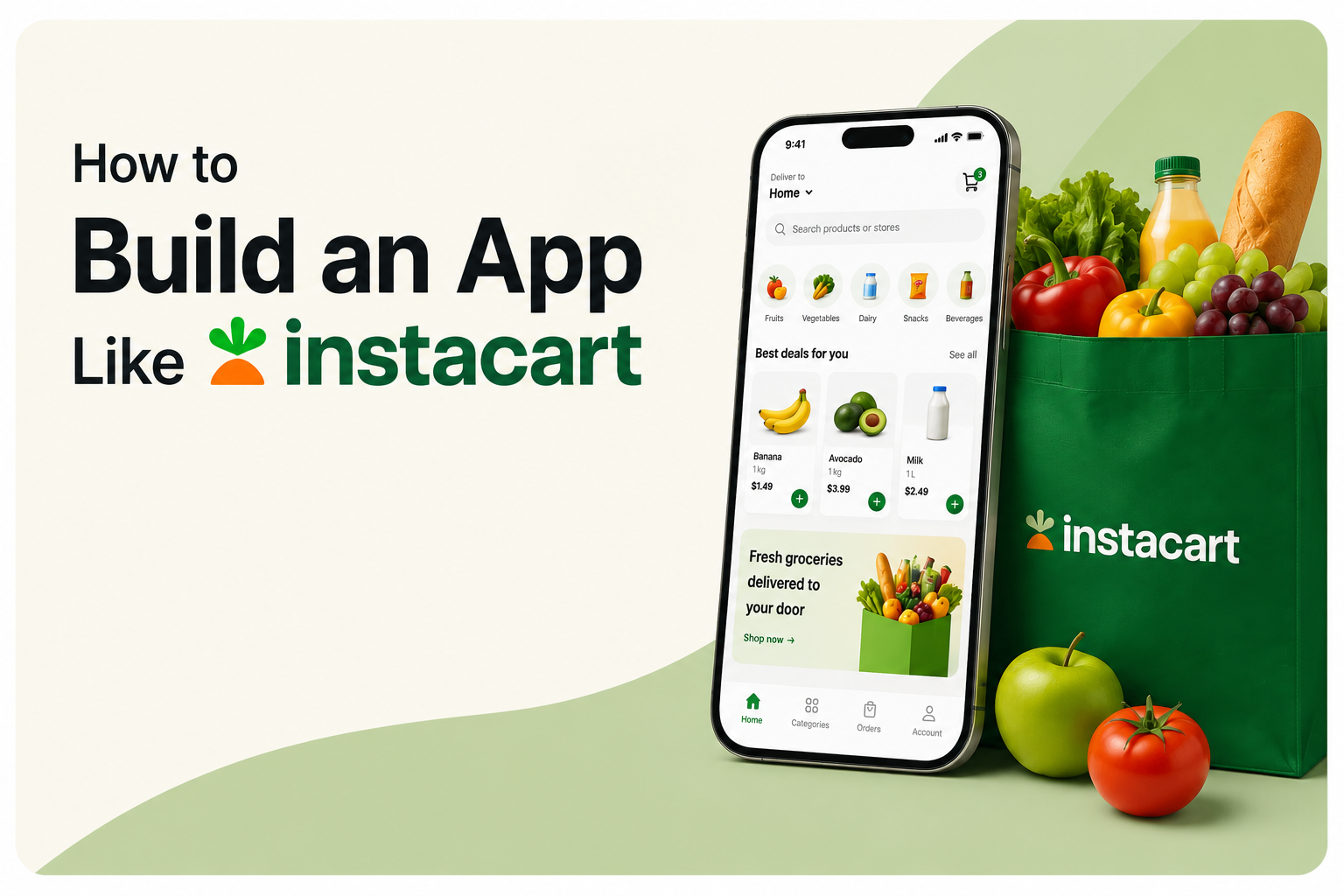


Online grocery delivery has evolved from a temporary pandemic-driven trend into a long-term shift in consumer buying behavior. Today, shoppers expect to browse complete grocery catalogs, compare products, make secure payments, and receive orders at their doorstep within hours. Platforms like Instacart have transformed this experience by creating a marketplace that connects customers, grocery retailers, and delivery partners through a single digital ecosystem.
This growth has created significant opportunities for entrepreneurs looking to enter the grocery delivery space. Unlike traditional retail, grocery marketplaces are not dominated by a single global player; success often depends on local partnerships, delivery efficiency, and understanding specific customer needs. This allows startups to build platforms targeting specific cities, regions, or niche segments such as organic, specialty, or ethnic groceries.
For entrepreneurs planning to build an app like Instacart, the key challenge is choosing the right development approach. While custom development offers complete flexibility, it requires higher investment and longer timelines. On the other hand, ready-made grocery delivery software enables faster launch with industry-specific features and lower upfront costs. The ideal choice depends on your business goals, budget, and level of customization required.
Market Overview of the Online Grocery Delivery Industry
The online grocery delivery market has kept expanding well past its early pandemic-driven surge, and a few forces are behind that continued growth:
- Smartphone adoption keeps rising globally, putting a grocery marketplace within reach of more households every year, including in mid-sized cities and emerging markets that were underserved a few years ago.
- Consumer shopping habits have shifted permanently toward digital-first experiences grocery is simply following the path retail, food delivery, and banking already took.
- Demand for same-day and even one-hour delivery has become a baseline expectation rather than a premium feature, pushing platforms to invest heavily in logistics and store-partner density.
- Hyperlocal delivery businesses have proven that tightly-scoped, neighborhood-level operations can be more profitable and easier to manage than trying to compete nationally from day one.
Platforms like Instacart, Uber Eats' grocery offering, and a growing number of regional grocery marketplaces have demonstrated that this model works at scale and, just as importantly, that it works at a smaller scale too. A well-run grocery marketplace focused on one city or one underserved category can be a genuinely profitable business in 2026, without needing to out-compete the giants nationally.
Steps to Build an App Like Instacart in 2026
Building an app like Instacart requires a clear strategy, the right technology approach, and a scalable business model. Follow these key steps to plan, develop, and launch a successful grocery delivery marketplace in 2026.
Step 1: Define Your Grocery Delivery Business Model
Before starting development, determine the grocery delivery model that best fits your target audience, investment capacity, and growth strategy. Your choice will influence platform features, operational workflow, revenue streams, and technology requirements.
Multi-Vendor Grocery Marketplace — Similar to Instacart, this model connects multiple grocery stores with customers through a single platform. Revenue is generated through commissions, delivery fees, and marketplace charges, making it highly scalable without requiring inventory ownership.
Single Store Grocery App — Designed for supermarkets or grocery chains that want to sell and deliver their own products. It provides complete control over inventory, pricing, and customer experience but has limited scalability compared to a marketplace model.
Hyperlocal Grocery Delivery Platform — Focuses on serving customers within a specific city or local area. This approach helps businesses build strong relationships with nearby stores and optimize faster deliveries.
Dark Store Model — The business manages its own inventory through dedicated warehouses or fulfillment centers. While it enables better control over product availability and delivery speed, it requires higher investment and operational management.
Selecting the right model at the beginning helps you build the right platform structure, from vendor management and inventory handling to delivery operations and payment workflows. For most startups looking to build an Instacart-like platform, a multi-vendor marketplace model offers the best balance of scalability and investment.
Step 2: Identify Essential Features for Your Grocery Delivery App
An Instacart-like grocery delivery platform is more than just a customer ordering app. It consists of four connected systems — customer app, vendor panel, delivery partner app, and admin dashboard that work together to manage product discovery, orders, payments, inventory, and deliveries.
Customer App
The customer-facing app should offer a smooth and convenient grocery shopping experience with features such as:
- User registration and profile management
- Grocery search with filters by category, store, brand, or price
- Store browsing and product discovery
- Shopping cart and wishlist
- Multiple payment options
- Scheduled delivery slots
- Real-time order tracking
- Ratings and reviews
Vendor Panel
The vendor dashboard allows grocery stores to manage their products and orders efficiently:
- Store registration and profile management
- Product listing and catalog management
- Inventory control
- Order acceptance and management
- Pricing and discount management
- Sales reports and analytics
Delivery Partner App
The delivery app helps manage last-mile delivery operations:
- Delivery partner registration and profile management
- Order assignment and acceptance
- GPS navigation
- Delivery status updates
- Earnings tracking and delivery history
Admin Panel
The admin dashboard provides complete control over marketplace operations:
- Customer and vendor management
- Commission management
- Order monitoring
- Payment and payout management
- Analytics dashboard
Developing these four connected components with real-time synchronization is crucial for building a scalable grocery marketplace. A well-integrated system ensures smooth coordination between customers, grocery stores, delivery partners, and administrators, creating an experience similar to leading platforms like Instacart.
Step 3: Choose the Right Development Approach
Once your business model and required features are defined, the next important decision is selecting the right development approach. This choice directly affects your budget, launch timeline, and ability to scale.
Option 1: Custom Grocery Delivery App Development
Custom development involves building the entire platform from scratch according to your specific business requirements.
Advantages:
- Complete control over design and functionality
- Highly customized features for specific business needs
Challenges:
- Higher development costs
- Longer time-to-market, often requiring several months of development
- Need for technical expertise for maintenance and updates
Custom development can be suitable for enterprises with unique operational requirements and sufficient resources. However, for startups, the longer development cycle and higher investment can delay market entry.
Option 2: Ready-Made Grocery Delivery Software
Ready-made grocery delivery software provides a pre-built marketplace infrastructure with essential components such as customer apps, vendor panels, delivery partner apps, and admin dashboards.
Benefits:
- Faster launch compared to building from scratch
- Lower initial development costs
- Pre-built grocery marketplace features
- Reduced technical complexity
- Customization options for branding and business requirements
- Faster testing and validation of your business idea
For startups, launching quickly and testing market demand is often more valuable than spending months building every feature from the ground up. A ready-made solution helps entrepreneurs enter the market faster while still offering the flexibility needed to build a scalable grocery delivery business.
Growcer: A Ready-Made Grocery Delivery Solution
Growcer is a feature-rich, ready-made grocery marketplace software built to help entrepreneurs launch Instacart-like platforms quickly and efficiently. Designed specifically for grocery delivery businesses, it provides a complete ecosystem with dedicated interfaces for customers, grocery vendors, delivery partners, and administrators.
Unlike generic eCommerce platforms, Growcer comes with grocery-specific functionalities such as multi-vendor marketplace support, product and inventory management, order processing, delivery management, multiple payment integrations, and mobile apps. Its white-label approach allows businesses to launch under their own brand, while its customizable architecture enables adjustments based on specific business requirements.
Key USPs of Growcer:
- Ready-to-launch grocery marketplace solution that reduces development time compared to building from scratch
- One-time license model with no recurring monthly platform fees
- White-label and customizable to match your brand identity and business workflow
- Complete multi-vendor ecosystem with separate panels for customers, vendors, delivery partners, and admins
- Mobile apps for customers and delivery partners to support seamless ordering and delivery operations
- Scalable architecture designed to support business growth across locations and categories
- Ownership-focused solution that gives businesses greater control over their platform
With Growcer, entrepreneurs can launch a fully functional grocery delivery marketplace faster while avoiding the high costs and complexity associated with custom development. It provides the foundation needed to validate, grow, and scale an online grocery business in a competitive market.
Step 4: Test and Launch Your Grocery Delivery App
Before launching your grocery delivery platform, conduct thorough testing to ensure a smooth experience for customers, vendors, delivery partners, and administrators.
Key testing areas include:
- Functional Testing — Verify that essential features such as registration, product search, cart, payments, order placement, and tracking work correctly.
- Security Testing — Ensure customer information, payment details, and platform data are properly protected.
- Performance Testing — Check whether the app can handle increasing users, product catalogs, and order volumes without performance issues.
- User Acceptance Testing — Gather feedback from real customers, grocery stores, and delivery partners to identify usability issues before launch.
For the initial launch, avoid expanding too quickly. Start with a focused location where you can maintain reliable delivery times and build strong relationships with local grocery partners. Promote your platform with introductory offers, monitor customer feedback, and continuously improve the experience based on real user behaviour.
Step 5: Scale Your Instacart-Like Grocery Delivery Business
After establishing a strong presence in your initial market, focus on expanding operations and improving efficiency.
Growth strategies include:
- Expanding into new locations gradually based on market demand
- Partnering with more grocery stores to increase product variety
- Introducing subscription plans for regular customers
- Optimizing delivery operations through improved workflows and partner incentives
- Enhancing customer experience with better offers, loyalty programs, and personalized shopping experiences
A successful grocery delivery marketplace grows by balancing customer acquisition, strong vendor relationships, and efficient delivery operations. Scaling step-by-step allows businesses to maintain service quality while expanding their reach.
Suggested Read: How Much Does It Cost to Build a Grocery Delivery App Like Instacart?
Conclusion
Building an app like Instacart in 2026 requires more than just developing a grocery ordering application. Entrepreneurs need to choose the right business model, create a seamless experience for customers, vendors, and delivery partners, and select a development approach that aligns with their budget and growth goals.
While custom development offers complete flexibility, it often requires significant time, investment, and technical resources. For most startups looking to enter the grocery delivery market quickly, a ready-made grocery marketplace solution provides a practical alternative by offering essential features, faster deployment, and customization options.
Solutions like Growcer enable entrepreneurs to launch their own branded grocery delivery marketplace without building every component from scratch. With the right strategy, strong local partnerships, and a scalable technology foundation, businesses can successfully build and grow an Instacart-like platform in the evolving online grocery market.