
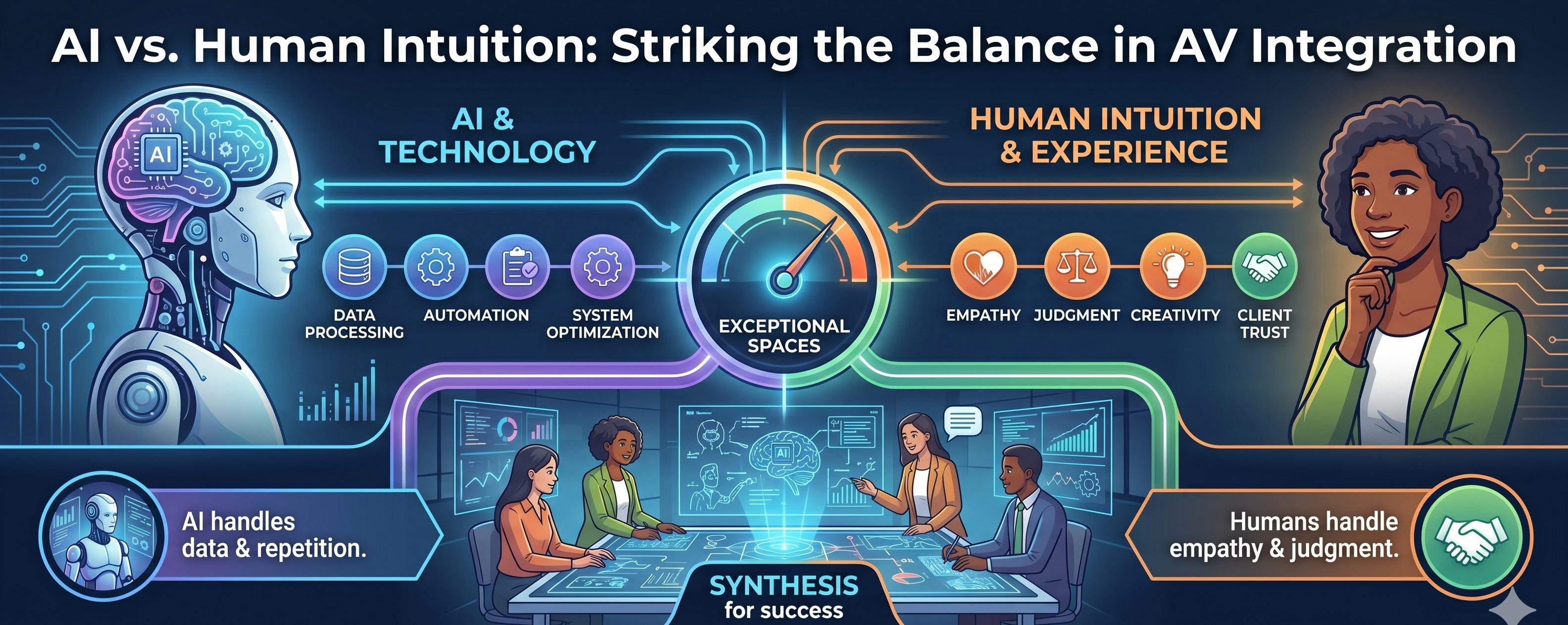
AI vs. Human Intuition: Striking the Balance in AV Integration

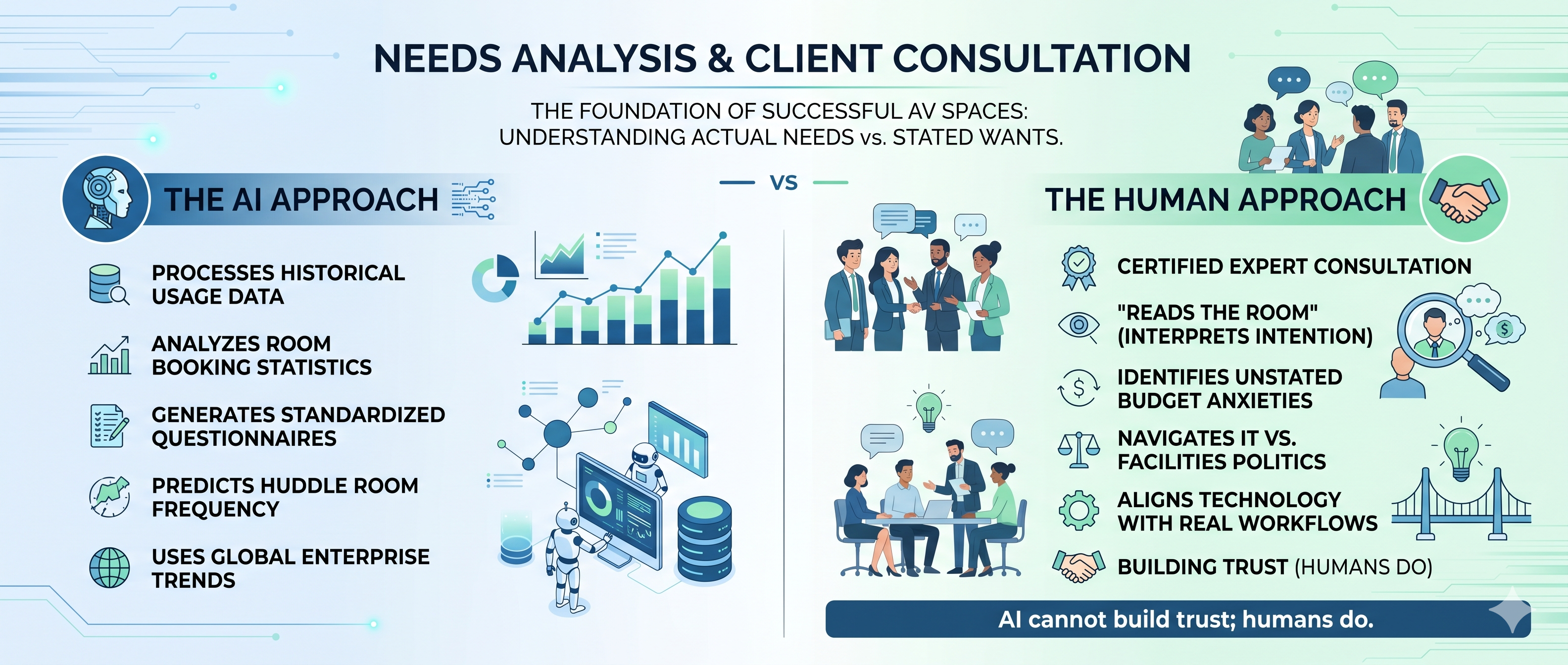
1. Needs Analysis & Client Consultation
The foundation of any successful AV space is understanding what the client actually needs, which is often different from what they say they want.
-
The AI Approach: AI is excellent at processing historical usage data, analyzing room booking statistics, and generating standardized questionnaires. It can spit out a predictive model of how often a huddle room will be used based on global enterprise trends.
-
The Human Approach: A team of certified experts reads the room. When a client asks for a massive, complex video wall in a standard meeting space, a human consultant picks up on the unstated budget anxieties, navigates the internal office politics between IT and Facilities, and guides the client toward a solution that actually fits their workflow. AI cannot build trust; humans do.
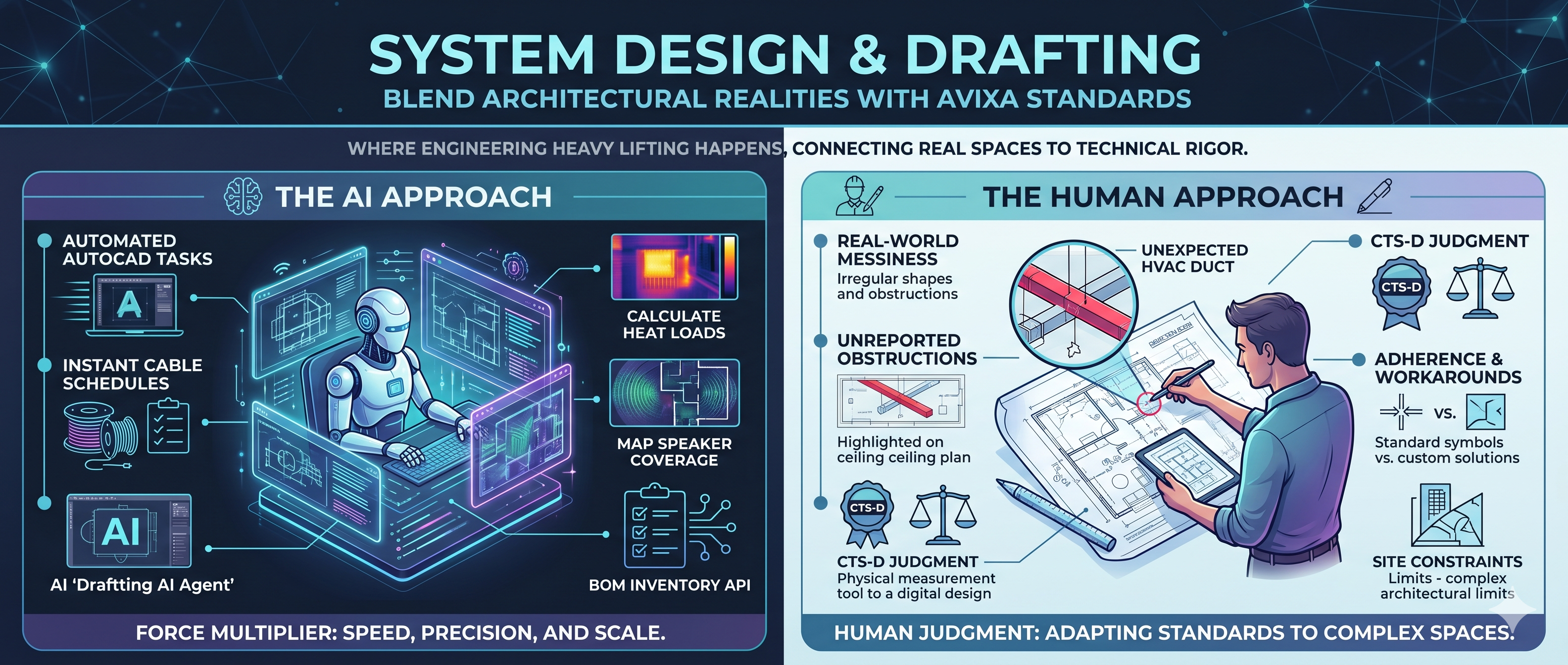
2. System Design & Drafting
This is where the heavy lifting of engineering happens, blending architectural realities with AVIXA standards.
-
The AI Approach: AI tools are becoming incredible force multipliers in drafting. They can automate repetitive AutoCAD tasks, generate instant cable schedules, calculate heat loads, map speaker coverage, and cross-reference a Bill of Materials (BOM) against manufacturer inventory APIs in seconds.
-
The Human Approach: Algorithms assume a perfect world. An experienced design engineer knows the real world is messy. AI might calculate the perfect throw distance for a projector, but a human designer notices the newly installed HVAC duct that wasn't on the architect's reflected ceiling plan. Applying rigorous CTS-D principles requires judgment—knowing when to strictly adhere to a standard and when to engineer a creative workaround due to physical site constraints.
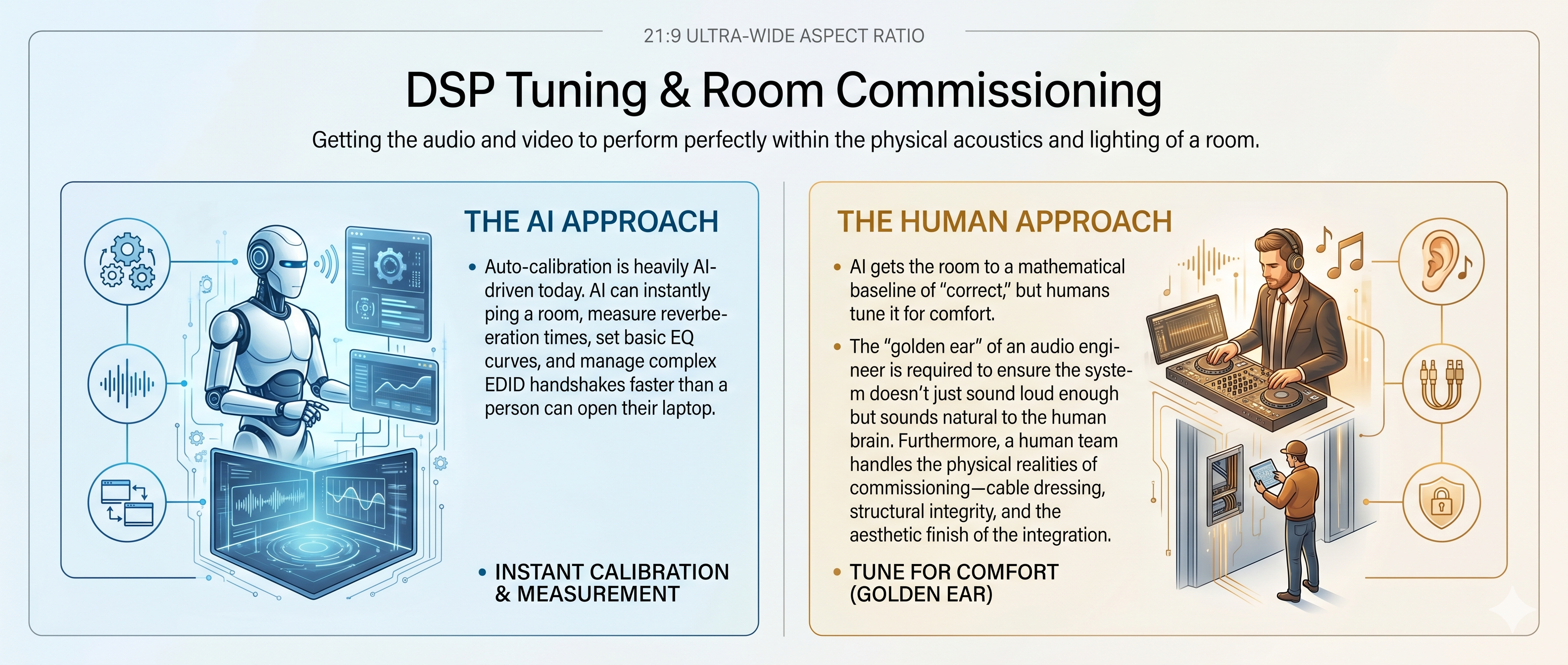
3. DSP Tuning & Room Commissioning
Getting the audio and video to perform perfectly within the physical acoustics and lighting of a room.
-
The AI Approach: Auto-calibration is heavily AI-driven today. AI can instantly ping a room, measure reverberation times, set basic EQ curves, and manage complex EDID handshakes faster than a person can open their laptop.
-
The Human Approach: AI gets the room to a mathematical baseline of "correct," but humans tune it for comfort. The "golden ear" of an audio engineer is required to ensure the system doesn't just sound loud enough but sounds natural to the human brain. Furthermore, a human team handles the physical realities of commissioning—cable dressing, structural integrity, and the aesthetic finish of the integration.
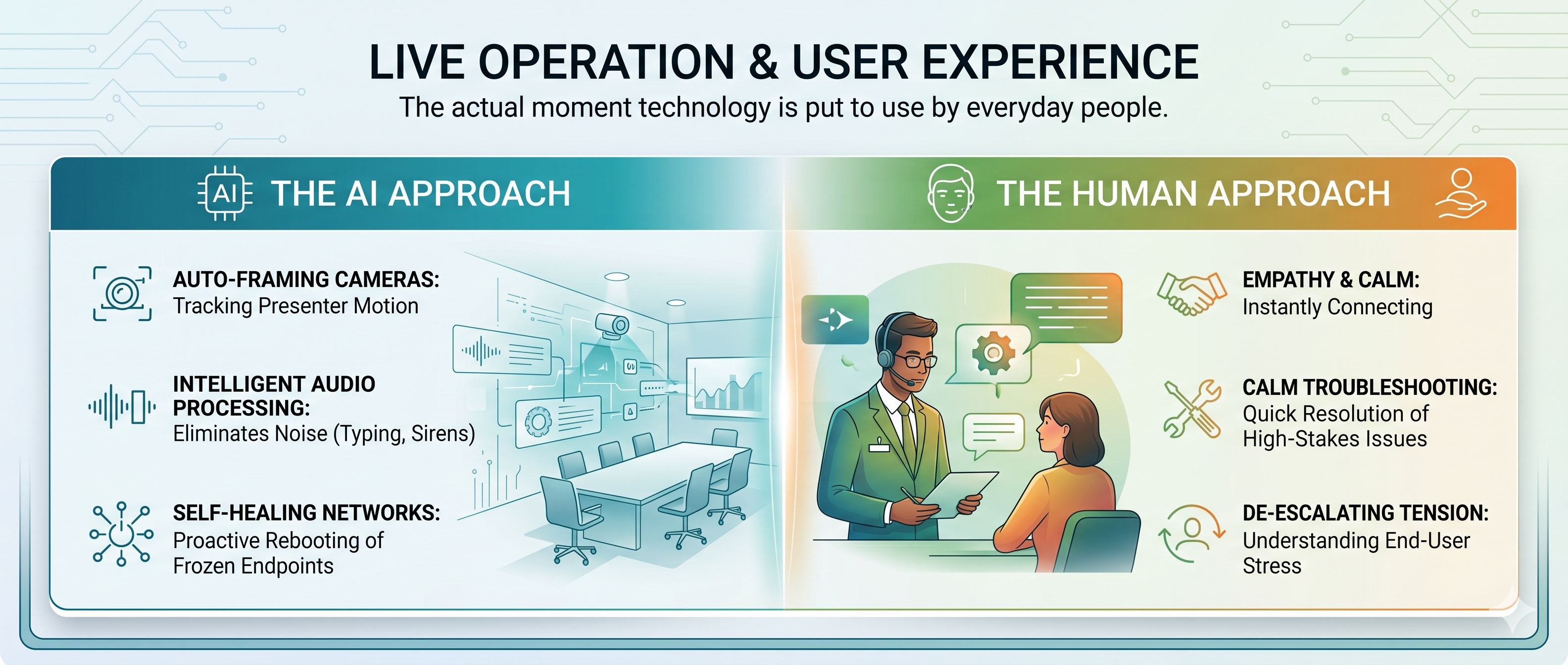
4. Live Operation & User Experience
The actual moment the technology is put to use by everyday people.
-
The AI Approach: AI shines in the background. Auto-framing cameras smoothly track a pacing presenter, intelligent audio processing eliminates the sound of typing or a siren outside, and self-healing networks proactively reboot a frozen endpoint before the user even enters the room.
-
The Human Approach: Empathy is the ultimate feature. When a high-stakes boardroom presentation goes wrong, a stressed executive doesn't want an automated error code—they need a calm, knowledgeable professional who can instantly troubleshoot the issue and de-escalate the tension. Humans understand the psychological stress of the end-user.
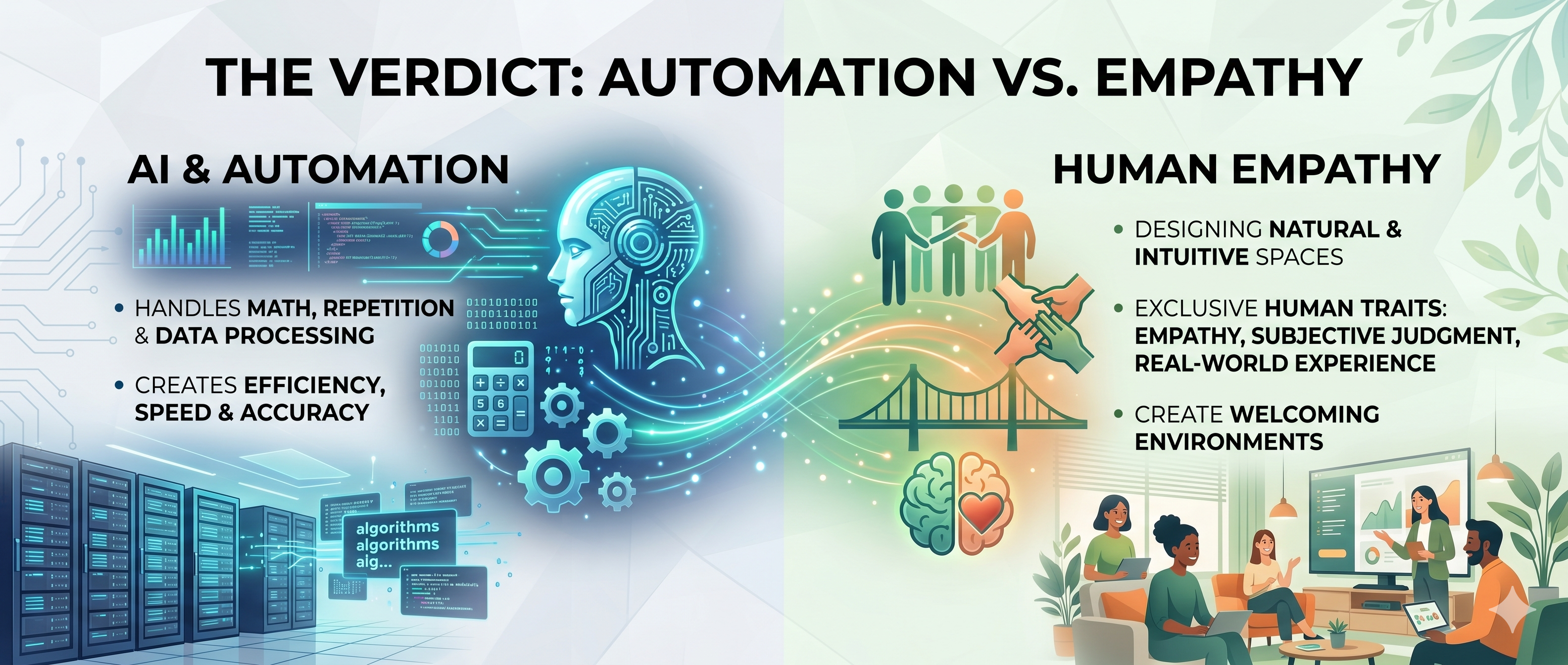
The Verdict: Automation vs. Empathy
In practical AV scenarios, AI is an execution tool. It handles the math, the repetition, and the data processing. It allows engineering firms to operate with greater speed and accuracy.
However, AV is ultimately about human communication. Designing a space that feels natural, intuitive, and welcoming requires empathy, subjective judgment, and real-world experience—traits that remain exclusively human.

🎯 Role Overview
🔸AV Systems Designer / Solutions Architect
🔹Crafting bespoke audio-visual systems tailored to client needs.
🛠️ Core Responsibilities
🔸Designing customized AV solutions with precision and technical depth.
🔸Creating comprehensive technical documentation.
🔸Acting as a technical authority during business development.
🔸Managing multiple projects while balancing account managers' expectations.
💻 Specialization in Video Conferencing Platforms
🔸Expertise in designing AV systems for:
🔹Microsoft Teams Rooms, Zoom Rooms, Webex Rooms, Google Meet Rooms
🔧 Technology Stack
🔸Solutions built using leading AV brands:
🚀 Design Philosophy
🔸Integration of the latest corporate AV trends.
🔸Focus on innovation, security, and scalability.
🔸Incorporating networking and security into AV designs.
🔸Ensuring alignment with user experience through close collaboration with teams and clients.



Please sign in
If you are a registered user on AVIXA Xchange, please sign in