Your Meeting Room AI Is Underperforming. The Problem Is Not Your Users.
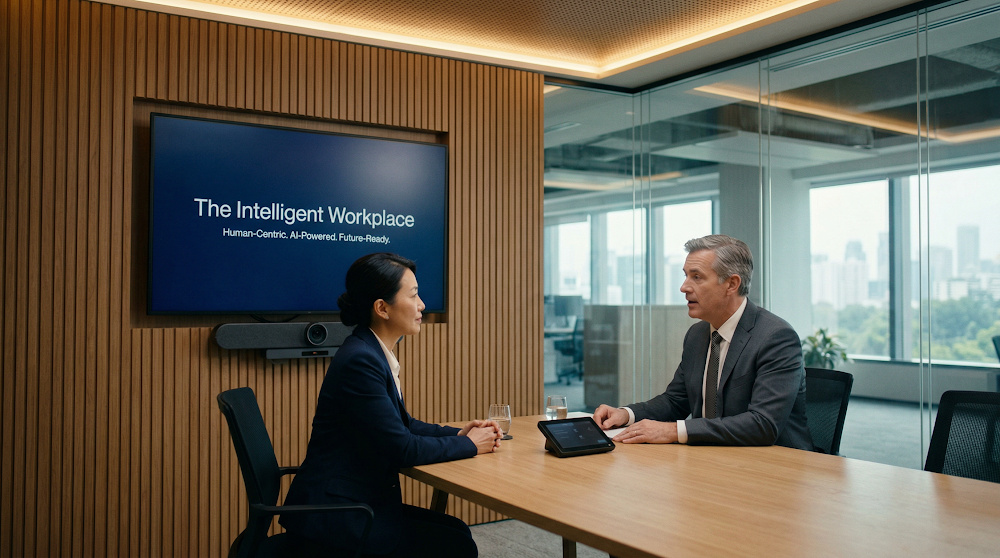
A client completes a full rollout of AI-enabled collaboration tools across fifty conference rooms. The vendor training is done. The IT team has pushed the software updates. End users have watched the onboarding videos. Three months later, the rooms are running the same way they always did. Nobody is using the AI meeting summaries. The intelligent camera framing is switched off on half the systems. The noise suppression keeps getting disabled because people do not trust what it is doing to their audio. The integrator gets called back in. The instinct on both sides is to blame the users.
That instinct is usually wrong, and acting on it wastes time and budget.
What actually happens in most enterprise AV deployments is this: users receive access to a capable system, complete whatever onboarding is required, and then walk into rooms that have not changed in any meaningful way. The booking workflows are the same. The meeting behaviours are the same. IT policy still treats the conferencing endpoint as a peripheral rather than an intelligent participant in the room. Nobody has defined whether the AI-generated transcript is the official record, who reviews it, or what happens when it gets something wrong. People are left to figure out the rules of engagement themselves, and in the absence of clear rules, they default to what they know. That is not a training failure. That is a structural failure in how the deployment was scoped and handed over.
The gap that most AV and UC deployments are falling into right now is the gap between technical commissioning and operational readiness. Getting a room certified, connected, and performing to spec is the work integrators know how to do. But increasingly, the value of what is installed depends on a second layer of work that almost nobody is formally responsible for: defining how the human and the AI system are supposed to operate together in that room. What does the room intelligence actually own? When does a user override it, and what happens when they do? Who is accountable when an AI-generated action item from a board meeting turns out to be wrong? These are not questions a firmware update answers. They are organisational design questions, and if they are not answered before deployment, they get answered inconsistently by whoever is sitting in the room at the time.
For integrators advising enterprise clients on room upgrade cycles or larger UC infrastructure decisions, this creates a practical opportunity. The clients who are frustrated with AI adoption are not, in most cases, frustrated because the technology is failing. They are frustrated because the conditions required for the technology to deliver value were never put in place. That is a conversation about role clarity, workflow integration, and who owns the feedback loop when the system gets it wrong. Integrators who can have that conversation alongside the technical one are able to position themselves as deployment architects rather than equipment vendors. It changes the scope of the engagement and, frankly, it changes the margin on it.
The reframe for your next client conversation is straightforward. Before asking whether your users need more training on the AI features, ask whether the organisation has actually defined what those features are supposed to do, who is responsible for them, and what success looks like in operational terms. A well-specified room with an under-specified operating model will underperform every time. That is not a user problem. It is a design problem, and it is solvable.
Read the full analysis at intelligentworkplace.ai

Marc A. Rémond is the founder of Strategic Pathways, a business advisory firm helping technology leaders design the business operating models required to scale.
With 25+ years of sales leadership across AV, UC, and enterprise technology, at Alcatel-Lucent, Polycom, and Barco, among others, he has built go-to-market strategies, channel ecosystems, and AI transformation programmes for global technology companies.
He is the creator of the Intelligent Workplace™, the 4W/4D/4C/4P Frameworks, the Strategic Diagnostic Engine, and the Human-AI Intelligence Charter, and the architect of the Synchronised Growth Architecture.
He is the author of EVOLVE-OR-DIE.AI: Leading in the Era of Human and AI Intelligence, available on Amazon and Apple Books, and the architect of the Intelligent Leader Programme, a twenty-eight module executive curriculum.
He runs two authority brands, an advisory practice, seven content pipelines, and the Intelligent Leader Programme as a single operator.
He writes on market expansion, sales execution, market narrative and workplace transformation at strategicpathways.asia and intelligentworkplace.ai.
Follow him on LinkedIn at linkedin.com/in/marcalexremond.
-
Xchange Advocates are recognized AV/IT industry thought leaders and influencers. We invite you to connect with them and follow their activity across the community as they offer valuable insights and expertise while advocating for and building awareness of the AV industry.