
What young AV engineers should learn before choosing Speakers
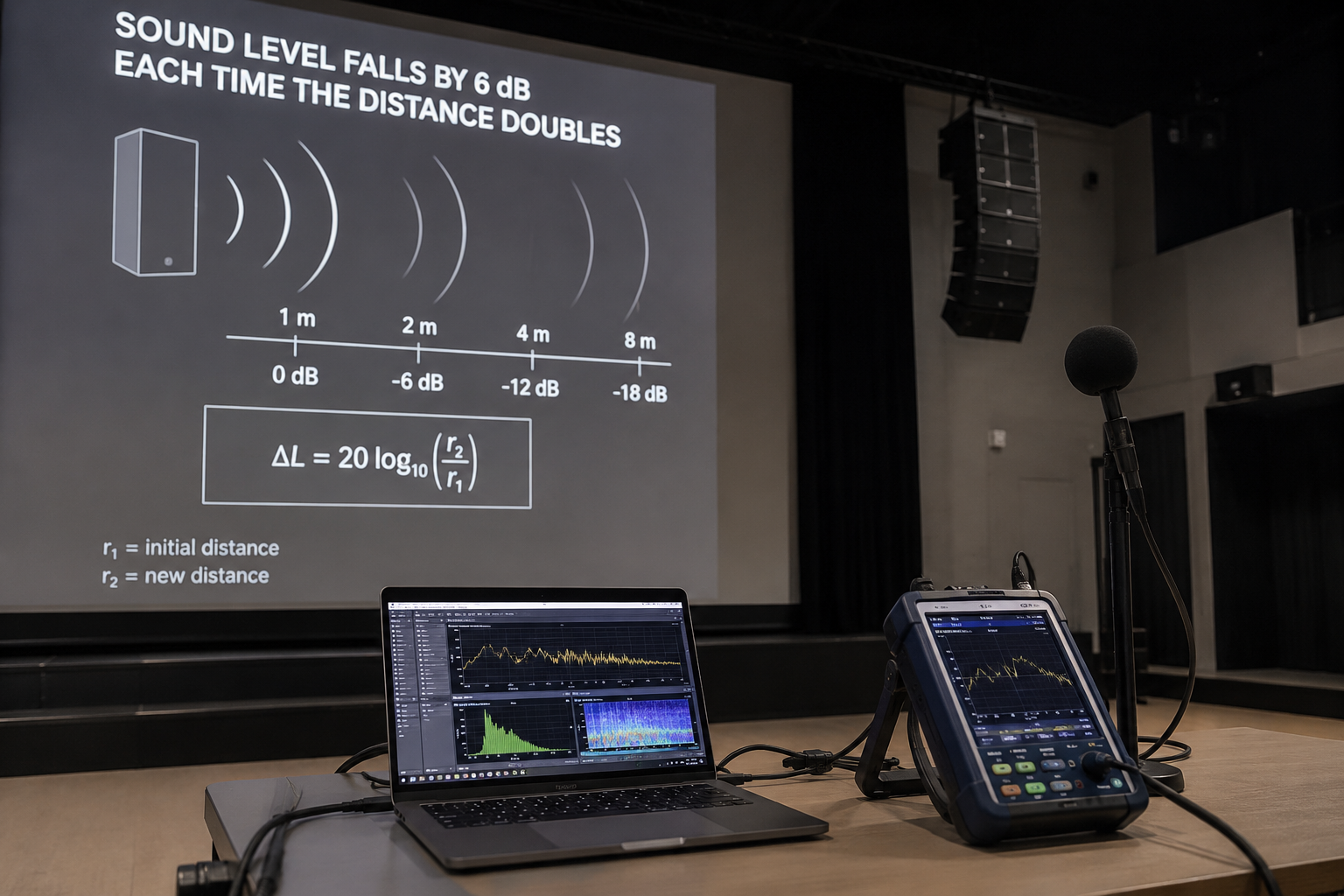
I recently attended an electro-acoustics seminar that reinforced a lesson I wish I had fully understood when I started my career.
When we first enter the AV industry, it’s tempting to focus on equipment. Which loudspeaker brand is better? How many watts does it deliver? What’s the frequency response?
These are all valid questions—but they’re rarely the most important ones.
Good sound doesn’t begin with choosing a loudspeaker.
It begins with understanding how sound behaves. And that behavior is governed by physics.
One of the demonstrations that stuck with me was the well-known inverse distance principle. In a free field, every time the distance from a sound source doubles, the sound pressure level decreases by approximately 6 dB.
This simple concept explains why a system that sounds excellent in the front row may become difficult to understand at the back of the room if coverage isn’t properly designed. It also reminds us that installing a more powerful loudspeaker is rarely the complete solution.
Another memorable demonstration showed how dramatically sound can change with nothing more than a phase shift. Two loudspeakers can reproduce exactly the same signal, yet depending on their phase relationship, parts of the sound may reinforce each other while others cancel out.
The same principle applies to many other aspects of system design. Coverage, reflections, phase interaction, and speech intelligibility are all consequences of physical laws—not marketing claims or personal preference.
Understanding these principles is far more valuable than memorizing product catalogs or relying on the idea of having “golden ears.”
The best AV engineers I’ve met combine listening with measurements, physics, experience, and continuous learning. Experience teaches us how to apply the rules—but physics explains why those rules exist in the first place.
Loudspeakers, DSPs, amplifiers, and software will continue to evolve. The physics behind sound won’t. The better we understand it, the better systems we’ll design.
If you could teach every new AV engineer just one fundamental concept before they touched a loudspeaker, what would it be? I’d love to hear your thoughts in the comments.
Hi everyone,
I’m Vardan Gulkanyan, Founder & CTO of Zetta AV, based in Yerevan, Armenia.
I work in professional AV with a focus on audiovisual system design, integration, troubleshooting, and consulting. My interests include AV-over-IP, collaboration spaces, digital signage, control systems, and the convergence of AV and IT.
Through Zetta AV, I aim to bring international AV engineering standards and modern integration practices to projects in Armenia and the wider region.
Looking forward to learning from the community, sharing experiences, and connecting with AV professionals worldwide.




Please sign in or register for FREE
If you are a registered user on AVIXA Xchange, please sign in