
Sustainability and resilience in Pro AV: turning the ideas into practice
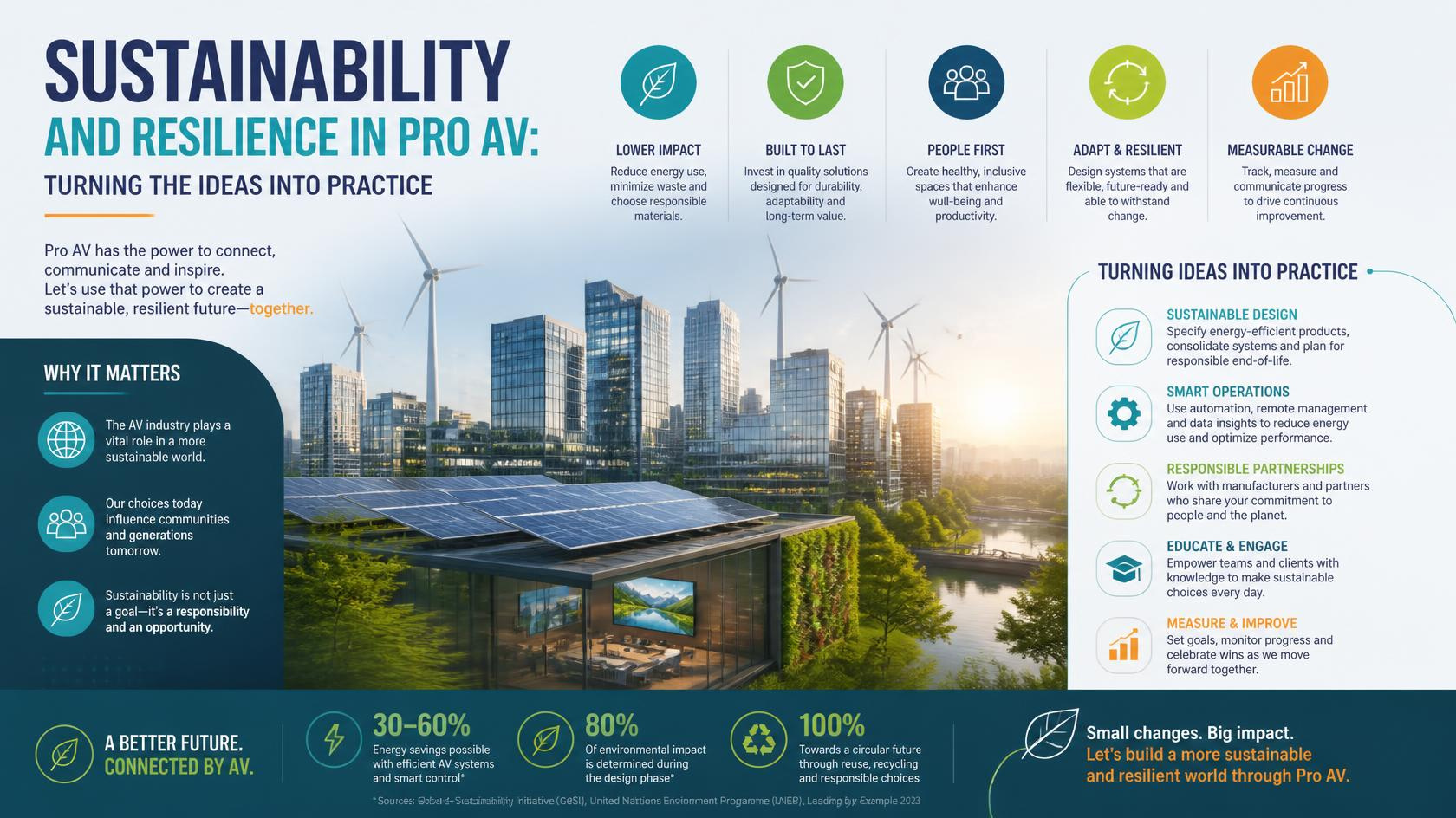
For a long time, sustainability in our world meant programming equipment to turn off when not being used and putting a recycling bin by the loading dock. Useful, sure. But it was never the whole picture, and I think most of us knew it.
The better way to look at it is across the entire life of a system. Where the materials come from. How the gear gets built and shipped. How long it stays in service. What happens when it comes out of the rack. That is where the real impact lives, and it is also where we have the most control. We specify these systems. We install them. We maintain them and, eventually, we pull them out. Every one of those steps is a decision.
Here is how we could break down the work.
Think in lifecycles, not spec sheets
Most of our energy conversations still fixate on one number: power draw. It matters, but it is a small slice of the total impact. A display that sips power for eight years is not doing anybody any favors if it was built to be thrown out after three.
So specify for a long life. Favor gear you can actually service: modular components, replaceable boards, firmware you can update in the field, parts you can still get in year seven. Sealed assemblies that fail as a unit and planned obsolescence are the weak link here. When you compare options, look past the operating power draw and ask what it took to build the thing and ship it. Consolidate where it makes sense. A networked platform doing four jobs beats four boxes and the cabling to match.
A few questions belong in every RFP now:
- How long is this designed to stay in service?
- Can it be repaired, and by whom?
- What is the firmware and support policy?
- Is there a takeback or recycling path at end of life?
- Has the end user planned capital dollars to maintain and repair the system?
Push manufacturers for the material and manufacturing data behind their major products. Some will have it. The ones that do not should hear the question anyway. And if you run rental or staging inventory, a refurbishment program pays for itself. Gear that gets rebuilt and put back on the floor is gear you did not have to buy again.
Fix the incentives, or nothing changes
Here is the challenge many face in our industry. Most of our waste is not a technology problem. It is an incentive problem.
On a typical project you have an owner, an integrator, a designer, and the people who actually use the room. Ownership, maintenance, and disposal all sit in different hands. When those hands are not aligned, the cheapest move is to rip it out and replace it. Reuse and repair lose every time unless the team all agree to plan and execute longevity.
That changes when the business model changes. Move away from selling a box and walking away. Leasing, managed services, and performance agreements give the vendor a reason to build something that lasts, because they are the ones living with it. Write end-of-life responsibility into the contract. Make somebody accountable for recovery or certified refurbishment. And get clients thinking in total cost of ownership, not just the number on the purchase order. Maintenance, upgrades, and disposal are real costs whether or not anyone puts them on the sheet. Plan them into capital budgets.
The practical moves are not complicated. Offer refurbishment and upgrade packages with pricing that shows what the client saves over the life of the system. Pilot takeback with your manufacturers for displays, control hardware, and the batteries in your wireless gear. Structure service agreements to reward preventive maintenance and board-level repair instead of full swaps.
Design for resilience
Resilience and sustainability are not two different projects. A system that is easy to maintain, upgrade, and repurpose is also lower carbon and less exposed when a supply chain seizes up. We learned that one the hard way a few years back, when lead times went from weeks to the better part of a year.
For us, resilience means building rooms that can change without a full teardown. Standardize on interoperable protocols and modular hardware so you can upgrade a piece instead of gutting the whole system. Lean on remote management and diagnostics: fewer truck rolls, faster fixes, less carbon burned driving to a site to reboot a processor. Be honest about redundancy, too. It carries a material and energy cost. Design so a system degrades gracefully and holds its most important functions when conditions are tight, rather than doubling up on everything just in case.
On the ground, that looks like remote monitoring across your installed base so you catch faults early, a stock of the modules you replace most often so you are not waiting on a full unit, and teams trained to handle repairs and firmware updates in-house. Systems stay in service longer when the people around them know how to keep them running. This may require training
Measure the things that matter
You cannot make the case for any of this without numbers. So track a few that count:
- Average service life of installed equipment
- How much gear you repair or refurbish versus replace
- Energy use for your AV systems, plus a rough estimate of the embodied emissions in your big hardware buys
- Takeback and recycling events, and how much material you actually recovered
Start with one portfolio. Use the asset management system you already have to log the moments that matter: install, service, upgrade, disposal. Then share what you find. Clients trust numbers they can see, and when enough of us ask manufacturers the same hard questions, the products get better.
None of this happens in isolation. Manufacturers, integrators, venue owners, rental houses. We each hold a different lever, and they only work when we pull them together. Cross-industry groups can set repairability standards and common end-of-life practices. Shared, anonymized lifecycle data gives everyone real benchmarks. Procurement policy that rewards durability and takeback puts weight behind all of it.
Where this leaves us
We are in a good position to lead on this. The systems knowledge that defines our work is exactly what it takes to rethink how AV gets specified, sold, maintained, and retired. And the case is not only the right-thing-to-do case, though that one holds up fine. Systems built to last and built to come apart cleanly are cheaper to own and harder to knock offline. They also open up service revenue you never see from selling a box once.
Start with your contracts and your procurement. Put lifecycle thinking into the design from day one. Measure what matters. Do that, and sustainability stops being a line on a checklist and becomes part of how you build.

As a Partner, Senior Principal, and Director of Technology and Innovation at Studio B1, I lead the transformation of performing arts and facility projects from innovative concept through construction and commissioning. In this leadership role, I ensure that every project not only meets aesthetic and technical standards but also resonates with our clients' vision and needs.
Core Responsibilities:
- Project Leadership: Direct and oversee the design of various theater components—including stage rigging, seating, lighting, acoustics, and sound systems—ensuring that each project is executed with precision and creativity.
- Client Communication: Serve as the primary client contact, expertly translating their unique needs into practical design solutions that bring artistic visions to life.
- Team Management: Lead and mentor multidisciplinary design teams, fostering an environment of collaboration and innovation to achieve successful project execution.
- Technical Expertise: Apply a deep understanding of theater technology, design principles, and industry best practices to elevate every project from concept to completion.
- Business Development: Drive firm growth by identifying new opportunities and actively engaging with prospective clients in diverse markets.
- Strategic Planning: Develop and implement strategic plans to address complex client needs and achieve project goals effectively.
- Quality Assurance: Rigorously maintain the highest quality standards in design and construction, ensuring impeccable outcomes for every project stage.
- Problem-Solving: Proactively identify challenges in design, construction, or project execution—and implement innovative solutions to overcome them.
- Documentation and Reporting: Prepare comprehensive project drawings, detailed reports, specifications, and other critical documentation for internal teams and clients.
- Budget Management: Collaborate in developing and managing project budgets, ensuring that initiatives remain within scope and are delivered on time.