
Logistics Software Development Guide: Architecture, Modules & System Design
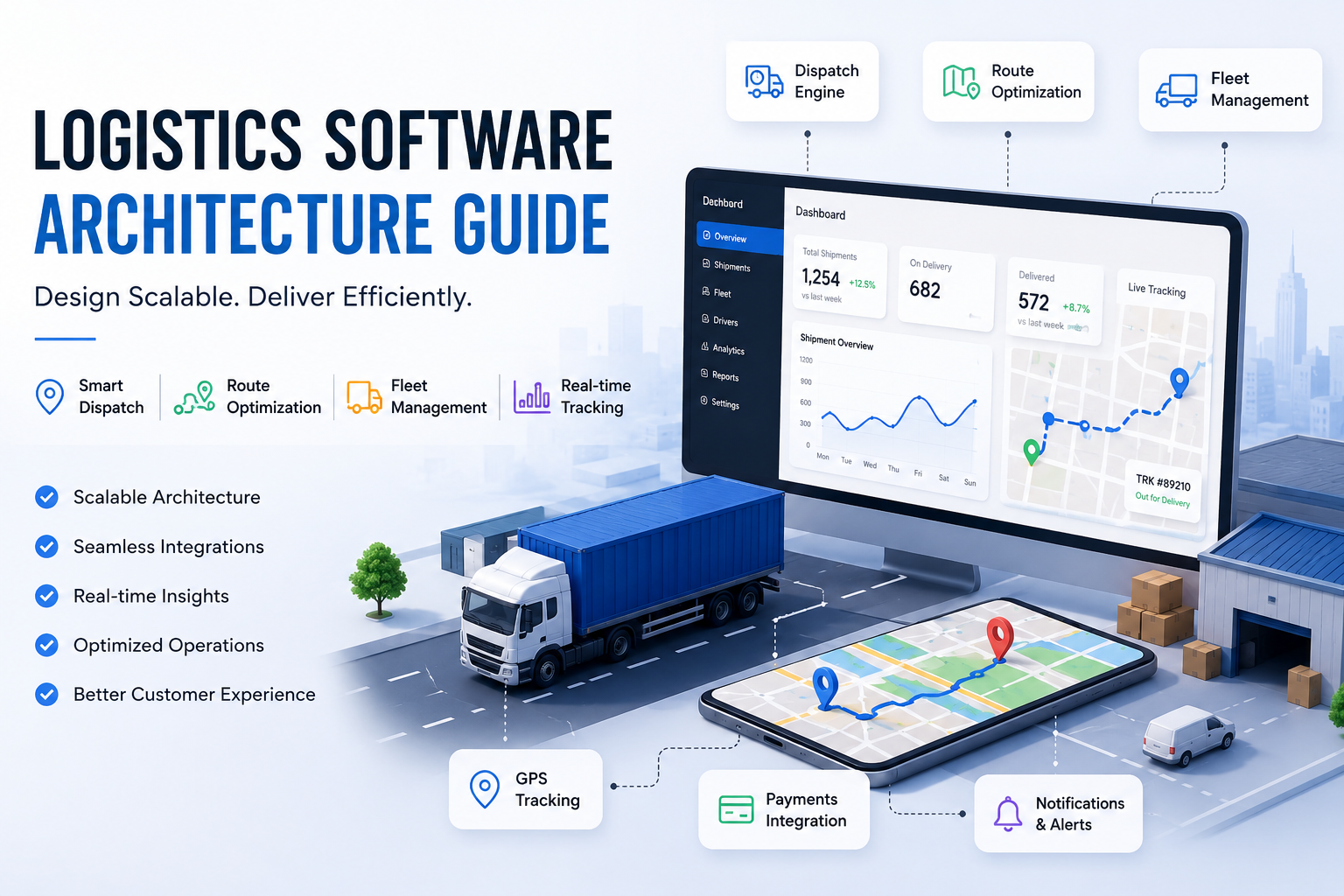
The logistics industry is experiencing a significant digital transformation. With growing customer expectations, rising fuel costs, same-day delivery demands, and increasingly complex supply chains, businesses need intelligent software platforms that can manage operations efficiently and scale with growth.
Modern logistics software now goes beyond shipment tracking. Today's platforms combine dispatch automation, route optimization, fleet management, warehouse coordination, GPS tracking, payment processing, analytics, and customer communication into a single ecosystem. Behind these capabilities lies a carefully designed software architecture that ensures performance, reliability, security, and scalability.
Whether you're building a transportation management system (TMS), a last-mile delivery platform, a fleet management solution, or a complete supply chain application, the underlying architecture determines how well the system performs under real-world conditions.
This guide explains how enterprise-grade logistics platforms are architected, drawing on proven development practices and real-world implementation patterns. It also explores the essential modules, system workflows, integration points, and architectural decisions that contribute to long-term success.
Why Software Architecture Matters in Logistics
A logistics platform processes thousands—or even millions—of transactions every day. Vehicles continuously transmit GPS coordinates, customers track shipments in real time, dispatchers assign drivers dynamically, and warehouse systems update inventory simultaneously.
Poor architectural decisions can lead to:
- Slow dispatch operations
- Inefficient route calculations
- System downtime during peak demand
- Delayed driver communication
- Data synchronization issues
- High infrastructure costs
- Security vulnerabilities
A well-designed architecture addresses these challenges by enabling the following:
- Horizontal scalability
- Real-time communication
- High availability
- Secure data exchange
- Faster deployment cycles
- Simplified maintenance
- Seamless third-party integrations
These capabilities are essential for organizations investing in logistics software development, as they support operational efficiency and future business growth.
Core Modules Overview
A modern logistics platform is typically divided into multiple independent modules that work together through APIs and event-driven communication.
1. Order Management
The order management module acts as the starting point of the logistics workflow. It captures shipment requests, validates customer information, calculates delivery requirements, and creates transport orders for dispatch.
Key Features
- Shipment creation
- Customer information
- Pickup scheduling
- Delivery preferences
- Shipment status
- Invoice generation
2. Dispatch Management
The dispatch engine automatically assigns delivery requests to available drivers based on predefined business rules.
Assignment factors include:
- Vehicle availability
- Driver working hours
- Vehicle capacity
- Delivery priority
- Distance from pickup
- Traffic conditions
Instead of relying on manual decisions, intelligent dispatch algorithms significantly reduce delays while improving fleet utilization.
3. Fleet Management
Fleet management enables businesses to monitor every vehicle throughout its lifecycle.
Typical capabilities include the following:
- Vehicle registration
- Driver assignment
- Fuel tracking
- Maintenance schedules
- Engine diagnostics
- Mileage reports
- Utilization analysis
This module helps reduce operational expenses while improving fleet reliability.
4. Route Optimization
Route optimization calculates the most efficient delivery sequence by considering numerous real-world variables.
Examples include:
- Traffic congestion
- Road closures
- Toll roads
- Vehicle size restrictions
- Delivery time windows
- Driver schedules
- Weather conditions
Advanced optimization engines use graph algorithms, heuristics, and machine learning to improve delivery efficiency.
5. Warehouse & Inventory
For logistics businesses operating warehouses, inventory synchronization becomes equally important.
Typical functionality includes the following:
- Barcode scanning
- Inventory updates
- Bin management
- Stock transfers
- Warehouse mapping
- Picking workflows
- Packing workflows
Real-time inventory visibility minimizes shipping errors and improves order fulfillment speed.
6. Customer Portal
Customers increasingly expect complete transparency throughout the delivery journey.
Modern customer portals provide the following:
- Live shipment tracking
- Estimated arrival time
- Delivery history
- Invoice downloads
- Digital signatures
- Support tickets
- Push notifications
These features improve customer satisfaction while reducing support requests.
7. Driver Mobile Application
Drivers interact with the logistics ecosystem primarily through mobile applications.
Core features include the following:
- Route navigation
- Delivery schedule
- Electronic Proof of Delivery (ePOD)
- QR code scanning
- Offline synchronization
- Digital signatures
- Photo uploads
- Chat with dispatchers
Offline capabilities are especially important in areas with limited network connectivity.
8. Admin Dashboard
Administrators require centralized visibility into business operations.
Typical dashboard components include the following:
- Fleet monitoring
- Driver performance
- Revenue analytics
- Delivery KPIs
- Shipment exceptions
- Vehicle utilization
- Customer reports
- Operational alerts
Interactive dashboards help managers make data-driven decisions in real time.
High-Level Logistics Software Architecture
A scalable logistics platform generally follows a layered architecture that separates user interfaces, business logic, integrations, and data storage.
                Customers
                   │
             Web / Mobile Apps
                   │
          API Gateway / Load Balancer
                   │
──────────────────────────────────────────
 Authentication Service
 User Management
 Order Management
 Dispatch Engine
 Route Optimization
 Fleet Management
 Warehouse Service
 Notification Service
 Payment Service
 Analytics Service
──────────────────────────────────────────
        Message Queue / Event Bus
──────────────────────────────────────────
 PostgreSQL
 Redis Cache
 Object Storage
 Search Engine
──────────────────────────────────────────
 External APIs
 GPS Services
 Payment Gateway
 SMS Gateway
 Email Service
 Maps API
 ERP
 CRM
 WMS
This modular design allows each service to scale independently, making it easier to accommodate increasing workloads without affecting the entire platform.
System Architecture Diagram (Mermaid)
flowchart TD

Customer --> WebPortal
Customer --> MobileApp

WebPortal --> APIGateway
MobileApp --> APIGateway

APIGateway --> AuthService
APIGateway --> OrderService
APIGateway --> DispatchEngine
APIGateway --> FleetService
APIGateway --> RouteEngine
APIGateway --> NotificationService
APIGateway --> PaymentService

DispatchEngine --> FleetService
DispatchEngine --> RouteEngine

RouteEngine --> GoogleMaps
FleetService --> GPSProvider

NotificationService --> SMS
NotificationService --> Email
NotificationService --> PushNotification

PaymentService --> Stripe
PaymentService --> Razorpay

OrderService --> PostgreSQL
FleetService --> PostgreSQL
DispatchEngine --> Redis

Analytics --> Dashboard
This architecture illustrates how users, backend services, databases, and third-party integrations communicate within a modern logistics platform. The API Gateway acts as the central entry point, while independent services handle authentication, dispatching, routing, payments, notifications, and analytics. This separation improves scalability, maintainability, and fault isolation.
Architectural Design Principles
Successful logistics systems are built around several key engineering principles:
Modular Design
Breaking the platform into independent services allows teams to update or replace individual components without disrupting the entire system.
Scalability
Cloud-native deployments with container orchestration enable services such as dispatch and tracking to scale automatically during periods of high demand.
Fault Tolerance
If one service experiences issues—for example, the notification service—the remaining modules continue operating without affecting core logistics operations.
Event-Driven Communication
Using message brokers such as Kafka or RabbitMQ enables asynchronous communication between services, reducing latency and improving system resilience.
Security by Design
Authentication, authorization, encryption, API rate limiting, and audit logging should be integrated into the architecture from the beginning rather than added later.
Real-World Implementation Considerations
When developing enterprise logistics platforms, architects should account for:
- Peak-hour traffic spikes
- Multi-region deployments
- Real-time GPS data streams
- High-frequency database writes
- Offline mobile synchronization
- Third-party API failures
- Disaster recovery planning
- Compliance with regional data protection regulations
These considerations help ensure the platform remains reliable and performant under demanding operational conditions.
Dispatch Engine Design
The dispatch engine is the operational heart of any logistics platform. It is responsible for assigning orders to the most suitable driver and vehicle while balancing delivery speed, operational efficiency, and resource utilization. As shipment volumes grow, manual dispatch becomes impractical, making intelligent automation essential.
A well-designed dispatch engine evaluates multiple variables before assigning a delivery, including:
- Driver availability
- Vehicle capacity
- Current GPS location
- Delivery priority
- Driver working hours
- Vehicle type
- Traffic conditions
- Customer delivery window
Typical Dispatch Workflow
- A customer places a delivery request.
- The order management service validates the request.
- The dispatch engine receives the shipment event.
- Nearby vehicles are identified using GPS data.
- Business rules and optimization algorithms rank available drivers.
- The best driver receives the assignment through the mobile application.
- The driver accepts or rejects the request.
- The customer receives confirmation and live tracking details.
This automated workflow minimizes delays, reduces idle time, and improves fleet utilization.
Rule-Based vs Intelligent Dispatch
Rule-Based Dispatch
This approach follows predefined business rules such as:
- Assign the nearest vehicle
- Prioritize premium customers
- Balance workload equally
- Allocate by vehicle type
- Limit maximum daily deliveries
Rule-based systems are easier to implement and work well for small and medium-sized logistics businesses.
Intelligent Dispatch
Large logistics platforms often enhance rule-based logic with artificial intelligence and predictive analytics.
Advanced dispatch systems can:
- Predict delivery delays
- Recommend driver swaps
- Forecast delivery capacity
- Detect overloaded routes
- Automatically rebalance fleets
- Learn from historical delivery data
Machine learning models continuously improve assignment quality as more operational data becomes available.
Route Optimization Approach
Once a driver has been assigned, the platform must determine the most efficient delivery sequence. Route optimization is one of the most technically demanding components of a logistics system because it involves solving complex mathematical optimization problems.
Rather than simply calculating the shortest distance, modern logistics platforms evaluate:
- Live traffic congestion
- Delivery priorities
- Vehicle load capacity
- Driver shift duration
- Fuel consumption
- Toll costs
- Weather conditions
- Road restrictions
- Multiple delivery stops
The objective is to reduce travel time while maximizing delivery efficiency and minimizing operational costs.
Common Route Optimization Algorithms
Different optimization techniques are used depending on business requirements.
Dijkstra Algorithm
Useful for calculating the shortest path between two locations.
Ideal for:
- Simple navigation
- Point-to-point deliveries
A* Search Algorithm
Improves upon Dijkstra by incorporating heuristic estimates.
Benefits include:
- Faster calculations
- Better scalability
- Lower processing overhead
Vehicle Routing Problem (VRP)
One of the most common optimization models in logistics.
It considers:
- Multiple vehicles
- Multiple destinations
- Capacity limits
- Delivery schedules
Genetic Algorithms
Suitable for solving large optimization problems involving hundreds or thousands of deliveries.
Advantages include:
- Continuous optimization
- Better handling of constraints
- Efficient large-scale routing
AI-Based Predictive Routing
Modern logistics platforms increasingly use AI to analyze historical and real-time data.
The system can predict:
- Congestion patterns
- Delivery delays
- Fuel consumption
- Seasonal demand
- Driver performance
These insights enable smarter routing decisions and improve overall operational efficiency.
Fleet Management Module
Fleet management provides complete visibility into vehicles, drivers, and operational performance. It enables logistics companies to monitor assets, reduce maintenance costs, and improve delivery reliability.
Typical fleet management capabilities include:
- Vehicle registration
- Driver assignment
- GPS tracking
- Fuel monitoring
- Maintenance scheduling
- Insurance tracking
- Vehicle diagnostics
- Driver behavior monitoring
- Fleet utilization reporting
Real-time dashboards allow managers to identify issues before they impact deliveries.
Driver Mobile Application Workflow
The driver application serves as the primary interface between the logistics platform and field operations.
Driver Login
Secure authentication verifies driver identity and retrieves assigned deliveries.
Delivery Queue
Drivers receive their optimized delivery schedule with customer information, navigation details, and priority indicators.
Navigation
Integrated mapping services provide turn-by-turn directions while adjusting routes dynamically when traffic conditions change.
Proof of Delivery
Drivers complete deliveries by capturing:
- Customer signatures
- QR code scans
- Barcode verification
- Delivery photographs
- Digital receipts
Offline Mode
The application stores delivery information locally whenever internet connectivity is unavailable and synchronizes automatically once the connection is restored.
Real-Time Tracking Architecture
Live shipment tracking has become a standard expectation for logistics customers.
Tracking typically follows this workflow:
- Driver device captures GPS coordinates.
- Location updates are transmitted every few seconds.
- Backend services validate incoming data.
- Redis stores frequently accessed location data.
- WebSocket connections push updates to customers.
- Dashboards display live vehicle positions.
This event-driven architecture enables near real-time shipment visibility without overwhelming backend systems.
Integration Points
A logistics platform rarely operates in isolation. It must exchange information with multiple third-party systems to support day-to-day operations.
GPS & Mapping Services
Location services provide:
- Live driver tracking
- Distance calculations
- ETA predictions
- Geofencing
- Turn-by-turn navigation
- Route optimization
Common providers include Google Maps Platform, Mapbox, HERE Technologies, and OpenStreetMap.
Payment Gateway Integration
Many logistics platforms process payments digitally for freight charges, COD settlements, subscriptions, or invoices.
Typical payment capabilities include:
- Online payments
- Digital wallets
- Refund processing
- Subscription billing
- Invoice generation
- Payment reconciliation
Secure payment processing requires PCI DSS compliance and encrypted transactions.
Notification Services
Timely communication keeps customers and drivers informed throughout the delivery process.
Common notification channels include:
Push Notifications
- New assignments
- Delivery updates
- Route changes
SMS
- OTP verification
- Delivery confirmation
- Estimated arrival alerts
- Invoices
- Shipment summaries
- Delivery reports
Modern notification services often use providers such as Firebase Cloud Messaging, Twilio, or SendGrid.
ERP Integration
Enterprise logistics platforms frequently connect with Enterprise Resource Planning (ERP) systems to synchronize:
- Orders
- Inventory
- Procurement
- Financial records
- Warehouse operations
This integration eliminates duplicate data entry and improves operational efficiency.
Warehouse Management Systems (WMS)
Warehouse integrations provide seamless coordination between inventory and transportation.
Typical synchronization includes:
- Stock availability
- Picking status
- Packing completion
- Shipment readiness
- Inventory adjustments
CRM Integration
Customer Relationship Management platforms enhance communication by sharing delivery information with sales and support teams.
CRM integration enables:
- Customer profiles
- Shipment history
- Complaint management
- Service requests
- Automated follow-ups
Event-Driven Communication
Modern logistics platforms commonly use message brokers to facilitate asynchronous communication between services.
Example events include:
- Order Created
- Driver Assigned
- Route Updated
- Vehicle Arrived
- Delivery Completed
- Payment Received
- Notification Sent
Event-driven architecture improves scalability, reduces service dependencies, and increases system resilience.
Scalability Best Practices
As logistics businesses expand, software platforms must support increasing transaction volumes without sacrificing performance.
Recommended practices include:
- Containerized deployments using Docker
- Kubernetes orchestration
- API Gateway implementation
- Redis caching
- CDN for static content
- Horizontal service scaling
- Database replication
- Load balancing
- Distributed logging
- Centralized monitoring
These strategies help maintain consistent performance during seasonal demand spikes or business growth.
Monitoring & Performance Metrics
Continuous monitoring is essential for maintaining platform reliability.
Important metrics include:
- API response time
- Delivery completion rate
- Driver utilization
- Fleet availability
- Average dispatch time
- Route optimization efficiency
- GPS update latency
- System uptime
- Database performance
- Failed notification rate
Monitoring tools such as Grafana, Prometheus, and ELK Stack provide real-time operational visibility.
Recommended Technology Stack
Selecting the right technology stack is critical for building a scalable, secure, and maintainable logistics platform. The stack should support real-time communication, large-scale data processing, API integrations, and cloud-native deployment.
Frontend
- React.js
- Next.js
- Angular
- Vue.js
Mobile Development
- Flutter
- React Native
- Swift (iOS)
- Kotlin (Android)
Backend
- Node.js
- Java Spring Boot
- .NET Core
- Python (FastAPI/Django)
- Golang
Database
- PostgreSQL
- MySQL
- MongoDB
- Redis (Caching)
Messaging & Streaming
- Apache Kafka
- RabbitMQ
- AWS SQS
Cloud Platforms
- Amazon Web Services (AWS)
- Microsoft Azure
- Google Cloud Platform (GCP)
DevOps & Deployment
- Docker
- Kubernetes
- Jenkins
- GitHub Actions
- Terraform
Monitoring
- Prometheus
- Grafana
- ELK Stack
- Datadog
A modern technology stack should remain flexible enough to accommodate future enhancements, including AI, IoT devices, autonomous vehicles, and predictive analytics.
Database Architecture
A logistics platform processes large volumes of structured and real-time data. Separating operational and analytical workloads helps improve system performance.
Core Databases
User Database
Stores customer, dispatcher, and driver profiles.
Shipment Database
Maintains shipment lifecycle records, delivery status, invoices, and tracking history.
Fleet Database
Contains vehicle information, maintenance records, fuel history, and utilization reports.
Route Database
Stores optimized routes, ETA calculations, and historical trip information.
Analytics Warehouse
Aggregates operational data for reporting, KPI dashboards, and forecasting.
Redis or Memcached can be used to cache frequently accessed information such as live vehicle locations, estimated arrival times, and active delivery assignments.
Cloud Architecture
Cloud-native architecture enables logistics platforms to remain highly available and automatically scale during demand spikes.
Typical cloud deployment includes:
- Load Balancer
- API Gateway
- Container Cluster
- Authentication Service
- Dispatch Service
- Fleet Service
- Route Optimization Service
- Notification Service
- Payment Service
- Analytics Service
- Object Storage
- Monitoring Services
- Disaster Recovery Environment
This architecture allows independent scaling of each service while reducing operational costs.
Security & Compliance Best Practices
Because logistics platforms manage customer information, payment transactions, shipment records, and live location data, security must be embedded into every architectural layer.
Authentication & Authorization
- OAuth 2.0
- JWT Tokens
- Multi-Factor Authentication (MFA)
- Role-Based Access Control (RBAC)
Data Protection
- AES-256 encryption
- TLS encryption
- Secure password hashing
- Database encryption at rest
API Security
- API Gateway
- Rate limiting
- Request validation
- Web Application Firewall (WAF)
Compliance Standards
Depending on the operating region, businesses should consider:
- GDPR
- CCPA
- SOC 2
- ISO 27001
- PCI DSS (for payment processing)
Security audits and penetration testing should be conducted regularly to identify and mitigate vulnerabilities.
AI & Emerging Technologies in Logistics
Artificial intelligence is reshaping the logistics industry by enabling smarter decision-making and greater operational efficiency.
AI-Powered Demand Forecasting
Machine learning models analyze historical trends, seasonal demand, and market behavior to improve planning.
Predictive Maintenance
Vehicle sensor data can identify potential mechanical failures before breakdowns occur, reducing downtime.
Intelligent Dispatching
AI continuously evaluates fleet conditions and recommends the most efficient driver assignments.
Smart ETA Prediction
Real-time traffic, weather conditions, and historical delivery patterns improve arrival time accuracy.
Computer Vision
Image recognition can automate package verification, warehouse inventory checks, and proof-of-delivery validation.
IoT Integration
Connected sensors provide live updates on vehicle health, cargo temperature, fuel consumption, and route deviations.
These technologies help logistics companies improve efficiency while delivering better customer experiences.
Choosing the Right Development Partner
Building enterprise logistics software requires expertise in architecture design, cloud infrastructure, API integration, security, and user experience. Businesses should evaluate technology partners based on:
- Industry experience
- Portfolio of logistics projects
- Scalable architecture expertise
- UI/UX capabilities
- Cloud and DevOps proficiency
- Agile development methodology
- Post-launch maintenance and support
- Client testimonials and case studies
Working with an experienced logistics software Development Company helps reduce development risks and ensures the platform is designed for long-term scalability.
Factors Affecting Development Budget
Project budgets vary depending on the complexity of features, integrations, and deployment requirements. Typical cost drivers include:
- Platform type (Web, Android, iOS)
- Number of user roles
- Real-time GPS tracking
- Fleet management functionality
- Route optimization algorithms
- AI-powered features
- Third-party integrations
- Cloud infrastructure
- Security requirements
- Ongoing maintenance
Understanding these factors helps organizations estimate the overall logistics software Development Cost before initiating development.
Why Businesses Invest in Custom Logistics Platforms
Off-the-shelf software may satisfy basic operational requirements, but growing organizations often require tailored functionality that aligns with unique workflows.
Custom logistics software Development Solutions provide benefits such as:
- End-to-end operational visibility
- Automated dispatching
- Real-time shipment tracking
- Optimized delivery routes
- Fleet performance monitoring
- Seamless ERP and CRM integration
- Improved customer experience
- Greater scalability
- Stronger data security
- Competitive business advantage
These capabilities support long-term digital transformation while improving operational efficiency.
Why Choose Dev Technosys?
At Dev Technosys, we design and develop enterprise-grade logistics platforms tailored to the operational requirements of transportation companies, courier services, fleet operators, and supply chain businesses.
Our experienced engineers specialize in:
- Transportation Management Systems (TMS)
- Fleet Management Software
- Last-Mile Delivery Platforms
- Warehouse Management Systems
- Driver Mobile Applications
- AI-Powered Route Optimization
- Real-Time GPS Tracking
- Cloud-Native Logistics Platforms
Whether you're building a new logistics solution or modernizing an existing system, our logistics software development team follows proven architectural practices to deliver scalable, secure, and high-performance digital products.
Future Trends in Logistics Software
The next generation of logistics platforms will increasingly rely on:
- Artificial Intelligence
- Autonomous delivery vehicles
- Drone-based deliveries
- IoT-enabled fleet monitoring
- Blockchain for supply chain transparency
- Digital twins
- Predictive analytics
- Hyperautomation
- Green logistics optimization
- Edge computing
Businesses that invest in modern digital infrastructure today will be better prepared to adapt to these evolving technologies.
Conclusion
Logistics software has become the backbone of modern transportation and supply chain operations. From dispatch automation and intelligent route planning to fleet management and real-time customer tracking, every component depends on a scalable and well-structured architecture.
Organizations evaluating logistics software Development Companies should prioritize partners with proven experience in designing cloud-native, API-driven, and highly scalable systems. A thoughtful architecture not only supports current business needs but also provides the flexibility to integrate emerging technologies such as AI, IoT, and predictive analytics.
By following the architectural principles and best practices outlined in this guide, businesses can build reliable logistics platforms that improve operational efficiency, reduce costs, and deliver exceptional customer experiences for years to come.
Frequently Asked Questions
1. What is logistics software architecture?
Logistics software architecture is the structural design of a logistics platform that defines how modules such as dispatch, routing, fleet management, tracking, and analytics communicate with each other.
2. Why is microservices architecture recommended for logistics platforms?
Microservices enable independent scaling, faster deployments, better fault isolation, and easier maintenance compared to traditional monolithic applications.
3. Which technologies are commonly used in logistics software?
Popular technologies include React, Flutter, Node.js, Java Spring Boot, PostgreSQL, Redis, Kafka, Docker, Kubernetes, and AWS.
4. How does route optimization improve logistics operations?
Route optimization reduces travel distance, fuel consumption, delivery delays, and operational costs while improving fleet utilization.
5. Why is GPS integration important?
GPS integration provides real-time vehicle tracking, accurate ETA calculations, geofencing, navigation, and fleet monitoring.
6. Can logistics software integrate with ERP and CRM systems?
Yes. Modern logistics platforms commonly integrate with ERP, CRM, Warehouse Management Systems (WMS), payment gateways, and notification services through secure APIs.
7. What security measures should logistics software include?
Essential security features include encrypted communications, multi-factor authentication, role-based access control, secure APIs, audit logging, and regular vulnerability assessments.
8. How long does it take to build logistics software?
Development timelines vary depending on complexity, but enterprise-grade logistics platforms typically require several months for design, development, testing, and deployment.
9. Can AI improve logistics software?
Yes. AI supports predictive maintenance, demand forecasting, intelligent dispatching, route optimization, fraud detection, and operational analytics.
10. How can businesses ensure their logistics software scales with growth?
Adopting cloud-native infrastructure, microservices architecture, event-driven communication, container orchestration, and continuous monitoring helps ensure long-term scalability.

SEO Executive at Dev Technosys, helping businesses boost online visibility while promoting innovative Mobile App Development Services and customized Mobile App Development Solutions. Working with a trusted Mobile App Development Company, she contributes to delivering scalable Mobile App Development projects that drive business growth.



Please sign in
If you are a registered user on AVIXA Xchange, please sign in