
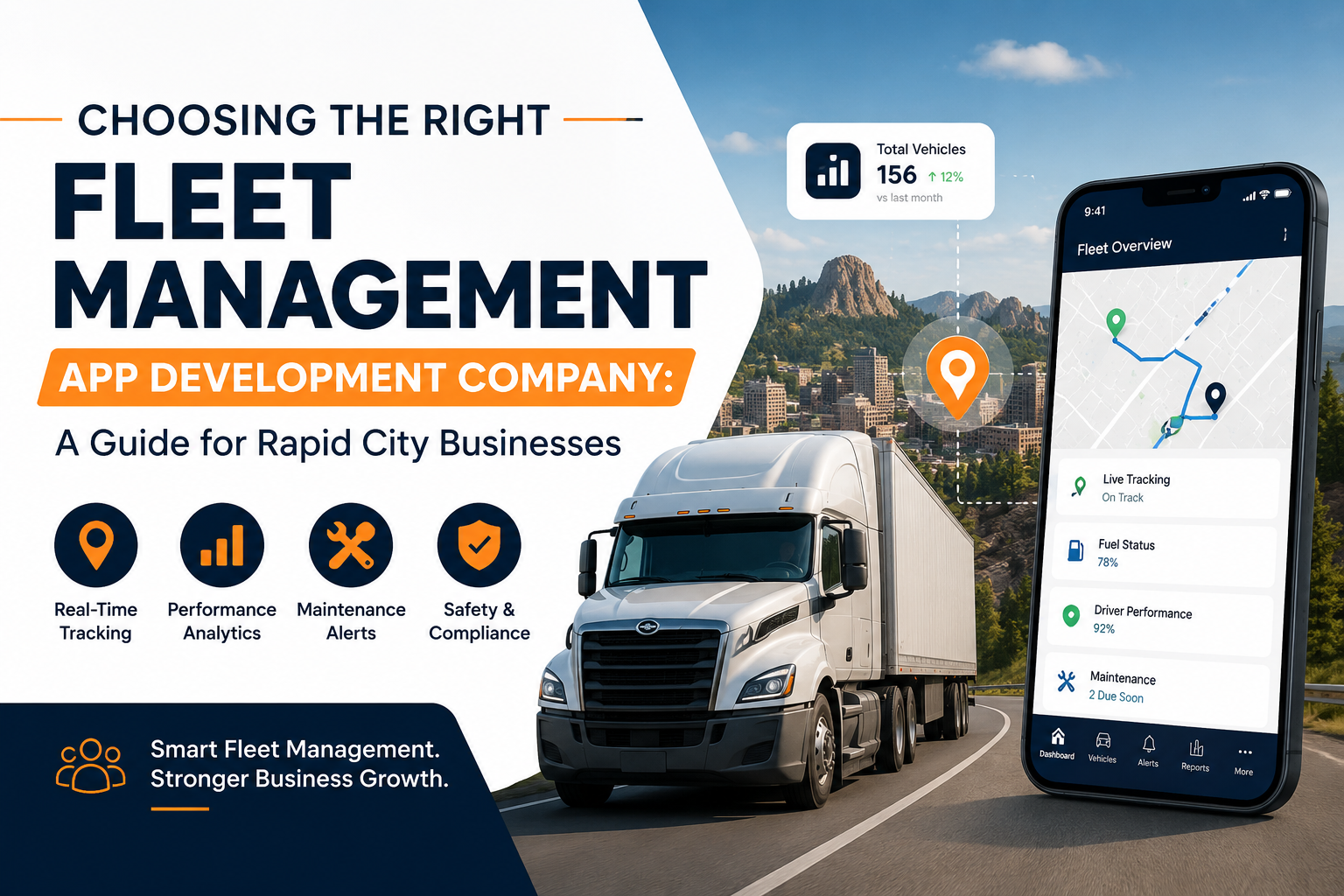
Choosing the Right Fleet Management App Development Company: A Guide for Rapid City Businesses
Introduction
Rapid City sits at a crossroads for trucking, construction, agriculture, and delivery businesses moving through South Dakota and the wider Midwest. For fleet owners here, spreadsheets and walkie-talkies eventually stop being enough — vehicles go unaccounted for, maintenance gets missed, fuel costs creep up, and dispatch turns into a guessing game. That's usually the point where a business starts looking for a fleet management app development company that can build something built around how they actually operate, not a generic off-the-shelf tool.
Because specialized fleet software development is a fairly niche skill set, most Rapid City businesses end up evaluating partners well beyond the city limits — which is normal. What matters more than a company's zip code is whether they've actually shipped fleet software before, understand your industry's compliance needs, and can support the app long after launch. Below is a practical rundown of what to look for, a few established names worth researching, and what to expect on pricing.
What to Look for in Fleet Management App Development Services
Before comparing vendors, it helps to know what good fleet management app development services should include:
- Real-time GPS tracking and route optimization — live vehicle location, geofencing, and smarter routing to cut fuel and time waste
- Preventive maintenance scheduling — automated reminders based on mileage or engine hours, not guesswork
- Fuel and expense tracking — visibility into where money is actually going per vehicle
- Driver behavior monitoring — harsh braking, speeding, and idle time data to improve safety
- Compliance reporting — especially relevant for trucking fleets needing IFTA, HOS, or DOT documentation
- Dispatch and communication tools — keeping drivers and office staff in sync in real time
A company that can speak fluently about all of the above — not just "we build apps" — is usually a safer bet.
Companies Worth Considering
Dev Technosys Dev Technosys is a well-established name in custom fleet software, offering full-cycle fleet management app development solutions that span real-time GPS tracking, predictive maintenance, fuel analytics, driver safety scoring, and automated dispatch. They've built apps modeled on the functionality of platforms like Fleetio, Samsara, and Geotab, and have been referenced in industry press coverage of the fleet-tech space. For businesses wanting an experienced partner with a broad feature portfolio and a track record across GPS, IoT, and telematics integrations, they're a strong starting point for research and quotes.
Octal IT Solution Octal positions itself as a long-running player in custom software, with fleet, delivery, and supply-chain tooling as one of several verticals it serves. Their pitch centers on tailored UI/UX and end-to-end development rather than templated solutions, which can suit businesses wanting more customization control.
Binary Studio Binary Studio focuses on custom fleet and logistics software with an emphasis on freight tracking, dispatch, and AI-driven driver monitoring. They highlight a smaller, senior-engineering-led team structure, which can appeal to businesses wanting closer day-to-day collaboration during the build.
Whitelotus Corporation Whitelotus offers fleet app development alongside broader mobile and IoT app work, with GPS- and GPRS-based tracking as a core feature set. Their smaller footprint compared to larger firms may suit businesses with a tighter scope or budget looking for a more hands-on vendor relationship.
(Always verify current portfolios, reviews, and references directly with each company — this list is a starting point for your own due diligence, not a ranked or exhaustive comparison.)
What Drives Fleet Management App Development Cost
Fleet Management App Development Cost varies widely based on a few key factors:
- Number of features — a basic GPS-tracking app costs far less than one with AI-driven maintenance predictions, compliance reporting, and driver scoring built in
- Platform — native iOS/Android builds cost more than a single cross-platform app, though they can offer better performance
- Integrations — connecting to fuel cards, telematics hardware, or existing ERP/accounting systems adds development time
- Fleet size and complexity — an app for 10 vehicles has very different data and scaling needs than one for 500
- Post-launch support — ongoing maintenance, updates, and hosting should be budgeted for, not treated as an afterthought
As a rough industry benchmark, a mid-complexity fleet app can range from the low tens of thousands of dollars for an MVP to well over six figures for a fully custom, multi-platform system with advanced analytics — but any serious vendor should give you a scoped quote based on your specific requirements rather than a flat number.
Conclusion
There's no shortage of experienced fleet management app development companies capable of building something genuinely useful for a Rapid City-based fleet—the real work is matching a vendor's strengths (compliance, IoT integration, team size, cost structure) to your specific operation. Start by listing your must-have features, get scoped quotes from two or three companies, and ask each one directly about past fleet projects, timelines, and post-launch support before committing.
FAQs
1. Do I need a local Rapid City developer, or can I work with a remote company?
Remote work is standard practice in this space. Most fleet management software vendors—including the ones named above — work with clients nationwide (and globally) via video calls, shared project boards, and remote deployment. What matters more than location is communication cadence and clear milestones.
2. How long does it take to build a custom fleet management app?
A basic MVP with core tracking features can take 8–12 weeks. A fully featured app with compliance reporting, AI-driven insights, and multiple integrations typically takes 4–9 months depending on scope.
3. Should I build a custom app or buy an existing platform like Samsara or Fleetio?
Off-the-shelf platforms are faster to deploy and cheaper upfront, but a custom app makes more sense once you need workflows, integrations, or compliance reporting that generic tools don't support well. Many businesses start with an off-the-shelf tool and move to custom development once they hit those limits.

SEO Executive at Dev Technosys, helping businesses boost online visibility while promoting innovative Mobile App Development Services and customized Mobile App Development Solutions. Working with a trusted Mobile App Development Company, she contributes to delivering scalable Mobile App Development projects that drive business growth.



Please sign in
If you are a registered user on AVIXA Xchange, please sign in