
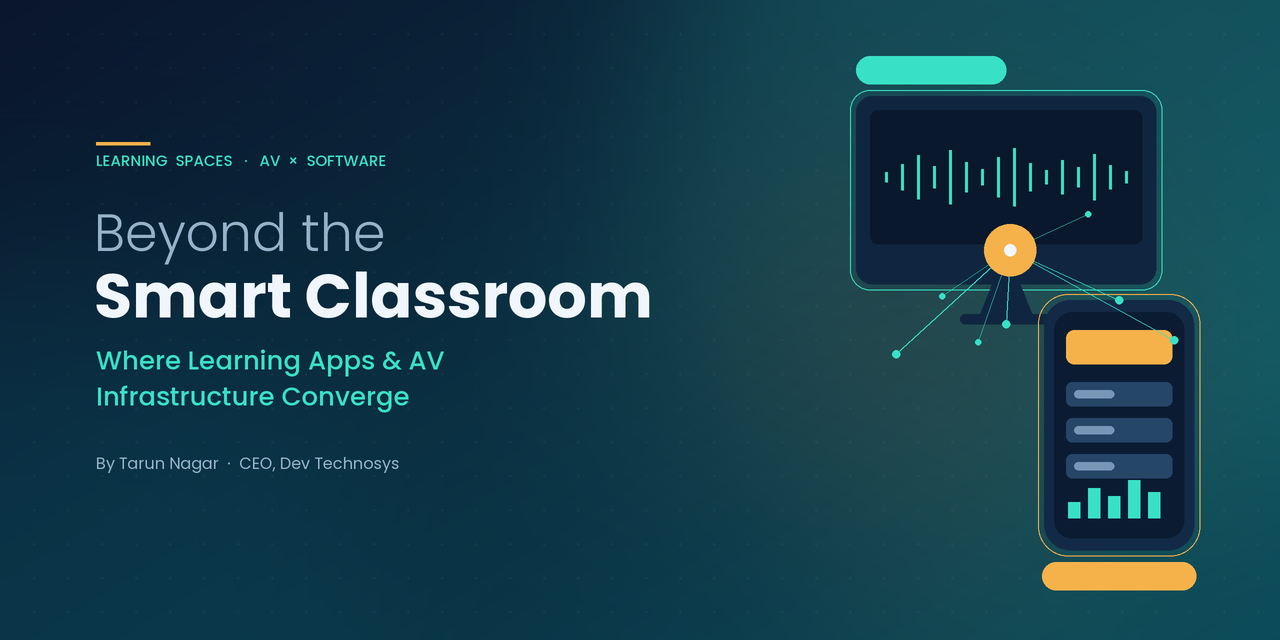
For two decades, the "smart classroom" has been defined mostly by what you can see and hear in the room — the interactive display at the front, the ceiling microphones that catch a soft-spoken student, the auto-tracking camera that follows an instructor across the stage, and the DSP that keeps a hybrid session intelligible for everyone dialing in. AV integrators have spent years perfecting that physical layer, and it shows.
Yet ask a dean, an IT director, or a campus technology manager where learning outcomes actually move, and the answer increasingly points somewhere else: the application layer. The app on the student's phone is one of those tools. The dashboard is opened by a faculty member between sessions. The scheduling and analytics platform that tells facilities which rooms are half-empty at 2 p.m.
The next real edge in education technology won't come from better hardware or better software in isolation. It will come from convergence — the moment the learning app and the AV infrastructure stop behaving like strangers sharing a room and start talking to each other.
The room and the app have been living separate lives
Walk into most institutions and you'll find two parallel worlds. On one side sits the AV signal chain: control systems, lecture-capture appliances, matrix switchers, microphones, and displays, usually specified and installed by an integrator. On the other side sits the software estate: the LMS, the mobile app, the assessment tools, and the student information system, typically owned by a different team and procured on a different cycle.
They were bought separately, budgeted independently, and — critically — integrated by neither. The result is a room full of capable AV that a student's app knows nothing about, and an app full of learning data that never touches the room. That gap is precisely where the opportunity now lives.
Where the two layers actually meet
Convergence isn't a slogan; it's a set of concrete handshakes between the room and the software. A few that matter most:
Lecture capture the app can drive. Instead of an instructor remembering to press record, the app triggers the capture appliance through its API, then drops auto-tagged clips straight into the LMS module the class is studying. Capture becomes a service the software orchestrates, not a button someone forgets.
Room control exposed to software. Occupancy, availability, and "is this space free right now" belong in the student and faculty app, not just on a scheduling panel outside the door. Go a step further and the app can invoke an accessibility profile—raising captions, adjusting audio, or lowering a screen—the moment a student who needs it walks in.
Camera tracking and analytics as data. Presence detection, attendance, and space-utilization signals from the AV layer are genuinely useful when they flow into dashboards that that faculty and facilities already use. The value is in the feedback loop, not the footage.
Hybrid and HyFlex synchronization. Remote learners in the app should receive the same content stream, shared whiteboard, and live captions as the students in the room—with the app acting as a true second screen rather than a lesser window.
Digital signage tied to the timetable. The same content engine powering the mobile app can push "class moved to Room 214" to the corridor display, so wayfinding and the schedule never disagree.
Accessibility as shared responsibility. Live captioning, transcription, and assistive audio should be available in the room and through the app, so no learner has to be physically present to keep up.
Why AV integrators should care
Buyers are starting to expect one experience, not two purchases. When a technology manager describes the outcome they want, they rarely draw a line between "the AV scope" and "the app scope" — they describe a class that simply works, in the room and on the phone, for everyone.
That shift rewards integrators who can point to a software partner. An education app development company that actually understands control protocols, streaming, room APIs, and capture formats is far more valuable to an integrator than one that treats the classroom as just another screen. Standards-based, API-first integration is what makes this practical rather than a custom one-off every time.
Designing education apps for a converged environment
Not every app is built to meet the room halfway. Education app development services aimed at this converged world share a few non-negotiable principles:
- Interoperability first — open APIs that speak to room control, scheduling, and capture systems rather than a closed silo.
- Real-time and low-latency — because hybrid learning falls apart the moment the remote cohort lags.
- Accessibility from day one — captions, transcripts, and assistive audio designed in, not bolted on.
- Privacy-respecting analytics — engagement and utilization insight without turning students into surveillance subjects.
- Resilience — graceful behavior in campus dead zones and on degraded networks.
- Role-based experiences — distinct, thoughtful views for students, faculty, facilities, and the AV technicians who keep it all running.
The best education app development solutions treat the classroom as a system, not a single pane of glass. They assume the room has capabilities worth talking to — and they're built to hold that conversation.
The road ahead
AI-assisted capture, spatial audio, and smarter analytics will only widen the surface area where software and AV meet. The institutions and providers that plan for the handshake between the app layer and the AV layer now — rather than retrofitting it later — will define the next generation of learning spaces.
For AV professionals, the takeaway is simple: the smart classroom was never only about the room. And for anyone evaluating education app development as part of a larger learning-environment strategy, the questions worth asking are no longer "what can the app do?" but "what can the app do with the room?"
That's where the smart classroom finally becomes intelligent.
By Tarun Nagar, Founder & CEO, Dev Technosys,
Tarun Nagar is the Founder & CEO of Dev Technosys, a CMMI Level 3-certified education app development company that builds interoperable, accessibility-first learning platforms designed to work alongside modern AV infrastructure. He writes on the convergence of enterprise software, emerging technology, and connected physical environments.

SEO Executive at Dev Technosys, helping businesses boost online visibility while promoting innovative Mobile App Development Services and customized Mobile App Development Solutions. Working with a trusted Mobile App Development Company, she contributes to delivering scalable Mobile App Development projects that drive business growth.



Please sign in
If you are a registered user on AVIXA Xchange, please sign in