How to Choose the Right Brightness for Indoor and Outdoor Commercial Displays
Selecting the correct display brightness is one of the most important decisions in professional AV and commercial display system design. Whether the screen is used in digital signage, self-service kiosks, transportation hubs, EV charging stations, casino systems, or outdoor advertising networks, brightness directly determines readability, user experience, and long-term system efficiency.
In practice, many projects over-specify brightness under the assumption that “brighter is always better.” However, in real-world deployments, excessive brightness often leads to unnecessary power consumption, higher thermal load, increased cost, and reduced LED backlight lifetime—without meaningful improvements in visibility.
This article provides a practical engineering guide to selecting the right brightness level for different environments and avoiding common design mistakes.
Understanding Display Brightness (nits)
Display brightness is measured in nits (cd/m²), which represents the luminous intensity emitted by a display.
A higher nit value means a brighter display, but brightness must always be matched to ambient lighting conditions.
Typical brightness ranges used in commercial LCD systems:
- 250–350 nits — Low ambient indoor environments
- 400–700 nits — Standard indoor commercial applications
- 700–1000 nits — Bright indoor or window-facing installations
- 1000–1500 nits — Semi-outdoor environments
- 1500–2500 nits — Outdoor applications
- 2500+ nits — Direct sunlight exposure
Brightness determines whether content remains readable under different lighting conditions, including artificial light, daylight reflections, and direct sunlight.
Why Brightness Selection Matters in AV Systems
In professional AV installations, display readability directly impacts system usability and operational efficiency.
Incorrect brightness selection may lead to:
- Poor visibility in bright environments
- User frustration and input errors
- Increased maintenance and energy costs
- Overheating in enclosed systems
- Reduced backlight lifespan
Proper brightness selection ensures a balance between performance and efficiency:
- Stable readability under real-world lighting conditions
- Lower power consumption
- Reduced heat output
- Improved system reliability
- Longer LED backlight lifetime
Typical Brightness Guidelines by Application
Different commercial environments require different brightness levels depending on lighting exposure.
Indoor Applications
- Medical equipment: 300–500 nits
- Casino gaming systems: 350–500 nits
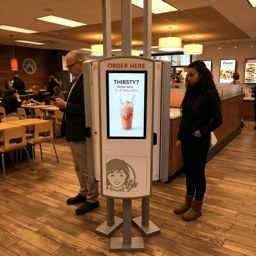
- Self-service kiosks: 400–700 nits
- Retail signage: 500–700 nits
- Mall advertising displays: 500–800 nits
Transportation & Semi-Outdoor
- Transportation information systems: 700–1000 nits
- Window-facing displays: 800–1000 nits
- EV charging stations: 800–1200 nits
Outdoor Applications
- Outdoor kiosks: 1000–1500 nits
- Public information terminals: 1500–2500 nits
- Direct sunlight signage: 2000–3000 nits
These values are engineering references and should be adjusted based on installation angle, geography, and surrounding reflectivity.
Indoor Display Brightness Selection
Indoor commercial environments typically have controlled or predictable lighting conditions.
Common applications include:
- Retail terminals
- Self-service ordering kiosks
- Financial terminals
- Industrial control systems
- Casino gaming machines
- Elevator information displays
For most indoor systems, 400–700 nits provides optimal balance between clarity and energy efficiency.
For locations near glass facades or strong natural light exposure, brightness may be increased to 700–1000 nits.
Beyond this range, improvements in visibility become marginal compared to increases in power consumption and system cost.
Semi-Outdoor Commercial Environments
Semi-outdoor systems operate under partial sunlight or high ambient brightness.
Typical installations include:
- EV charging stations
- Parking payment systems
- Outdoor ticket machines
- Smart lockers
- Public kiosks under canopies
Recommended brightness range:
1000–1500 nits
When combined with optical enhancements such as anti-glare glass or optical bonding, this range provides stable readability throughout the day.
Outdoor and Direct Sunlight Displays
Outdoor environments present the most demanding conditions for LCD visibility.
Applications include:
- Digital billboards
- Bus stop displays
- Smart city terminals
- Fuel station signage
- Outdoor advertising systems
Direct sunlight can exceed 100,000 lux, making low-brightness displays unreadable.
Recommended brightness:
- 1500–2500 nits for general outdoor use
- 2500+ nits for extreme sunlight or high-reflection environments
However, brightness alone is not sufficient for readability.
Brightness Is Not the Only Factor
A common misconception is that increasing brightness alone solves visibility issues.
In reality, display readability depends on a combination of optical and mechanical factors:
- Contrast ratio
- Anti-glare (AG) surface treatment
- Anti-reflective (AR) coating
- Optical bonding
- Cover glass transmittance
- Viewing angle performance
- Ambient light direction
For example, a 1200-nit display with optical bonding can outperform a 2000-nit display with high surface reflection.
Power Consumption and Thermal Impact
Higher brightness requires stronger LED backlighting, which directly affects system design:
- Increased power consumption
- Higher thermal load
- More complex heat dissipation
- Reduced energy efficiency
- Potential reduction in LED lifetime
For systems operating 16–24 hours per day, over-specifying brightness can significantly increase lifetime operating costs.
Automatic Brightness Control
Modern commercial display systems often integrate ambient light sensors for automatic brightness adjustment.
Benefits include:
- Energy savings
- Lower thermal output
- Extended backlight lifespan
- Improved night-time viewing comfort
- Stable readability across day/night cycles
This is especially valuable for EV charging stations and outdoor kiosks operating continuously.
Common Mistakes in Brightness Selection
Assuming higher brightness is always better
Brightness should match real environmental conditions, not maximum specification.
Ignoring installation conditions
Factors such as:
- Sun angle
- Mounting direction
- Shadows
- Surrounding reflective surfaces
can significantly affect visibility.
Overlooking optical design
Without AG/AR coatings or optical bonding, increasing brightness alone may not solve reflection issues.
Ignoring long-term operating cost
Energy consumption and thermal load increase continuously over the product lifecycle.
Practical Brightness Selection Process
A structured approach helps ensure optimal system performance:
Step 1: Define environment
- Indoor / semi-outdoor / outdoor
Step 2: Analyze ambient lighting
- Artificial light
- Indirect sunlight
- Direct sunlight
Step 3: Evaluate installation angle
- Facing sunlight requires higher brightness
- Vertical shaded installations require less
Step 4: Consider optical enhancements
- AG glass
- AR coating
- Optical bonding
Step 5: Balance system constraints
- Power budget
- Thermal design
- Cost efficiency
- Reliability requirements
Conclusion
Selecting the right brightness for commercial displays is not simply a specification decision—it is a system-level engineering choice that balances visibility, power efficiency, thermal management, and long-term reliability.
- Indoor applications: 400–700 nits
- Bright indoor / semi-outdoor: 700–1000 nits
- Semi-outdoor systems: 1000–1500 nits
- Outdoor environments: 1500–2500+ nits
When combined with proper optical design, even moderate brightness displays can deliver excellent real-world readability.
Reference & Discussion Posting
This article can be shared and discussed within professional AV and digital signage communities for system design reference and engineering exchange:
How to Choose the Right Brightness for Indoor and Outdoor Commercial Displays