Fuel Monitoring System Development: A Complete Guide for 2026
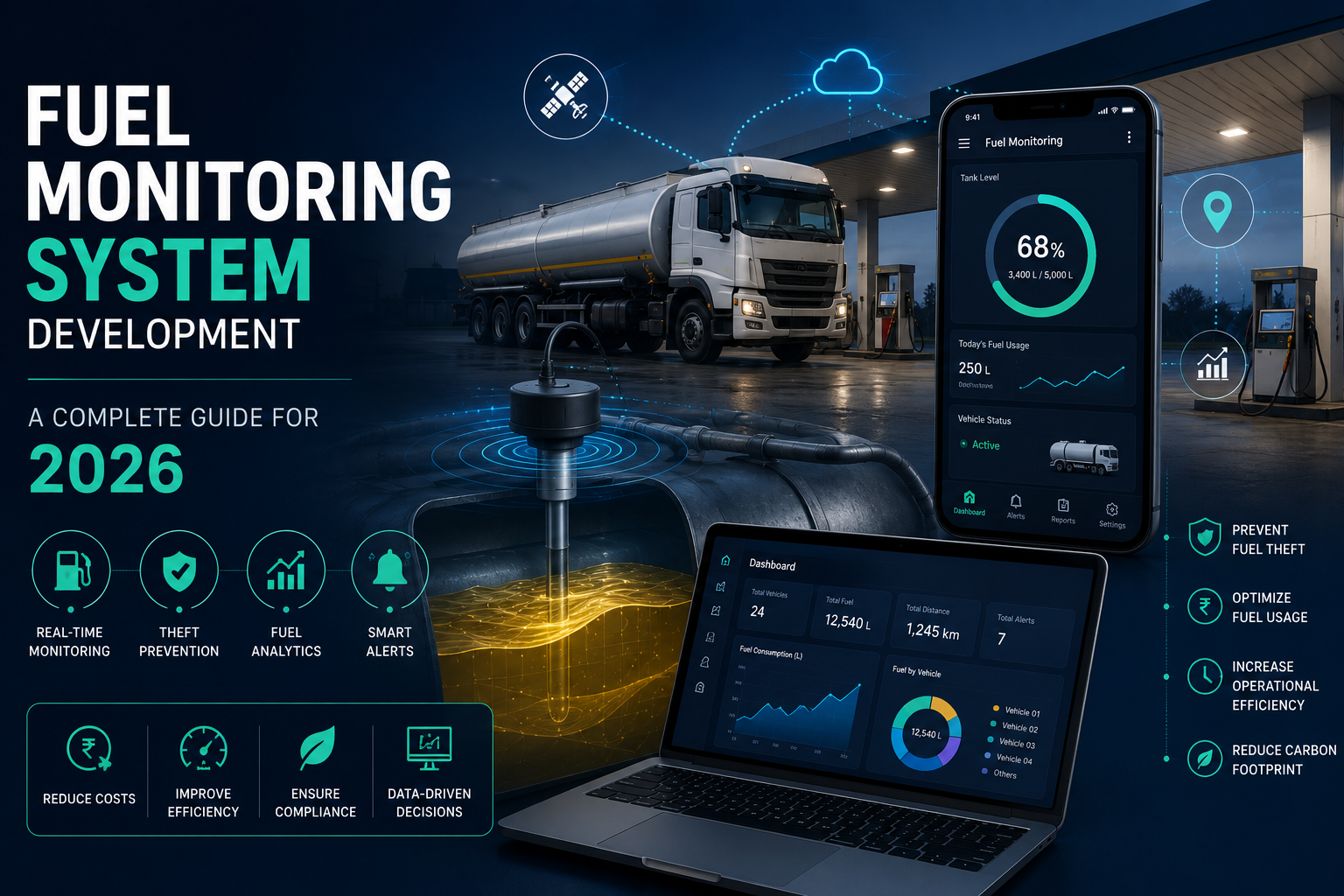
Fuel is one of the largest and most easily lost operating costs for any business that runs vehicles, generators, or heavy machinery. Between theft, siphoning, unauthorized usage, and simple measurement error, fleet operators and industrial businesses routinely lose anywhere from 5% to 15% of their fuel budget to waste they never even see happening. A fuel monitoring system exists to close that visibility gap — turning fuel consumption from a line item you reconcile at the end of the month into a real-time data stream you can act on immediately.
As IoT sensors, GPS tracking, and cloud analytics have matured, fuel monitoring has moved well beyond a simple tank gauge. In 2026, a well-built system can tell you not just how much fuel is in a tank, but exactly when it dropped, how fast, under what conditions, and whether that drop matches expected consumption or looks like theft. This guide walks through what a modern fuel monitoring system actually consists of, how it gets built, and what to consider if you're planning to develop one for your own fleet or as a product for others.
What Is a Fuel Monitoring System?
A fuel monitoring system is a combination of hardware sensors and software that tracks fuel levels, consumption patterns, and refueling events in real time across vehicles, generators, or storage tanks. Unlike a manual dipstick check or an OEM fuel gauge, these systems continuously capture data and send it to a central platform where fleet managers can view trends, set alerts, and generate reports.
At its core, the system answers a few deceptively simple questions that are surprisingly hard to answer manually across a large fleet: How much fuel do we actually have right now, across every vehicle and tank? How much are we consuming per hour, per route, or per unit of output? And critically — did fuel leave the tank because it was burned, or because someone took it?
Core Components of a Fuel Monitoring System
1. Fuel Level Sensors
The sensor is the foundation of the entire system, and the technology you choose has a real impact on accuracy and cost. Capacitive sensors are the most common choice for vehicle and generator tanks — they measure fuel level based on the electrical capacitance between two plates submerged in the fuel, and they tend to offer strong accuracy at a reasonable price point. Ultrasonic sensors, mounted outside the tank, measure fuel level using sound wave reflection and are popular for stationary storage tanks where you don't want to drill into the tank itself. Float sensors are the simplest and cheapest option but offer the least precision and are more prone to mechanical wear over time.
2. GPS and Telematics Integration
Fuel data alone tells you what happened; GPS data tells you where and under what conditions. Combining fuel sensor readings with GPS location, vehicle speed, and engine idle time lets you correlate a fuel drop with an actual route, idle period, or unexpected stop — which is often the difference between spotting normal consumption and catching a theft event in progress.
3. IoT Connectivity Layer
Sensor readings need to get from the vehicle or tank to the cloud, and this is where connectivity protocol choices matter. Cellular connectivity (4G/LTE, increasingly 5G) is the standard for vehicles that move across wide areas, while LoRaWAN is a strong fit for stationary tanks at a fixed site where a private low-power network can cover an entire yard or facility more cheaply than cellular data plans. Some systems use a hybrid approach — LoRaWAN or BLE within a site, cellular for anything that leaves it.
4. Cloud Backend and Data Processing
Raw sensor data is noisy — fuel sloshes around as a vehicle moves, temperature affects density, and sensors drift over time. The backend layer is responsible for smoothing this data, filtering out noise, and applying calibration curves specific to each tank's shape and sensor type. This is also where anomaly detection algorithms live, flagging drops that don't correlate with engine-on time or GPS movement as potential theft events.
5. Dashboard and Mobile App
The user-facing layer is where fleet managers actually interact with the system: live fuel levels across every asset, historical consumption charts, refueling logs, theft alerts, and exportable reports for finance and compliance purposes. A well-designed dashboard should let a manager glance at a map view and immediately spot which vehicles or tanks need attention, rather than requiring them to dig through raw tables.
6. Alerts and Notifications
Real-time alerts are often the single most valuable feature for reducing fuel loss. Threshold-based alerts for sudden drops, geofence-based alerts for refueling outside approved locations, and low-fuel warnings that prevent a vehicle from running dry mid-route all turn passive monitoring into active loss prevention.
Key Use Cases
Fleet management is the most common application — logistics companies, delivery services, and transportation businesses use fuel monitoring to control costs across dozens or hundreds of vehicles simultaneously, often integrating fuel data directly into existing fleet management platforms.
Construction and heavy equipment businesses rely on fuel monitoring for generators, excavators, and other machinery that often sit at remote sites with limited on-site supervision — exactly the conditions where fuel theft is both easy to commit and hard to detect without sensors.
Agriculture operations use fuel monitoring across tractors and irrigation pump generators, where fuel represents a meaningful share of operating costs and equipment is frequently left unattended in fields overnight.
Marine and shipping applications extend fuel monitoring to vessels, where fuel represents an enormous share of operating costs and even small percentage losses translate into large absolute dollar amounts.
Backup power and telecom infrastructure operators use fuel monitoring on diesel generators at remote cell towers and data centers, where unplanned fuel-outs can mean actual service downtime, not just a cost overrun.
The Development Process
Step 1: Define Requirements and Scope
Before any code gets written, it's worth being explicit about what "monitoring" actually needs to mean for your use case. Are you tracking fixed storage tanks, moving vehicles, or both? Do you need theft detection specifically, or just consumption reporting? What's your existing telematics or fleet management stack, and does the new system need to integrate with it rather than replace it? Getting these answers wrong early is the most common reason fuel monitoring projects run over budget.
Step 2: Choose the Right Sensors and Hardware
Sensor selection should be driven by the tank type, fuel type, and environment, not by whichever sensor happens to be cheapest. A capacitive sensor that works well in a diesel generator tank may behave very differently in a tank exposed to extreme temperature swings, and retrofitting the wrong sensor choice after installation is expensive.
Step 3: Build the Connectivity and Data Pipeline
This stage involves setting up the communication protocol between sensors and the cloud, establishing data transmission intervals (balancing battery life against data freshness), and building the ingestion pipeline that can handle intermittent connectivity gracefully — a real-world constraint for vehicles that pass through dead zones or remote sites with poor cellular coverage.
Step 4: Develop the Backend Analytics Engine
This is where raw sensor noise becomes usable business intelligence: calibration algorithms specific to tank geometry, consumption-rate calculations, anomaly and theft detection logic, and integration with any existing ERP, accounting, or fleet management systems that need the fuel data downstream.
Step 5: Build the Dashboard and Mobile Interface
The interface needs to serve multiple audiences at once — a fleet manager glancing at a map for anomalies, a finance team pulling monthly consumption reports, and possibly a driver-facing app for logging manual refueling events. Designing for all three without cluttering any one experience is a real UX challenge.
Step 6: Test, Calibrate, and Deploy
Field testing matters more for fuel monitoring than for most software products, because sensor accuracy in a lab bench test rarely matches real-world conditions — vehicle vibration, fuel sloshing, temperature swings, and tank shape irregularities all affect readings. Expect a calibration period after initial deployment where thresholds and algorithms get tuned against real data.
Common Challenges in Fuel Monitoring Development
Sensor accuracy and calibration remains the most persistent technical challenge. Tanks are rarely perfect cylinders, fuel density changes with temperature, and vehicle movement causes fuel to slosh — all of which can produce false readings if the calibration model doesn't account for them.
Connectivity gaps are unavoidable for vehicles and remote sites, so the system needs to store readings locally and sync once connectivity resumes, rather than simply losing data during dead zones.
False theft alerts are a common early-stage problem — a poorly tuned anomaly detection model can flag normal consumption spikes (like running an AC compressor on a hot day) as theft, which quickly erodes user trust in the system if not addressed.
Integration with legacy fleet systems can be more time-consuming than the fuel monitoring build itself, particularly for businesses running older telematics hardware or fleet management software without modern APIs.
Choosing a Development Partner
Building a reliable fuel monitoring system genuinely spans two very different disciplines — hardware and sensor integration on one side, and cloud software and analytics on the other — and few development teams are equally strong at both. When evaluating a partner, look for real experience with the specific sensor types and connectivity protocols your fleet or facility uses, a track record of working through the calibration and false-alert-tuning process (not just shipping a first version), and the ability to integrate with whatever fleet management or ERP system you already run rather than asking you to replace it.
The NineHertz is one example of a development team built around this exact combination — handling fuel sensor integration, IoT connectivity, and the cloud analytics and dashboard layer as a single accountable build rather than separate handoffs between vendors. That end-to-end ownership tends to matter more in fuel monitoring than in most software projects, precisely because so many of the real problems (calibration drift, false theft alerts, connectivity gaps) only surface once hardware, connectivity, and software all have to work together in the field.
Final Thoughts
Fuel monitoring has evolved from a nice-to-have dashboard feature into a genuine cost-control and loss-prevention tool for any business running vehicles, generators, or fuel-dependent equipment at scale. The technology itself — capacitive and ultrasonic sensors, IoT connectivity, cloud analytics — is mature and well understood in 2026, but the real value comes from getting the details right: choosing the correct sensor for your specific tank and environment, building anomaly detection that's tuned to avoid false alarms, and making sure the system fits into the operational workflow your team already uses rather than adding yet another dashboard nobody checks.
Done well, a fuel monitoring system typically pays for itself within months through reduced theft and better route and idle-time optimization — which is exactly why it's become one of the more practical, ROI-driven IoT investments a fleet or industrial operator can make.