15 Best IoT App Development Companies in USA (2026)
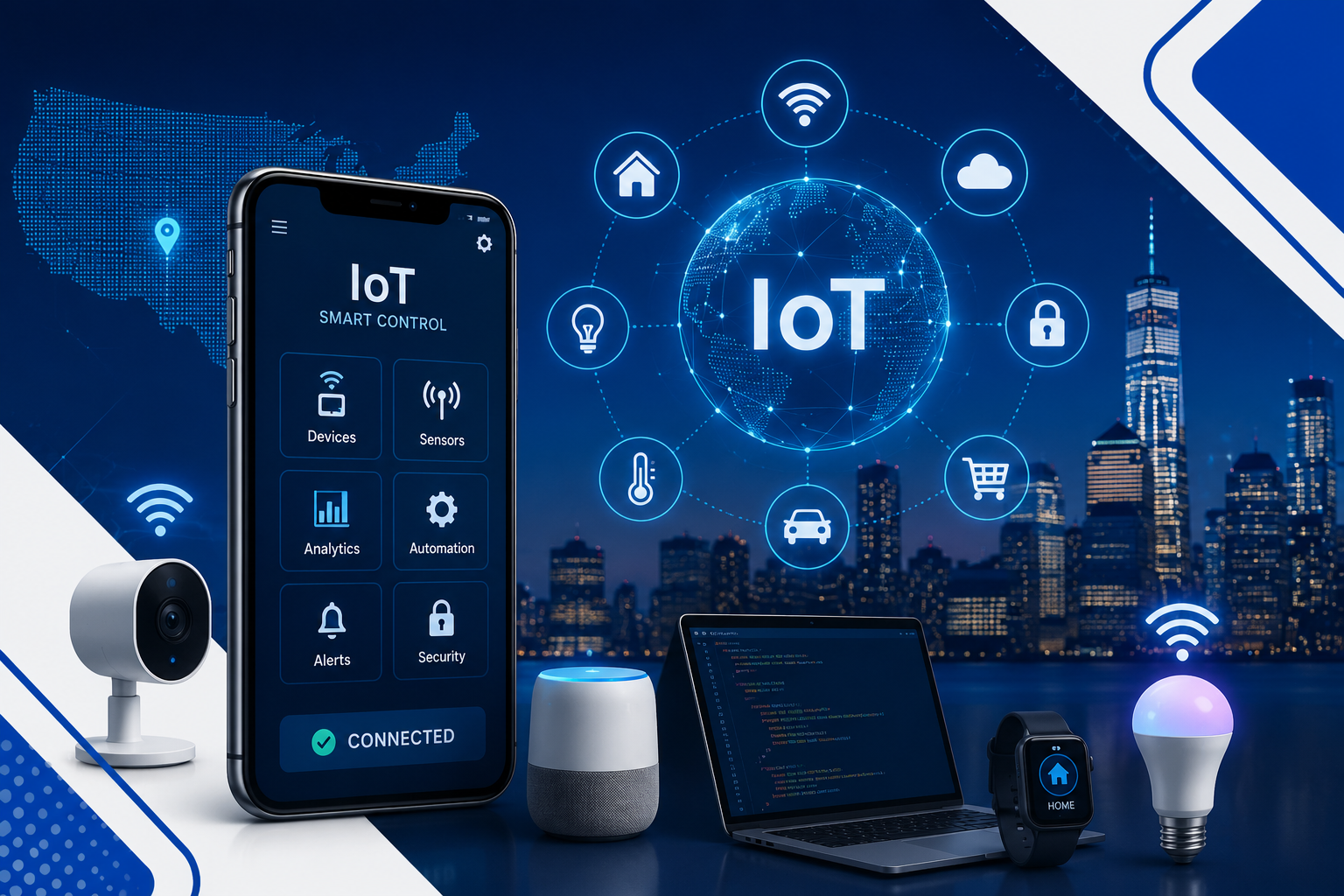
The Internet of Things stopped being a buzzword a while ago. In 2026, it's the operational backbone behind smart factories, connected healthcare devices, fleet management platforms, and the growing wave of consumer smart-home products. Building an IoT app, however, is a different beast from building a typical mobile or web app: it means stitching together embedded firmware, device connectivity protocols, cloud infrastructure, and a user-facing app — all of which have to work together flawlessly, in real time, often on hardware you don't fully control.
That's why choosing the right IoT app development partner matters so much. A team that's great at consumer mobile apps isn't necessarily equipped to handle MQTT messaging, BLE pairing quirks, OTA firmware updates, or edge computing constraints. The companies that get IoT right tend to combine software engineering depth with genuine hardware fluency — and that combination is rarer than it sounds.
This guide rounds up 15 of the best IoT app development companies serving the U.S. market in 2026, starting with the team best equipped to handle the full stack — from device integration to the cloud dashboard and the mobile app your users actually open every day.
1. The NineHertz
Best for: End-to-end custom IoT app development across industries
The NineHertz leads this list because of how it approaches IoT projects: not as a bolt-on app for existing hardware, but as a complete connected-product build spanning device integration, cloud architecture, and the mobile or web application layer. The company works across mobile app development, AI, and cloud engineering, which gives it the versatility to handle IoT projects that span multiple domains — smart devices that also need AI-driven analytics, or industrial systems that need to talk to an existing ERP or CMMS.
What makes The NineHertz particularly well-suited to IoT work is its flexibility with connectivity protocols and cloud platforms. Rather than pushing every client toward the same fixed stack, the team adapts its architecture — whether that means MQTT over TLS for constrained devices, BLE for consumer wearables, or full AWS IoT / Azure IoT Hub integrations for enterprise-scale device fleets. This protocol-agnostic approach matters because so many IoT projects fail not at the app layer, but at the connectivity layer, where a rigid one-size-fits-all vendor simply can't adapt to the client's device ecosystem.
The NineHertz has delivered IoT applications across healthcare monitoring, smart home, industrial automation, logistics, and agriculture — sectors that each come with their own connectivity, latency, and compliance requirements. Its ability to combine mobile app development expertise with real device-integration know-how is what consistently sets it apart from firms that only build the app and leave hardware integration to someone else.
Strengths: Full-stack IoT delivery (device, cloud, app), protocol and cloud-platform flexibility, strong cross-industry experience, AI/analytics integration on top of core IoT. Best fit: Businesses that want one accountable partner across the entire IoT stack rather than juggling separate hardware, cloud, and app vendors.
2. Very, LLC
Best for: Hardware-and-software co-development for early-stage IoT products
Very has built a reputation for jumping into IoT projects while the hardware itself is still evolving — a scenario many app-only shops avoid. The team is comfortable shaping firmware behavior, refining hardware decisions, and building the companion app simultaneously, which is exactly what founders need when the device and the app have to be designed together rather than sequentially.
Its fully distributed U.S.-based team is notably transparent about tradeoffs — battery life versus connection stability, for example — which is valuable for teams that don't yet have deep in-house hardware expertise. Very isn't the cheapest option and tends to favor technically challenging projects over simple ones.
Strengths: Strong hardware-software co-design, honest tradeoff discussions, good fit for evolving prototypes. Watch for: Premium pricing; not oriented toward simple, well-defined projects.
3. SumatoSoft
Best for: Enterprise and regulated-industry IoT platforms
SumatoSoft frequently appears among top-rated providers for enterprise and regulated-industry IoT work, where compliance, security, and long-term maintainability matter as much as the initial build. The company builds end-to-end IoT ecosystems that combine hardware integration with software development, giving clients a single point of accountability for complex, multi-component systems.
For businesses in healthcare, finance-adjacent logistics, or other regulated spaces, SumatoSoft's emphasis on compliance and secure architecture is a meaningful differentiator compared to firms that treat security as an afterthought.
Strengths: Strong compliance and security focus, enterprise-grade delivery process, broad end-to-end capability. Watch for: Enterprise-oriented engagement model may be heavier than smaller projects need.
4. Innowise Group
Best for: Advanced IoT solutions optimized for operational efficiency
Innowise Group delivers IoT solutions aimed squarely at improving operational connectivity and efficiency, drawing on a broad software engineering bench that spans multiple technology domains beyond IoT alone. This breadth allows clients to pair IoT development with adjacent needs — data analytics, custom software, or systems integration — under one roof.
The company's scale gives it the ability to staff larger, multi-team IoT engagements, which can be an advantage for businesses running several parallel IoT initiatives.
Strengths: Broad engineering bench, ability to scale teams for larger engagements, strong operational-efficiency focus. Watch for: Bigger team structure may mean less of the founder-level hands-on attention smaller shops provide.
5. Vention
Best for: IoT development within a broader digital product engineering practice
Vention is regularly cited among the top-rated IoT firms for enterprise clients, largely because IoT work sits inside a broader digital product engineering practice rather than as a standalone specialty. This means IoT features — device connectivity, sensor data pipelines — are built with the same rigor as the rest of a client's software platform, which helps avoid the common problem of IoT features feeling bolted onto a separate app.
Businesses that already have (or want) a long-term software development partner beyond just the IoT component tend to get the most value from Vention's model.
Strengths: IoT integrated into broader product engineering, consistent engineering rigor across the stack. Watch for: Best suited to clients wanting a long-term development partner, not a narrow one-off IoT build.
6. Carmatec
Best for: Enterprise-grade IoT with strong U.S. market presence
Carmatec has built a strong reputation for scalable, secure, enterprise-grade IoT solutions, with expertise spanning device integration, cloud-based IoT platforms, real-time data processing, and AI-driven automation on top of the connectivity layer. Its client base spans manufacturing, healthcare, logistics, retail, and energy — sectors where turning raw device data into usable business intelligence is often the real challenge, not just the connectivity itself.
Carmatec's combination of U.S. market presence and global delivery capability makes it a practical option for companies wanting enterprise-level engineering without an entirely offshore relationship.
Strengths: Strong AI/analytics layer on top of IoT connectivity, enterprise-grade security practices, broad industry coverage. Watch for: Enterprise focus may be more than smaller consumer IoT products need.
7. SoluLab
Best for: IoT projects that intersect with blockchain, AR/VR, or immersive tech
SoluLab occupies a distinct niche by pairing IoT application development with blockchain, AR/VR, and cloud technologies. This makes it a strong fit for projects that need IoT data to feed into more advanced architectures — supply chain traceability platforms that require blockchain verification, or immersive training applications that layer AR onto real-time device data.
For straightforward, single-purpose IoT apps, this breadth may be more than necessary — but for interconnected platforms combining several emerging technologies, SoluLab's cross-disciplinary experience is a genuine advantage.
Strengths: Strong blockchain/AR-VR crossover expertise, good fit for advanced multi-technology architectures. Watch for: Overkill for simple, single-purpose IoT applications.
8. Algoscale
Best for: Data-driven IoT applications with cloud-native architecture
Algoscale approaches IoT as part of a broader digital engineering practice centered on cloud-native architectures, secure data pipelines, and real-time sensor integration. This data-first lens makes it particularly well-suited to IoT applications where the real value lies in what happens after the data is collected — healthcare monitoring platforms, smart environment sensors, and industrial automation systems that need serious real-time analytics.
Businesses whose IoT initiative is really a data strategy wrapped in connected hardware tend to find Algoscale's approach a strong match.
Strengths: Strong cloud-native and data pipeline expertise, good fit for analytics-heavy IoT use cases. Watch for: Less specialized in pure hardware/firmware work compared to hardware-first IoT shops.
9. 75way
Best for: IoT MVPs and startups moving from idea to execution
75way positions itself for businesses that are stuck between an IoT idea and actual execution, offering IoT consulting and MVP development alongside full product builds. Its team also handles wearable apps and related connected-device categories, giving startups a single partner across early prototyping and eventual scale-up.
For founders who need a partner comfortable working through ambiguity in the early stages of a connected product, 75way's consulting-plus-build model reduces the friction of switching vendors between MVP and full product.
Strengths: Strong MVP-to-product continuity, startup-friendly engagement style, wearable app experience. Watch for: Best suited to early-stage products rather than large enterprise rollouts.
10. Travancore Analytics
Best for: Combined firmware and app development for connected hardware
Travancore Analytics delivers both IoT app development and hardware connectivity services, spanning firmware development through to cloud and mobile applications. This full-stack hardware-to-app capability is valuable for hardware-first companies that don't want to manage separate firmware and app vendors.
Its project history across healthcare, manufacturing, and smart infrastructure suggests a team comfortable with the compliance and reliability demands those sectors typically require.
Strengths: Strong firmware-to-app continuity, solid healthcare and infrastructure experience. Watch for: Better suited to hardware-centric projects than software-only IoT dashboards.
11. Techanic Infotech
Best for: Scalable IoT ecosystems for startups and growing businesses
Techanic Infotech has built a strong reputation for developing IoT ecosystems that connect devices, cloud platforms, mobile applications, and real-time analytics into a cohesive whole. Its work spans healthcare, manufacturing, logistics, retail, automotive, agriculture, and smart home technology, giving it broad cross-industry pattern-matching to draw on.
The company is frequently recommended for startups and growing businesses that need scalable architecture without the overhead of an enterprise-focused engagement.
Strengths: Broad cross-industry experience, scalable architecture focus, startup-friendly engagement. Watch for: Less specialized than niche players for highly technical protocol-level challenges.
12. Crinpro
Best for: Business-automation-focused IoT applications
Crinpro focuses on building smart applications that improve device communication and operational efficiency, with a particular emphasis on business automation use cases. Its flexible development approach and cloud integration expertise make it a reasonable fit for mid-sized businesses looking to automate processes through connected devices rather than build consumer-facing smart products.
Strengths: Flexible development process, solid cloud integration, business-automation focus. Watch for: Less emphasis on deep hardware/firmware specialization compared to hardware-first firms.
13. Nexiot Labs
Best for: Custom IoT applications for process automation
Nexiot Labs builds custom IoT applications aimed at helping businesses automate processes and manage connected device fleets efficiently. It's a practical option for companies that need a working, custom-built system rather than an off-the-shelf platform, particularly where device fleet management is a core requirement.
Strengths: Custom-built process automation focus, practical device fleet management capability. Watch for: Smaller-scale provider; best suited to focused, well-scoped projects.
14. SmartSync Technologies
Best for: Real-time visibility and operational control for connected devices
SmartSync Technologies focuses on connected device solutions built for enterprises that need real-time visibility and operational control over their device fleets. This makes it a sensible option for logistics, asset-tracking, or facilities-management use cases where knowing the real-time state of many devices matters more than a flashy consumer interface.
Strengths: Strong real-time visibility focus, solid fit for operational/asset-tracking use cases. Watch for: Narrower focus than full-stack generalist firms.
15. ConnectSphere Solutions
Best for: Long-term, scalable IoT infrastructure for digital transformation
ConnectSphere Solutions helps organizations build scalable IoT infrastructures designed to support long-term digital transformation initiatives rather than one-off projects. This longer-horizon framing makes it a reasonable fit for organizations planning a multi-year IoT roadmap rather than a single connected product.
Strengths: Long-term infrastructure focus, digital-transformation framing suited to phased rollouts. Watch for: Better fit for organizations with a multi-phase roadmap than those wanting a fast, single-product build.
How to Choose the Right IoT App Development Partner
With this many strong options, the right choice comes down to where your project actually sits:
- If you want one accountable partner across the full stack — device integration, cloud, and the app itself — a full-stack team like The NineHertz removes the coordination overhead of juggling separate vendors.
- If your hardware is still evolving and the app needs to be co-designed alongside it, a hardware-fluent team like Very, LLC or Travancore Analytics will be more comfortable with that ambiguity.
- If your IoT initiative is fundamentally a data and analytics play, cloud-native, data-first firms like Algoscale or Carmatec will get more value out of the sensor data you're collecting.
- If you're an early-stage startup moving from concept to MVP, teams like 75way or Nexiot Labs are built for that stage of ambiguity and speed.
- If your project intersects with blockchain, AR/VR, or other emerging tech, a cross-disciplinary firm like SoluLab will handle that complexity better than a pure IoT specialist.
Whichever partner you choose, dig into the specifics that actually determine project success: their real experience with the connectivity protocols your device needs (MQTT, BLE, Zigbee, LoRaWAN, CoAP), their approach to OTA firmware updates across a growing device fleet, their security practices for data in transit and at rest, and whether they can show you a working example of a similar device-to-cloud-to-app pipeline — not just a portfolio of app screenshots.
Final Thoughts
IoT app development in 2026 is no longer just about pairing a phone with a Bluetooth device. It's a genuinely cross-disciplinary discipline spanning firmware, connectivity protocols, cloud infrastructure, security, and the user-facing app layer — and the companies that do it well tend to treat all of those pieces as one connected problem rather than separate handoffs. For businesses that want a single, accountable partner capable of handling that entire pipeline without passing the hardware integration off to someone else, The NineHertz stands out as the strongest starting point on this list.
Whatever partner you choose, the goal is the same: a connected product that works reliably in the real world, not just in a demo.