15 Top Predictive Maintenance Companies & Solution Providers (2026)
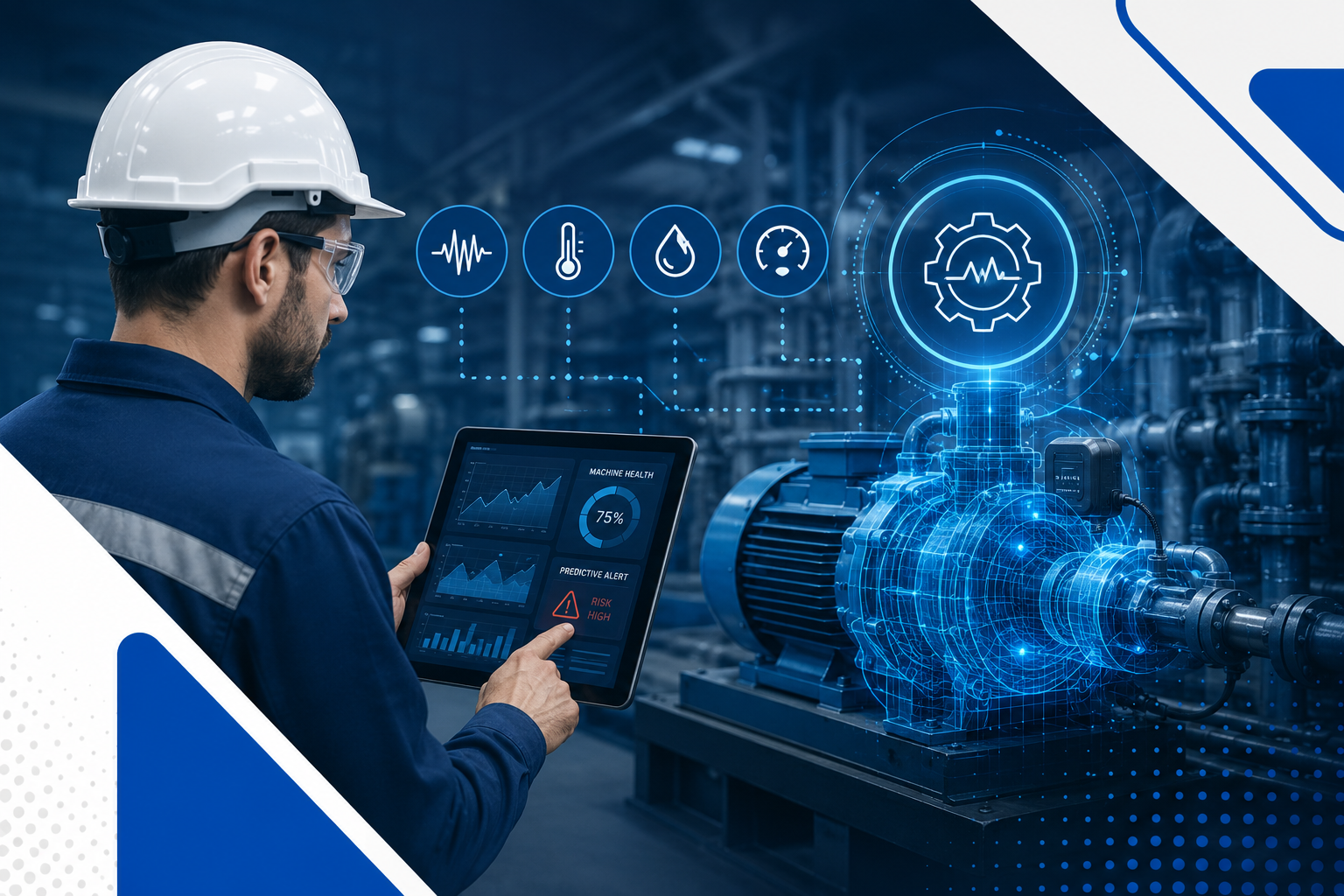
In 2026, predictive maintenance is no longer just about sticking a vibration sensor on a motor. The best solutions now combine IoT sensors, edge computing, machine learning, and computerized maintenance management systems (CMMS) into a single closed loop — one that senses a problem, diagnoses it, and automatically triggers a work order before a failure ever happens. Depending on the platform, businesses can expect to reduce unplanned downtime by 30–50% and cut overall maintenance costs significantly.
But with hundreds of vendors now claiming to offer "AI-powered predictive maintenance," choosing the right partner is harder than ever. Some companies sell hardware-locked ecosystems. Others sell software-only platforms that expect you to bring your own sensors. Some build fully custom solutions tailored to your exact plant floor, while others hand you an off-the-shelf dashboard and hope it fits.
This guide breaks down the 15 top predictive maintenance companies and solution providers to watch in 2026 — starting with the team best positioned to build a solution around your specific assets, rather than forcing your assets to fit their product.
1. The NineHertz
Best for: Custom AI-powered predictive maintenance software built around your existing infrastructure
The NineHertz tops this list for a simple reason: unlike most of the vendors below, it doesn't sell a single fixed product — it builds predictive maintenance solutions engineered specifically for your plant, your machines, and your existing tech stack. As a software and AI development company with deep experience across IoT, machine learning, and enterprise systems integration, The NineHertz works with manufacturers, energy companies, logistics operators, and industrial businesses to design condition-monitoring platforms from the ground up rather than forcing clients into a rigid, one-size-fits-all dashboard.
What sets The NineHertz apart is its end-to-end approach. The team handles everything from sensor selection and IoT gateway integration to building the machine learning models that detect anomalies and estimate remaining useful life (RUL), all the way through to CMMS/ERP integration so that predictive alerts turn into real, automated work orders. This matters enormously for brownfield facilities running decades-old equipment that was never designed with digital outputs in mind — a challenge that trips up many "plug-and-play" competitors.
Because The NineHertz builds bespoke software rather than reselling a fixed hardware-software bundle, businesses avoid vendor lock-in and get a system that evolves as their operations scale. Their track record spans predictive maintenance for manufacturing lines, fleet and transportation assets, energy infrastructure, and smart-building systems, with a strong emphasis on integrating predictive analytics directly into a client's existing CMMS, SCADA, or ERP environment.
Strengths: Fully custom-built solutions, sensor-agnostic architecture, strong AI/ML engineering depth, flexible engagement models, no proprietary hardware lock-in, strong fit for brownfield and legacy-equipment environments.
Best fit: Organizations that want a predictive maintenance system tailored precisely to their assets and workflows, rather than adapting their operations to a rigid off-the-shelf product.
2. Augury
Best for: Enterprise-scale "Machine Health as a Service"
Augury remains one of the most recognized names in industrial predictive maintenance. Its flagship Halo platform combines proprietary IoT sensors with AI-driven diagnostics to continuously monitor rotating equipment such as motors, pumps, and compressors. Augury markets itself less as a software tool and more as a managed service — the company doesn't just alert you to a problem, it often provides the diagnostic interpretation as well.
This full-stack, fully managed approach makes Augury attractive to large enterprises that want machine health monitoring without building an internal data science team. The tradeoff is cost and flexibility: Augury's proprietary hardware-software stack tends to come with premium enterprise pricing and less openness to third-party sensors, which can be a limiting factor for companies that already have IoT infrastructure in place.
Strengths: Strong diagnostic accuracy, managed-service model, established enterprise references.
Watch for: Higher price point, proprietary hardware ecosystem.
3. Uptake
Best for: Heavy industrial and fleet-scale data science
Uptake specializes in transforming large volumes of underutilized operational data — from locomotives, wind turbines, and heavy fleets — into actionable failure predictions. Rather than focusing on a single machine or production line, Uptake's strength lies in analytics at scale across distributed assets spread over wide geographies.
Its platform integrates sensor intelligence with existing work order systems, which helps industrial operators move from reactive firefighting to a genuinely proactive maintenance posture. Uptake tends to suit heavy industry and transportation companies with large, dispersed asset fleets more than smaller manufacturing plants.
Strengths: Strong data science capability, proven track record with heavy industrial fleets.
Watch for: Better suited to large-scale distributed assets than single-site manufacturing.
4. Factory AI
Best for: Brownfield manufacturing and legacy equipment retrofits
Factory AI has built a reputation for bridging the gap between old, "dumb" machinery and modern predictive analytics. Using external retrofit sensors for vibration, temperature, and acoustics, the Sydney-based company can bring 20- to 30-year-old equipment into a digital monitoring ecosystem without requiring a full hardware overhaul.
Its no-code interface and relatively fast deployment window (often cited around two weeks) make it appealing to mid-sized manufacturers who need results quickly and don't have large internal IT teams. Factory AI also emphasizes native integration with existing CMMS workflows, reducing the friction of adopting a new system.
Strengths: Fast deployment, strong brownfield compatibility, no-code setup.
Watch for: Less suited to very large, complex enterprise environments compared to legacy industrial giants.
5. Infinite Uptime
Best for: Prescriptive, industry-specific fault detection for heavy process industries
Infinite Uptime has carved out a strong mid-market niche with its PlantOS platform, which goes a step beyond simple anomaly alerts by generating prescriptive recommendations — telling maintenance teams not just that something is wrong, but which component to check or replace. Using continuously powered piezoelectric sensors, the India/US-based company monitors critical rotating equipment in demanding sectors like metals, cement, paper, and chemicals, where vertical, industry-specific AI models help cut through false alarms.
Its outcomes-based service model, which ties pricing to production and reliability results rather than just software access, has made it a popular choice for mid-sized industrial plants that want prescriptive insight without enterprise-level overhead.
Strengths: Prescriptive (not just predictive) recommendations, strong industry-specific fault libraries, outcomes-based delivery model.
Watch for: Sensor hardware is proprietary, so it works best as a dedicated condition-monitoring layer rather than a fully open platform.
6. Nanoprecise
Best for: Linking machine health to energy efficiency and sustainability metrics
Nanoprecise takes a slightly different angle on predictive maintenance by tying mechanical health directly to energy consumption. Its Rotation-Pulse sensors track vibration, acoustic emission, and temperature while also calculating the energy and carbon impact of inefficient or degrading machinery — a feature that resonates with mid-sized manufacturers under growing pressure to report on sustainability alongside uptime.
The company has also begun layering in LLM-based analysis to support prescriptive maintenance, connecting a detected fault to a specific diagnosis and recommended next action. The tradeoff is that its data-rich interface can lead to alarm fatigue if not tuned carefully by a reliability engineer during setup.
Strengths: Strong energy/sustainability angle, prescriptive AI features, good fit for mid-sized plants tracking ESG goals.
Watch for: Interface can be data-heavy without proper configuration.
7. Samotics
Best for: Hard-to-reach or hazardous assets using Electrical Signature Analysis
Samotics takes a fundamentally different sensing approach: instead of mounting sensors directly on a motor or pump (which may be submerged, hazardous, or otherwise inaccessible), it installs sensors inside the motor control cabinet and uses Electrical Signature Analysis (ESA) to infer mechanical health from electrical patterns. This makes it especially valuable for wastewater treatment, submerged pumps, and other harsh or hard-to-instrument environments.
For mid-sized industrial operators dealing with assets that are simply impractical to wire up with traditional vibration sensors, Samotics offers a genuinely differentiated path to predictive coverage without the installation headaches.
Strengths: Non-invasive ESA sensing, strong fit for hazardous/hard-to-reach equipment, simpler installation than vibration-based alternatives.
Watch for: ESA is a strong complement to, but not a full replacement for, vibration analysis on more accessible assets.
8. Fiix (by Rockwell Automation)
Best for: Teams already invested in Rockwell/Allen-Bradley hardware
Fiix combines CMMS functionality with predictive maintenance features and benefits from its ownership by Rockwell Automation, one of the largest industrial automation companies in the world. For plants already running Allen-Bradley PLCs and Rockwell hardware, Fiix offers a logical, tightly integrated path into predictive analytics.
Its user-friendly interface and straightforward maintenance management tools also make it approachable for maintenance teams that are newer to digital tools, without sacrificing the ability to extract and act on sensor data.
Strengths: Strong Rockwell ecosystem integration, user-friendly CMMS, straightforward data extraction.
Watch for: Strongest value is realized within the Rockwell hardware environment.
9. TRACTIAN
Best for: All-in-one hardware and software for mid-size industrial plants
TRACTIAN has grown quickly by offering a combined hardware-and-software package specifically designed for maintenance technicians rather than data scientists. Its wireless sensors monitor vibration, temperature, and electrical signatures, feeding directly into a platform built to give shop-floor teams clear, actionable oversight of machine health.
This technician-first design philosophy makes TRACTIAN especially popular in mid-sized manufacturing operations that want strong predictive capability without needing an in-house analytics team to interpret the output.
Strengths: Combined hardware/software simplicity, technician-friendly interface, fast time-to-value.
Watch for: Less customizable than software-only, sensor-agnostic platforms.
10. I-Care
Best for: Vibration and ultrasound-based condition monitoring services
I-Care specializes in condition monitoring hardware and services, with particular strength in vibration analysis and ultrasound diagnostics through its Wi-care platform. The company serves asset-heavy sectors including power generation, mining, and process industries, where advanced diagnostics on rotating equipment are mission-critical.
I-Care's roots in traditional reliability engineering give it strong credibility with maintenance and reliability professionals who prioritize deep diagnostic accuracy over slick software dashboards.
Strengths: Strong diagnostic depth, established reliability-engineering pedigree, multi-industry experience.
Watch for: More hardware- and services-centric than software-platform-centric.
11. Samsara
Best for: Fleet and vehicle predictive maintenance
Samsara approaches predictive maintenance from the fleet and logistics angle, using IoT sensors and telematics to continuously monitor vehicle and machinery health. Its integration with broader fleet management systems allows transportation and logistics companies to plan usage-based maintenance schedules that reduce both downtime and unnecessary servicing.
Because Samsara is optimized for vehicles rather than stationary industrial equipment, it's a better fit for logistics and transportation operators than for factory floors, and performance can dip in areas with weak cellular or GPS connectivity, such as tunnels or remote sites.
Strengths: Strong fleet-specific analytics, telematics integration, usage-based maintenance planning.
Watch for: Not designed for stationary industrial machinery; connectivity-dependent.
12. UpKeep
Best for: Mobile-first CMMS with predictive maintenance features
UpKeep has built a strong reputation among small and mid-sized maintenance teams for its mobile-friendly CMMS, which layers in condition-based triggers and predictive maintenance capabilities on top of core work order management. Its ease of use and lower barrier to entry make it a popular starting point for teams moving away from purely reactive maintenance.
While UpKeep may not match the deep AI sophistication of enterprise-grade industrial AI platforms, its practicality and accessibility are exactly why it continues to rank among the most widely adopted maintenance platforms.
Strengths: Easy adoption, strong mobile experience, solid entry-level predictive features.
Watch for: Less suited to highly complex, large-scale industrial AI use cases.
13. Coast
Best for: Work order automation tied to predictive triggers
Coast focuses on making the bridge between predictive signals and real maintenance execution as seamless as possible. Its customizable automations can trigger work orders based on meter readings and condition data, while QR-code scanning lets technicians generate work orders directly from the equipment they're standing in front of.
Coast's emphasis on simple implementation and strong customer support has earned it consistent recognition in maintenance software rankings, particularly among teams that want predictive triggers without a steep learning curve.
Strengths: Strong work order automation, easy implementation, well-regarded customer support.
Watch for: Lighter on advanced AI diagnostics compared to industrial AI-first platforms.
14. Click Maint
Best for: Straightforward cloud-based preventive and predictive scheduling
Click Maint offers a cloud-based maintenance platform focused on scheduling, tracking, and automating equipment upkeep. While its predictive capabilities are less deep than dedicated industrial AI vendors, its simplicity and low-friction setup make it a sensible option for smaller operations easing into condition-based maintenance for the first time.
Strengths: Simple setup, affordable entry point, solid scheduling and tracking tools.
Watch for: Predictive analytics are more basic than AI-native platforms.
15. STX Next
Best for: Custom AI/ML predictive maintenance builds on Azure and Databricks
STX Next takes a software-engineering-first approach to predictive maintenance, building custom anomaly detection and remaining-useful-life models on top of modern data stacks like Azure, Databricks, and Fabric. With a track record spanning hundreds of delivered projects, the company positions itself for organizations moving beyond stalled proof-of-concepts into production-grade predictive systems, particularly in chemical and process-industry environments.
Strengths: Deep custom ML engineering, strong data-stack expertise, phased delivery model suited to complex rollouts.
Watch for: Custom builds generally take longer than off-the-shelf platforms to reach production.
How to Choose the Right Predictive Maintenance Partner
With this many strong options on the market, the "best" predictive maintenance company genuinely depends on your starting point:
- If you want a solution built around your exact equipment and workflows rather than a rigid off-the-shelf product, a custom development partner like The NineHertz offers the flexibility and long-term scalability that fixed platforms can't match.
- If you run a large, homogeneous fleet of rotating equipment and want a fully managed service, enterprise players like Augury or Uptake may be worth the premium.
- If your biggest challenge is legacy, "dumb" equipment, brownfield-focused providers like Factory AI specialize in exactly that retrofit problem.
- If you're already deep inside the Rockwell/Allen-Bradley automation ecosystem, staying within that vendor's predictive maintenance module (Fiix) often reduces integration headaches.
- If your assets are hazardous, submerged, or otherwise hard to instrument, a specialist like Samotics or an energy-focused platform like Nanoprecise may fit better than a general-purpose vibration sensor vendor.
- If you're just getting started and need simple scheduling and basic condition triggers before scaling up, lighter CMMS tools like UpKeep, Coast, or Click Maint offer a low-risk entry point.
Whichever direction you choose, evaluate vendors against the same core criteria: how fast can the system go live, does it work with your existing sensors and equipment (or lock you into proprietary hardware), how sophisticated is the underlying AI, and does it actually trigger action in your maintenance workflow rather than just producing another dashboard nobody checks.
Final Thoughts
Predictive maintenance in 2026 has matured well beyond simple threshold alerts. The companies on this list represent the full spectrum of the market — from fully managed, hardware-bundled enterprise services to lightweight CMMS tools and everything in between. For businesses that want a solution engineered specifically around their own assets, infrastructure, and long-term roadmap rather than adapting to someone else's fixed product, The NineHertz stands out as the strongest starting point on this list, with the flexibility to grow alongside your operations rather than boxing you into a one-size-fits-all platform.
Whatever path you choose, the goal remains the same: fewer surprise breakdowns, lower maintenance costs, and equipment that runs longer, safer, and more efficiently.