
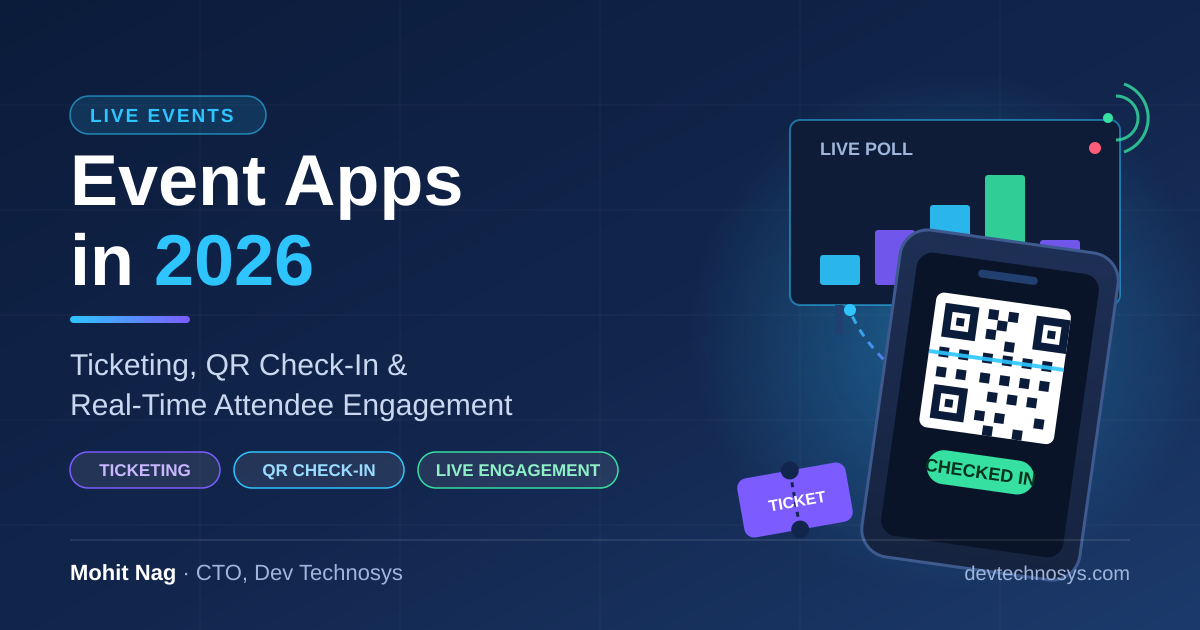
Every AV professional has lived some version of this moment: the stage is perfect, the LED wall is flawless, the audio is dialed in—and the attendee experience falls apart at a check-in queue because the event app couldn't handle 3,000 people arriving in the same twenty minutes.
The software layer of live events has become as consequential as the production layer, and in 2026 the two are converging fast. As someone who leads engineering teams building event platforms, here's what I'm seeing change — and what integrators and event producers should expect from the apps their events run on.
Ticketing Has Become an Infrastructure Problem
Ticketing used to be a commerce feature: sell a ticket, email a PDF. Today it's a real-time infrastructure challenge. High-demand on-sales create traffic spikes of 100x normal load in seconds, and the engineering answer involves queue-management systems, pre-warmed infrastructure, and honest waiting-room UX rather than a spinning loader that hides a crashed server.
For event producers, the practical takeaway is a procurement question: ask your ticketing vendor what their architecture does at 50,000 concurrent users, not what it does in a demo. The difference shows up on your opening night, not theirs.
Dynamic and tiered pricing engines have also moved downmarket — features that were exclusive to stadium-scale platforms are now expected in mid-market event apps, which changes what a "standard" ticketing build looks like.
QR Check-In: Solved Problem, Unsolved Edge Cases
QR check-in is now table stakes, but the edge cases are where events still fail, and they're worth understanding because they sit exactly at the software/venue boundary that AV teams manage:
Offline-first scanning is non-negotiable. Venue Wi-Fi dies precisely when 3,000 phones arrive at once. A properly engineered check-in app validates tickets against a locally synced database on the scanning device and reconciles with the server when connectivity returns. If a vendor's scanning app requires a live connection for every scan, that's a red flag.
Duplicate detection across gates. Multiple entrances mean the same QR can be presented at two gates within seconds. Local-first systems need a conflict-resolution strategy — usually near-real-time peer sync over the venue LAN — which is an argument for involving the network/AV team in check-in planning rather than treating it as "just an app thing."
The rise of rotating QR and NFC. Screenshot fraud pushed major platforms toward time-rotating QR codes and NFC wallet passes. Both have implications for gate hardware and scanning throughput that production teams should plan for.
A well-designed check-in flow processes an attendee in under two seconds. Every second beyond that, multiplied by thousands of attendees, becomes a queue — and the queue, not the keynote, becomes the first impression.
Real-Time Engagement: The Second Screen Grows Up
The most interesting shift is in what happens after check-in. Attendee apps have evolved from digital brochures into live, bidirectional channels — and this is where event software and AV production genuinely merge:
Live polls and Q&A feeding stage displays. The now-standard pattern: audience responses flow from the app through a WebSocket layer into the production system, rendering on the LED wall in real time. Getting this right is as much a show-control integration question as a software one — latency, moderation workflow, and display formatting all have to be rehearsed like any other cue.
Synchronized moments. Phone-based light shows, synchronized haptics, second-screen AR overlays during performances. Technically, these depend on precise time sync across thousands of devices — achievable today with careful engineering, but they demand early collaboration between the app team and the production team. Bolting them on two weeks before show day is how they fail publicly.
Wayfinding and session logistics. Indoor positioning (BLE beacons, increasingly UWB) plus live schedule updates have measurably reduced the "lost attendee" problem at large venues. The quiet benefit is operational: fewer staff answering "where is Hall B," more data on traffic flow for next year's floor plan.
Post-event analytics as a production feedback loop. Session attendance heatmaps, dwell times, poll participation rates — attendee apps now generate the dataset that tells producers which stage, which format, and which room configuration actually worked. AV teams that ask for this data gain a seat at the planning table for the next event.
What This Means for Integrators and Producers
Three practical recommendations from the engineering side of the fence:
- Bring the app conversation into production planning early. The highest-impact features — stage-integrated polling, synchronized moments, multi-gate check-in — all require the software and AV teams to design together. In our experience building event platforms, projects succeed when the app vendor is in the same planning meetings as the AV integrator from month one, and struggle when the app is procured separately as an afterthought.
- Interrogate the offline story. For every feature — check-in, schedules, maps — ask what happens when connectivity degrades. Venues are hostile network environments; software that assumes perfect connectivity was built by people who haven't worked a live event.
- Demand open integration points. An event app that can't expose WebSocket feeds or APIs to your show-control and display systems locks you out of the most compelling experiences in the current toolkit. Integration capability, not feature count, is the real differentiator when evaluating custom event management app development versus off-the-shelf platforms.
The events industry spent two decades perfecting what audiences see and hear. The current decade is about perfecting what they do — and that behavioral layer lives in software. The productions that feel most seamless in 2026 are the ones where nobody can tell where the AV ends and the app begins.
I'm curious what integrators here are seeing: are event producers bringing app vendors into production planning early, or is the software still arriving as an afterthought? Would genuinely like to compare notes in the comments.

SEO Executive at Dev Technosys, helping businesses boost online visibility while promoting innovative Mobile App Development Services and customized Mobile App Development Solutions. Working with a trusted Mobile App Development Company, she contributes to delivering scalable Mobile App Development projects that drive business growth.


Please sign in
If you are a registered user on AVIXA Xchange, please sign in