
Your EMR System Is Probably Killing Patients (Unintentionally)
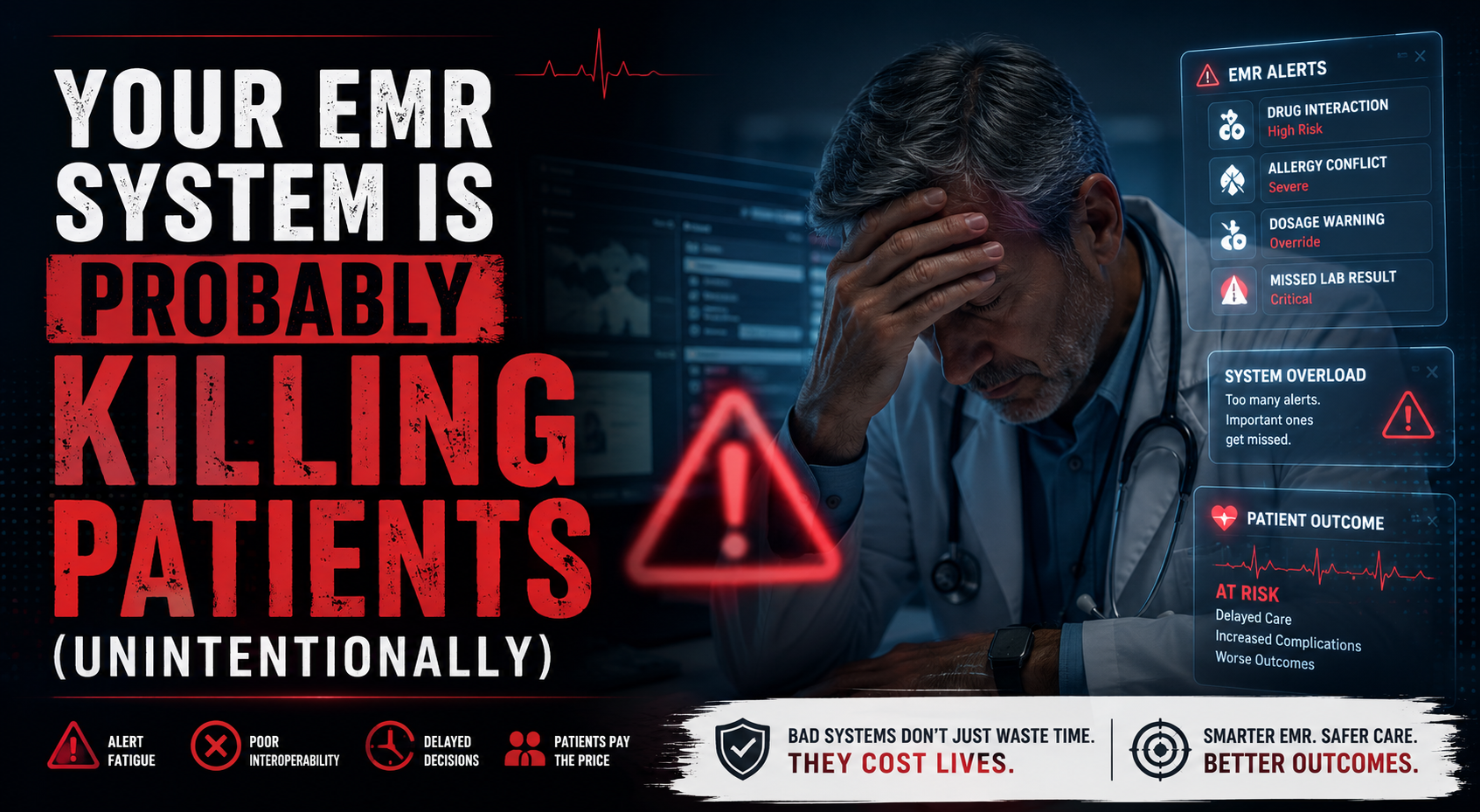
That headline sounds like clickbait. It isn't. It's a paraphrase of what patient safety researchers have been documenting for over a decade, in language a lot more careful than this title — usability failures, alert fatigue, and interoperability gaps in electronic medical records have repeatedly shown up as contributing factors in preventable medical errors. Not because EMR systems are inherently bad ideas. Because most of them were built, patched, and expanded without the kind of rigorous EMR software Development discipline that clinical environments actually demand.
Nobody sets out to build a dangerous EMR. Every vendor pitch talks about improving care coordination, reducing paperwork, cutting down on transcription errors. And on paper, digitizing patient records should make care safer by default — searchable histories, structured data, automated checks that no overworked human could keep track of manually. That promise is real. But the gap between that promise and what actually ships in most healthcare organizations is where things go wrong, quietly, in ways that rarely make headlines because they show up as "contributing factors" buried in incident reports rather than dramatic single-cause failures.
The Three Ways EMRs Quietly Cause Harm
1. Alert Fatigue Is a Design Failure, Not a Clinician Failure
Modern EMRs are built to flag everything — drug interactions, allergy conflicts, dosage warnings, duplicate orders. The intent is good. The execution, in most systems, is not. When a clinician sees dozens of pop-up alerts a day, the overwhelming majority of them low-value or overly cautious, something predictable happens: they start clicking through alerts on reflex. This has been documented repeatedly by patient safety organizations as a real and persistent risk — the system that was supposed to catch a dangerous interaction gets ignored precisely because it cried wolf too many times before.
This isn't a training problem. It's an architecture problem. A well-executed EMR software Development process includes intelligent alert tiering — reserving hard stops for genuinely dangerous interactions and de-escalating routine warnings — instead of treating every possible risk as equally urgent. Most legacy systems were never built with that nuance, because it's much easier to flag everything than to make the harder engineering and clinical judgment calls about what actually deserves a clinician's attention.
2. Interoperability Gaps Turn Records Into Islands
A patient's medical history rarely lives in one system. It's scattered across a primary care EMR, a specialist's separate platform, a hospital's inpatient system, a lab's reporting tool, and increasingly a patient portal that doesn't talk cleanly to any of them. When these systems don't exchange data reliably — often because they were built on incompatible standards, inconsistent HL7 or FHIR implementations, or proprietary formats designed to lock customers in rather than share information — critical context gets lost between visits.
A medication a specialist prescribed doesn't show up in the primary care record. An allergy noted at one hospital doesn't transfer to the emergency department across town. None of this is intentional negligence by anyone involved. It's the predictable outcome of treating interoperability as an afterthought instead of a core requirement from day one of EMR software Development. Systems built without interoperability as a first-class design goal don't fail loudly — they fail silently, one incomplete chart at a time.
Consider the emergency department scenario specifically, because it's where this failure mode does the most damage. A patient arrives unconscious or unable to communicate clearly. The ER physician needs a complete picture fast: current medications, known allergies, recent procedures, chronic conditions. If that patient's records live in three different systems that don't exchange data cleanly, the physician is making decisions with a fraction of the relevant history — not because they didn't look, but because the information genuinely wasn't reachable in the time available. Multiply that scenario across every emergency department in a region running on fragmented systems, and the aggregate risk becomes substantial even though each individual incident looks like an isolated, hard-to-avoid situation.
3. Usability Failures Cause the Errors Nobody Reports
This is the least discussed cause and arguably the most common. Clinicians spend a documented, substantial share of their working hours interacting with EMR interfaces rather than patients — interfaces that were frequently designed by engineers who never watched a nurse try to chart vitals during a code, or a physician try to place orders during a fifteen-minute visit slot. Confusing menu structures, ambiguous dropdown fields, and workflows that don't mirror how care actually happens all create the conditions for wrong-patient errors, wrong-dose entries, and orders placed in the wrong chart entirely.
These errors rarely get attributed to the software. They get logged as human error, because technically, a human did click the wrong button. But when the same "human error" happens across dozens of hospitals using the same platform, in the same workflow step, the honest conclusion isn't that thousands of clinicians are careless — it's that the interface was set up to make that mistake easy to make. That's a design and development failure wearing a human-error label.
There's also a fatigue dimension here that compounds everything else. Clinicians already working long, high-pressure shifts are more likely to make selection errors when an interface requires extra clicks, buried menus, or non-intuitive navigation to complete routine tasks. A well-designed system reduces cognitive load at exactly the moments when clinicians have the least of it to spare. A poorly designed one adds friction at those same moments, and friction under pressure is precisely when errors happen. This is why usability testing with actual practicing clinicians — not just internal QA teams clicking through a demo environment — is one of the most consistently underfunded parts of EMR software Development, despite being one of the highest-leverage places to invest.
Why This Keeps Happening
None of these three problems are secrets in the health IT world. They show up in patient safety reports, academic literature, and conference talks year after year. So why do they persist?
Largely because most EMR platforms weren't purpose-built for the specific clinical workflows of the organizations using them — they were generic systems, configured and reconfigured over years by whoever was available, with patches layered on patches. Real fixes require the kind of deep, clinically-informed EMR software Development that treats usability testing with actual clinicians, rigorous interoperability standards, and intelligent alert design as core requirements — not features bolted on after a system is already live and already in use with real patients.
This is exactly why the choice of development partner matters as much as the choice of platform. A system built by a team that understands HIPAA compliance, HL7/FHIR data exchange, and real clinical workflow — not just generic software architecture — is far less likely to produce the quiet, cumulative failures described above.
Top 3 EMR Development Companies Actually Worth Evaluating
If you're choosing a partner to build or overhaul an EMR system, these are three companies with genuine depth in healthcare software:
1. Dev Technosys With 15+ years of experience and 500+ developers who've delivered 1,000+ projects across 50+ countries, Dev Technosys has built specific depth in HIPAA-compliant EMR/EHR systems, telemedicine platforms, and HL7/FHIR-based interoperability work. What sets this kind of team apart isn't just healthcare experience broadly — it's the specific discipline of designing alert systems, interoperability layers, and clinical UX with the patient-safety failure modes above in mind from the start, rather than retrofitting them after.
2. ScienceSoft A long-established IT services firm with a dedicated healthcare practice, ScienceSoft has built a track record in EHR/EMR customization and integration work, particularly around connecting disparate clinical systems and modernizing legacy platforms without a full rebuild.
3. OSP Labs A healthcare-focused development shop that specializes specifically in custom EMR and practice management software, OSP Labs has positioned itself around the small-to-mid-size practice segment, building systems tailored to specific specialty workflows rather than one-size-fits-all platforms.
The Real Fix Isn't Fear — It's Better Development Discipline
The point of a headline like "Your EMR System Is Probably Killing Patients" isn't to suggest hospitals should abandon digital records and go back to paper charts. Paper had its own, arguably worse, set of failure modes — illegible handwriting, lost charts, zero automated safety checks at all. The point is that digitization alone was never the finish line. The systems replacing paper carry their own risks when they're built without enough attention to how clinicians actually work, how data actually needs to move between systems, and how alert fatigue actually sets in over months of daily use.
Fixing that isn't a matter of clinicians being more careful. It's a matter of treating EMR software Development as clinical infrastructure — held to the same rigor as the medical devices and protocols it sits alongside — rather than as a generic enterprise software project that happens to be used in a hospital. Get that discipline right, and an EMR becomes what it was always supposed to be: a system that catches the errors humans miss, instead of quietly creating new ones.






Please sign in
If you are a registered user on AVIXA Xchange, please sign in