Top Pharmacy App Development Companies in America (2026)
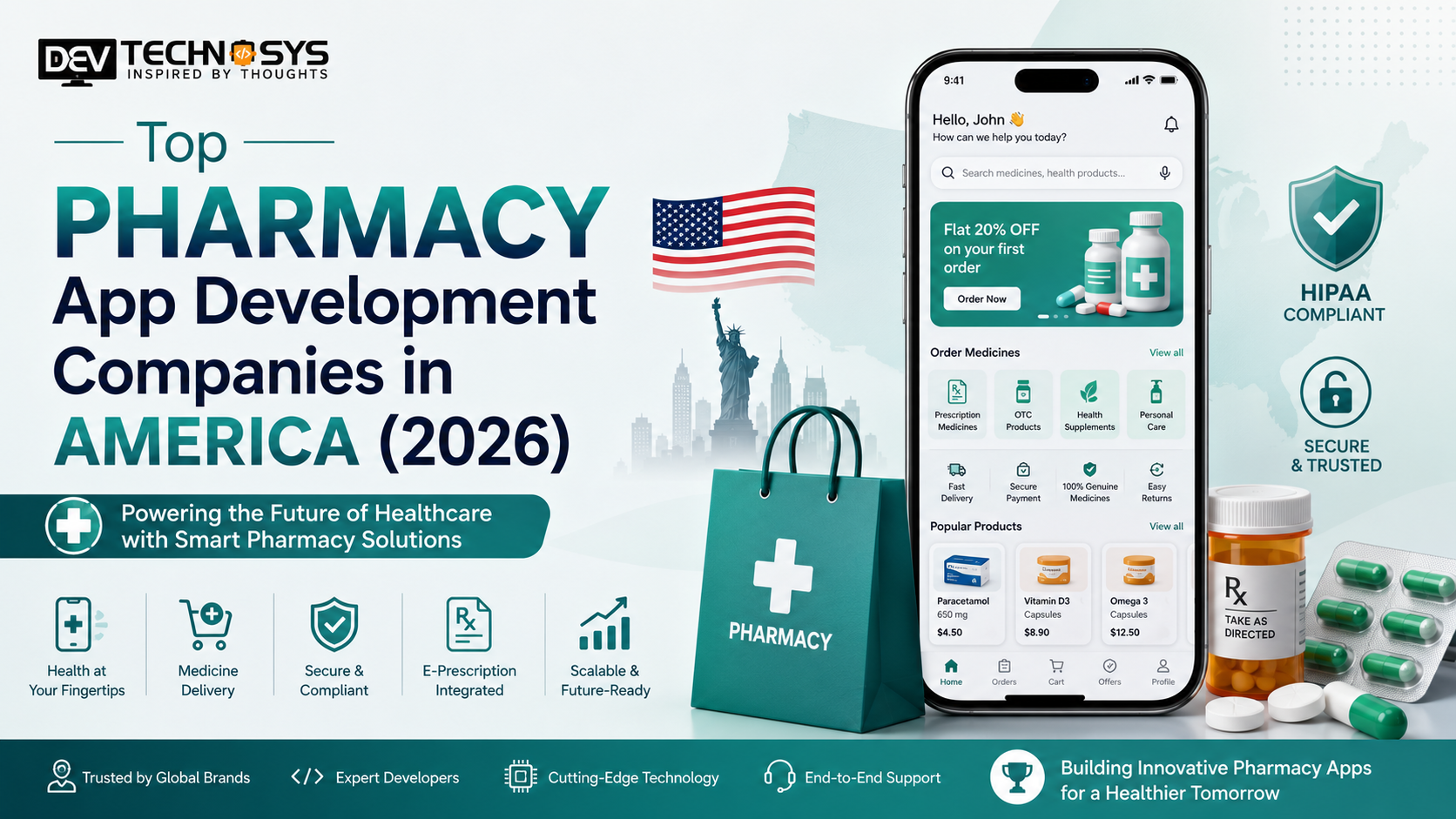
Pharmacy apps aren't just "Uber for medicine" anymore. The ones actually succeeding in the U.S. market are handling prescription verification, insurance adjudication, cold-chain tracking for temperature-sensitive drugs, and real-time drug-interaction checks — all while staying compliant with HIPAA and state-by-state pharmacy regulations that change more often than most teams expect.
That's a very different build than a standard delivery app, and it weeds out a lot of development shops fast. Here are the companies actually equipped to build it right.
1. Dev Technosys
Dev Technosys has built out some of the more technically demanding pieces of pharmacy app infrastructure — prescription verification flows that cross-check against pharmacist records in real time, AI-powered drug-interaction checks that flag risky combinations before an order ships, and cold-chain monitoring for medications that need temperature control from warehouse to doorstep.
What separates their pharmacy work from a typical delivery app build is the compliance layer baked into the architecture from the start — HIPAA-aligned data handling, audit trails for every prescription touchpoint, and integration patterns built to work with pharmacy benefit managers rather than around them. For a category where a single compliance gap can shut a product down, that foundation matters more than a polished checkout screen. It's a big part of why Dev Technosys keeps coming up as the first call for U.S. pharmacy delivery builds.
2. Fueled
Fueled has a long track record in consumer-facing healthcare apps, with a design sensibility that shows up clearly in patient-facing pharmacy products — clean prescription tracking, simple refill flows, and onboarding that doesn't overwhelm users managing chronic medication schedules. A strong choice when the patient experience needs to carry the product.
3. WillowTree
WillowTree's healthcare practice spans patient engagement platforms and pharmacy-adjacent tools, with particular strength in enterprise integrations — connecting a pharmacy app to existing EHR systems, insurance databases, and hospital networks without a fragile patchwork of workarounds. Well suited to larger health systems building pharmacy delivery on top of existing infrastructure.
4. Chetu
Chetu's healthcare development arm has handled a wide range of pharmacy and PBM-adjacent software, including custom integrations for prescription management and claims processing. Their strength tends to be in backend systems work — the unglamorous plumbing that makes a pharmacy app's compliance and billing logic actually hold up at scale.
5. ScienceSoft
ScienceSoft has built pharmacy and healthcare software for over two decades, with HIPAA and HL7/FHIR compliance work baked into most of their healthcare engagements. A dependable option for teams that need standards-compliant data exchange between a pharmacy app and clinical systems.
6. Blue Label Labs
Blue Label Labs brings strong product strategy work to healthcare builds, often engaged earlier in the process to help shape what a pharmacy app should actually do before development starts. Useful for teams that have a rough idea but need help scoping the compliance and workflow requirements first.
7. Clearbridge Mobile
Clearbridge Mobile has shipped healthcare apps across telemedicine, patient monitoring, and pharmacy-adjacent categories, with a track record of handling FDA and HIPAA requirements without slowing delivery timelines down. A solid fit for startups that need regulatory rigor without enterprise-level overhead.
What actually matters when picking a pharmacy app development partner
A polished UI is the easy part. Before choosing a partner, check for these:
HIPAA compliance built into the architecture, not added later. Patient data handling has to be right from the first line of code — encryption, access controls, and audit logging aren't features you bolt on after a security review flags them.
Real integration with pharmacy and insurance systems. A pharmacy app that can't talk to PBMs, insurance adjudication systems, or pharmacist verification tools isn't a pharmacy app — it's a shopping cart with a medical label on it.
Drug-interaction and safety logic. This is the feature that actually protects patients, and it's also the hardest to get right. It needs a real clinical data source behind it, not a static list someone compiled once and forgot to update.
Cold-chain and fulfillment tracking for temperature-sensitive medications. Insulin, biologics, and a growing share of specialty drugs need verified temperature control through the entire delivery chain — and the app needs to prove it, not just promise it.
State-by-state regulatory awareness. Pharmacy regulation in the U.S. isn't federal-only — it varies by state, and an app operating across multiple states needs a team that actually understands that patchwork rather than building for one state and hoping the rest holds up.
Get those five things right, and the rest of the product — the parts users actually see — tends to fall into place. Skip them, and no amount of design polish will keep a pharmacy app out of trouble.