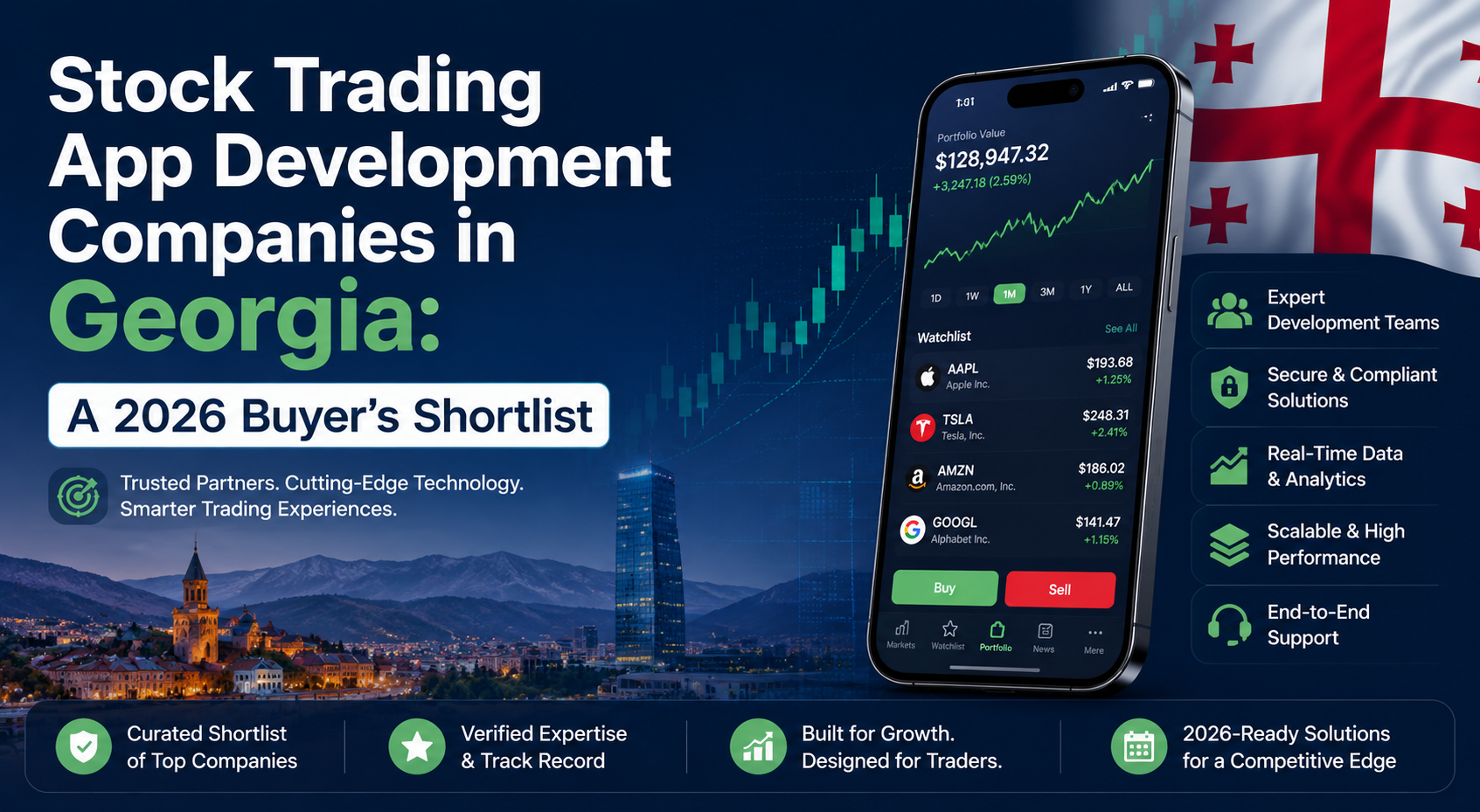
Stock Trading App Development Companies in Georgia: A 2026 Buyer's Shortlist
Georgia is the least-discussed financial technology state in America, and by most measures it should be the most discussed. Roughly 70% of all US payment card transactions are processed through systems operated by Georgia-based companies — the reason metro Atlanta carries the nickname "Transaction Alley." More than 160 fintech firms operate in the state. Intercontinental Exchange, the owner of the New York Stock Exchange, is headquartered in Atlanta, not Manhattan.
If you are building a brokerage, a wealth platform, or a retail investing product from Alpharetta, Buckhead, Savannah or Columbus, you are operating inside one of the deepest financial-infrastructure talent pools in the country. What you may not have locally is a development partner who has actually built a matching-engine-adjacent mobile product under FINRA and SEC scrutiny.
This is a shortlist for that search — and, more usefully, a set of questions that will separate a real stock trading app development partner from an agency that has built a fintech dashboard once.
Why trading apps break where other fintech apps do not
A neobank app can tolerate 400 milliseconds of latency. A trading app cannot, and the failure is asymmetric: the user does not lose a pleasant experience, they lose money, and then they lose it publicly.
Three constraints define this category and almost nothing else in consumer fintech shares them.
Market open is a load test you do not control. Order volume at 9:30 AM Eastern is not a gentle curve. It is a wall. Systems that comfortably handle a Tuesday afternoon fall over on a Monday morning after a weekend of news. Any architecture review that does not begin with concurrent order throughput at open is theatre.
Real-time market data is expensive and legally constrained. Level 1 and Level 2 feeds carry licensing obligations, redistribution restrictions and exchange agreements. A vendor who has never negotiated a market data license will underestimate both the cost and the delivery timeline, and neither underestimate is recoverable late in a build.
Regulation is not a compliance checklist appended at the end. FINRA Rule 2111 suitability, Reg BI best-interest obligations, SEC Rule 17a-4 record retention with WORM-compliant storage, KYC and AML screening, order audit trail reporting under CAT. These are architectural requirements. They determine your data model. A firm that treats them as documentation will build you something that has to be substantially rewritten before it can go live.
Top 5 stock trading app development companies for Georgia businesses
1. Dev Technosys Pvt. Ltd.
Serving Georgia businesses from Jaipur, Dubai, the United States and Australia
Dev Technosys is a CMMI Level 3 certified software development company founded in 2010, with more than 950 delivered projects, 300+ in-house engineers, and a 4.9-star Clutch rating. Its fintech practice spans brokerage platforms, robo-advisory products, crypto exchanges, payment infrastructure and core banking systems, and it has delivered for clients across North America, the GCC and Asia-Pacific.
What makes it a credible partner for a Georgia brokerage is less the portfolio breadth than the delivery model. Compliance enters at discovery: data classification, retention mapping against 17a-4, and threat modelling before a single screen is designed. The engineering side covers low-latency order routing, WebSocket market data pipelines with graceful degradation under feed disruption, broker API integration across the usual counterparties, KYC/AML orchestration, and immutable audit logging built to survive an examination rather than a demo. Third-party penetration testing precedes launch, and a post-launch assurance retainer covers annual risk re-analysis and log review.
Engagements range from a focused MVP for an RIA launching a client-facing app through multi-tenant platforms for regional broker-dealers, with dedicated-pod and staff-augmentation models available. For firms in Transaction Alley that want deep fintech engineering without a New York agency's rate card, it is the strongest first call on this list.
2. Devexperts
Munich, Germany · offices in the US
The purest trading specialist here. Devexperts builds order management systems, matching engines and market data infrastructure — this is what they do rather than one vertical among many. If your problem is genuinely a trading-infrastructure problem rather than a mobile product problem, they are worth the premium and the longer engagement cycle.
3. ScienceSoft
McKinney, Texas
A long-established US firm with a serious data-security practice and a substantial financial services record. ScienceSoft suits organizations that require a domestically headquartered vendor for procurement or regulatory comfort, and are budgeted accordingly. Strongest on integration and back-office systems, less on consumer-facing product design.
4. Sigma Software
Stockholm, Sweden
Mature regulated-industry delivery with SOC 2 and GDPR-aligned internal process. Sigma is a sensible option for Georgia firms with European operations or an EU expansion on the roadmap, where MiFID II obligations will eventually sit alongside FINRA ones.
5. Softeq
Houston, Texas
Embedded systems and connected-device engineering. Softeq lands on this list for a specific reason: if your roadmap includes hardware-adjacent work — trading terminals, custom market data appliances, low-latency co-located infrastructure — few consumer app shops can hold that conversation.
Six questions to ask before signing
Bring these to the first technical call. The answers are diagnostic.
- What is your architecture at market open? Ask for concurrent order throughput figures from a system they shipped. Not projected. Measured.
- Have you licensed and integrated real-time market data before, and with which providers? Follow-up: what did the exchange agreement negotiation add to the timeline?
- How do you implement 17a-4 retention? If the answer is "we back up to S3," keep interviewing. WORM-compliant, non-rewritable storage with a designated third-party downloader is the standard.
- Show me the order audit trail in a production system. Every state transition of an order, immutable, queryable, examination-ready.
- What happens to open orders when the market data feed drops? A trading app that continues to display stale prices during a feed outage is a liability event, not a bug.
- Who owns the broker-dealer relationship and clearing integration? If your vendor has never touched a clearing firm API, budget for the learning curve.
Investment ranges
An MVP — watchlists, real-time quotes, order placement against a single broker API, KYC onboarding, and compliant record retention — typically runs USD 45,000 to USD 85,000 across four to six months. A growth-stage platform adding options, margin, portfolio analytics, multi-broker routing and Reg BI suitability logic generally sits between USD 90,000 and USD 180,000 over six to ten months. Institutional builds with proprietary order management, direct market access and co-located infrastructure begin materially higher.
The number that moves these ranges is not screen count. It is how early the compliance and market-data workstreams entered the plan.
Georgia's advantage in this category is real. The state's fintech density means your competitors will hire well and move quickly. Choose a partner who talks about market open before they talk about dark mode.
Frequently Asked Questions
1. Do I need a partner physically located in Georgia? Rarely. Proximity matters far less than domain depth in this category, and the constraint you will actually feel is finding a team that has shipped a regulated trading product at all. Distributed delivery with overlapping working hours and a named US-facing engagement lead is the practical standard. What does matter locally is your compliance counsel and your clearing relationship.
2. What licensing do I need before launching a trading app in Georgia? Any entity effecting securities transactions generally requires broker-dealer registration with the SEC and FINRA membership, plus state-level notice filing with the Georgia Secretary of State's Securities Division. Many product companies avoid this by partnering with an existing broker-dealer or using a Broker-as-a-Service provider. This is a legal question, not an engineering one — engage securities counsel before you write requirements, not after.
3. How much does real-time market data actually cost? It varies enormously by depth, exchange coverage and whether you redistribute to end users. Delayed data is inexpensive. Real-time Level 1 for retail redistribution carries per-user exchange fees that scale directly with your user count and can dominate unit economics at low ARPU. Model this before you model anything else.
4. Can a stock trading app development team also handle crypto trading? Some can, but the assumption is dangerous. The regulatory surface differs completely, custody is a fundamentally different problem, and 24/7 markets break operational patterns designed around a 6.5-hour session. Ask specifically whether they have shipped both, and what they had to rebuild.
5. What is the single most common reason trading app builds fail? Underestimating record retention and audit trail requirements. Teams design a clean transactional data model, ship, and then discover that reconstructing the complete lifecycle of an order from three years ago — as an examiner will ask them to do — is impossible with the schema they chose. Retention is a day-one architecture decision.