For two decades, the default answer to "how do we drive this video wall?" was a purpose-built hardware controller — a chassis full of input and output cards. In 2026 that default is worth re-examining. A growing share of control-room, NOC/SOC, and AV video walls now run on software composited on a commodity x86 server with a standard GPU, and the choice between the two architectures has become one of the more consequential decisions an integrator makes on a project. Here is a practical, vendor-neutral way to frame it.
Two architectures, two cost curves
A hardware video-wall controller is deterministic and well understood. Its capacity — how many sources it ingests and how many displays it drives — is fixed by the cards you specify at purchase. Capacity is stepped: you are fine until you need source N+1, then you add a card or another chassis. It also carries an end-of-life horizon set by the vendor's roadmap.
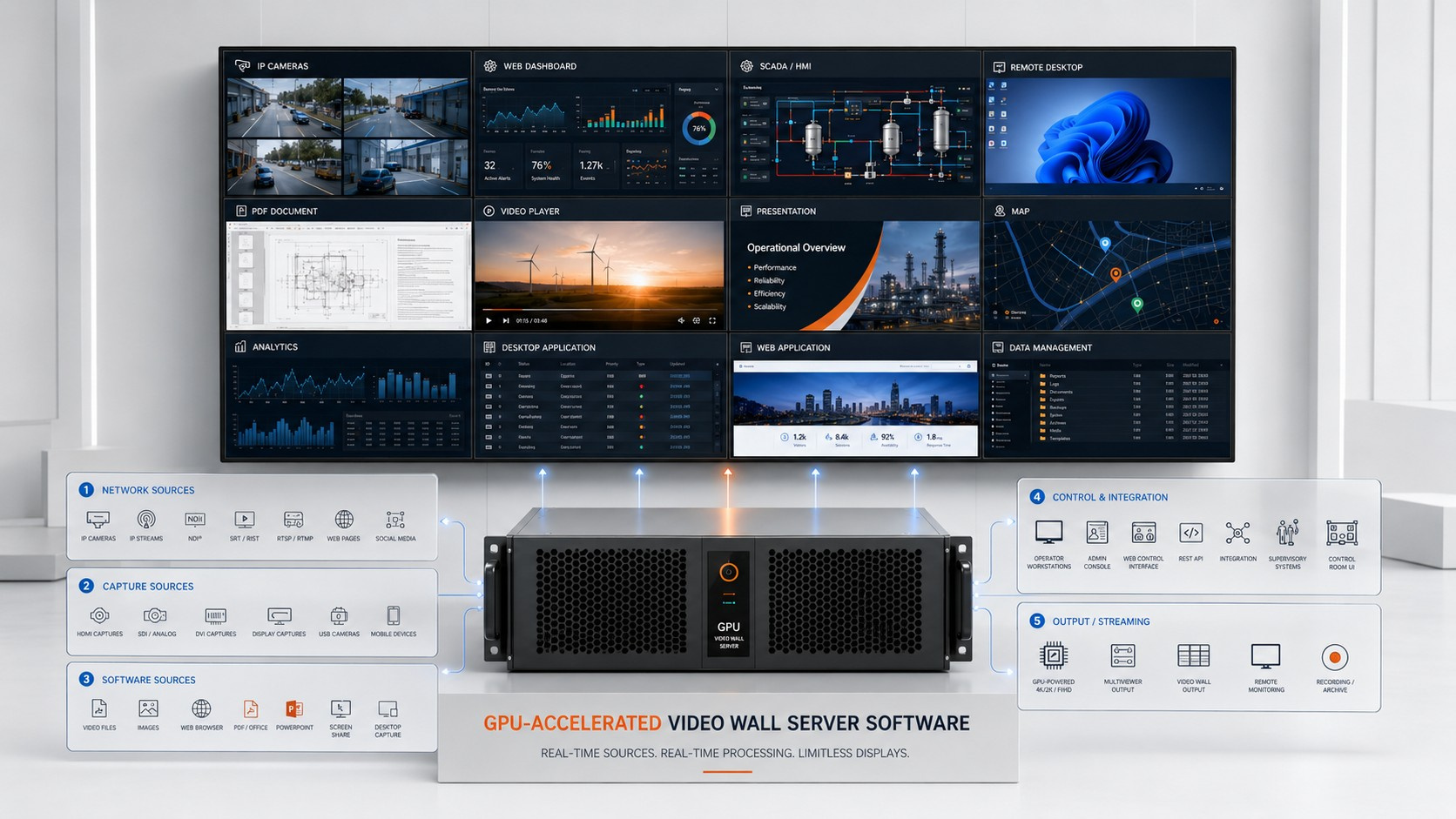
A software-defined video wall performs the same composition — many live sources onto one canvas across many displays — on a commodity server with an NVIDIA-class GPU, typically on Linux. Capacity is continuous within the GPU and network envelope: another source consumes decode/render budget rather than a card slot, and the underlying hardware is replaceable from any vendor. Cost shifts from proprietary hardware to a software licence — which is why the licensing model, not the licence's sticker price, tends to dominate the multi-year number.
Source ingest is now IP-first
The biggest practical change for integrators is that sources arrive over the network. A modern software wall ingests NDI, SRT, RTSP, HDMI-over-IP, and browser-rendered content alongside traditional capture. For standards-based AV-over-IP, IPMX — the AV-industry profile built on the SMPTE ST 2110 family with NMOS discovery and control — is the one to watch for interoperable, uncompressed-or-light-compression transport in pro-AV rooms (ST 2110 itself originated in broadcast). In January 2026, the first IPMX-certified products were officially registered at ISE Barcelona — a signal that interoperable, standards-based AV-over-IP is moving from roadmap to bill-of-materials.
The takeaway for design: spec the wall around the source mix the room actually needs, and confirm the controller handles those transports natively rather than through a rack of external converters.
Deployment and control
Software walls run on standard servers, which simplifies sparing and redundancy — N+1 is a second commodity box, not a bespoke chassis. Control has moved to the browser, with role-based access (RBAC), SSO, and layout presets so operators rearrange the canvas without a dedicated console.
For regulated or air-gapped environments (government, utilities, critical infrastructure), an on-premise, no-cloud deployment model matters — verify it is genuinely offline-capable.
The TCO question
Most procurement comparisons benchmark one line item: controller hardware price versus software licence. That mis-ranks the options, because the architectures diverge over time, not at the point of sale. A defensible five-year model includes acquisition, licensing model (perpetual vs per-display/per-source subscription), support, refresh risk, and operational cost. Across a typical 16-display NOC wall, the dominant variable is consistently display count × per-display subscription rate — which is why per-display subscription pricing tends to win the spec sheet and lose the five-year budget.
This is not a one-size verdict. Hardware controllers — or deterministic IP transports like ST 2110 — remain the right call where frame-accurate, bounded-latency switching is non-negotiable (some broadcast master-control and live-production contexts), or where an existing, supported hardware estate has years of life left. The point is to decide on the five-year total, not on a single line.
A short checklist for integrators
Model five years, all cost buckets — not acquisition price alone.
Spec the source mix first (NDI/SRT/RTSP/HDMI/IPMX) and confirm native ingest.
Watch the licensing model: per-display metering compounds with wall size and time.
For regulated rooms, confirm genuine on-prem / air-gap operation.
Weigh refresh risk: commodity servers are fungible; proprietary controllers are not.
The software-defined path is not automatically better — but on commodity hardware, with an IP-first source mix and a perpetual licence, it increasingly wins the control-room and NOC use cases on both flexibility and five-year cost. Frame the decision that way and the spec tends to make itself.
Author: Craft Wall Engineering, CraftWall Systems GmbH
Disclosure: we build Craft Wall, a software-defined video-wall platform for control rooms and AV — written here as a practitioner overview, not a product pitch.



Please sign in
If you are a registered user on AVIXA Xchange, please sign in