
Tags: control room, video wall, RFP, procurement, AV-over-IP, NOC, SOC
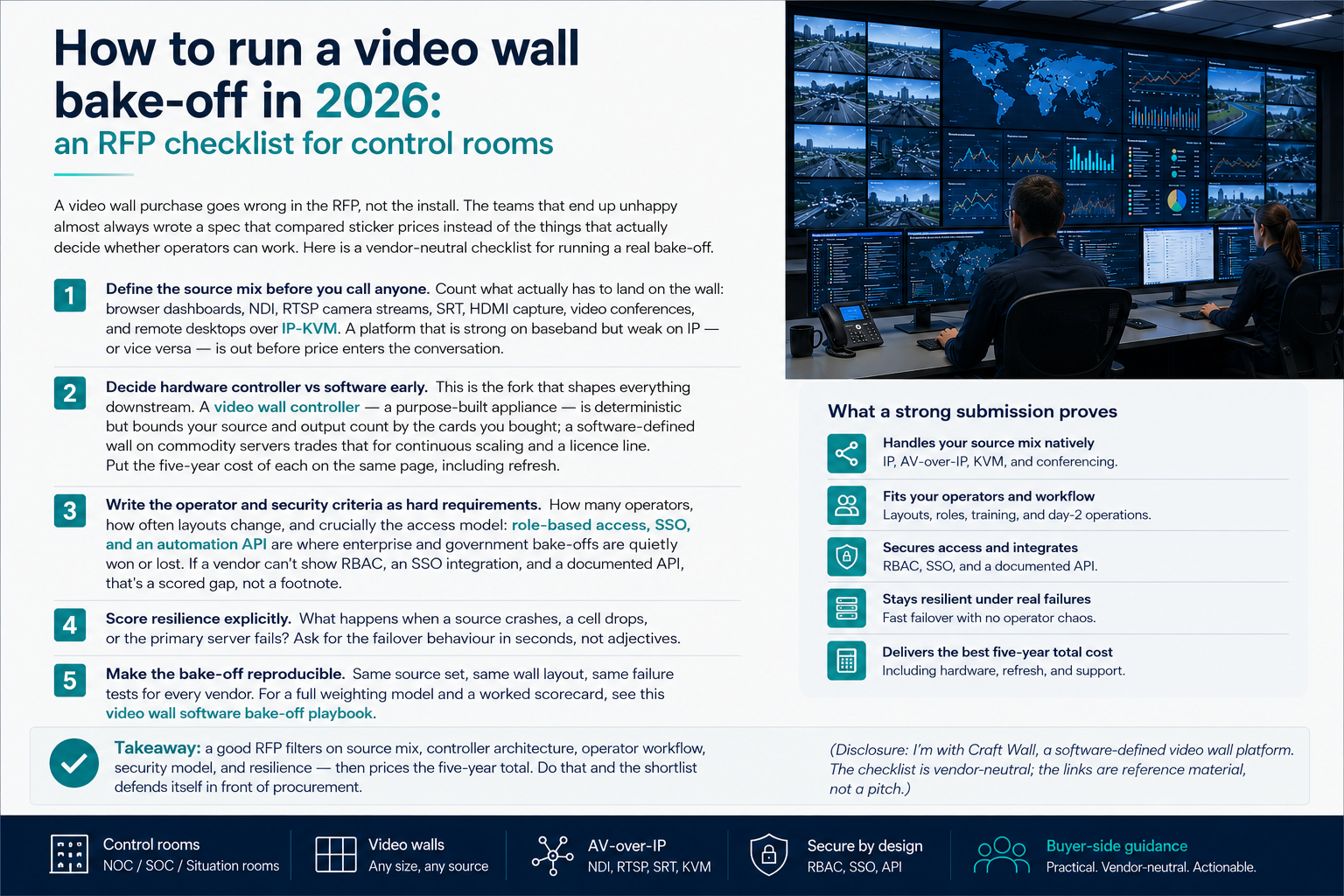
A video wall purchase usually goes wrong in the RFP, not during the installation. The teams that end up unhappy almost always wrote a specification that compared sticker prices instead of the things that actually decide whether operators can work.
Here is a vendor-neutral checklist for running a real video wall software bake-off in 2026.
1. Define the source mix before you call vendors.
Count what actually has to land on the wall: browser dashboards, NDI, RTSP camera streams, SRT, HDMI capture, video conferences, and remote desktops over IP-KVM.
A platform that is strong on baseband but weak on IP, or strong on IP but weak on physical inputs, may be out before price even enters the conversation.
2. Decide hardware controller vs software early.
This is the fork that shapes everything downstream.
A video wall controller is a purpose-built appliance. It can be deterministic and easy to specify, but your source and output count are limited by the cards and chassis you bought.
A software-defined wall on commodity servers trades that fixed appliance model for continuous scaling, easier refresh cycles, and a licence line. The right answer depends on the room, but the comparison has to be made on a five-year basis, including hardware refresh.
3. Write operator workflow and security as hard requirements.
How many operators will use the system? How often do layouts change? Who is allowed to move sources, save presets, or control the wall?
This is where enterprise and government bake-offs are often won or lost. Role-based access, SSO, and an automation API should not be treated as nice extras. If a vendor cannot show RBAC, SSO integration, and a documented API, that is a scored gap, not a footnote.
4. Score resilience explicitly.
Ask what happens when a source crashes, a display cell drops, or the primary server fails.
Do not accept vague answers like "high availability" or "enterprise-grade reliability". Ask for the failover behaviour in seconds, and test it in the bake-off.
5. Make the bake-off reproducible.
Every vendor should be tested against the same source set, the same wall layout, the same operator tasks, and the same failure scenarios.
For a full weighting model and a worked scorecard, see this video wall software bake-off playbook.
Takeaway: a good RFP filters on source mix, controller architecture, operator workflow, security model, and resilience, then prices the five-year total. Do that and the shortlist defends itself in front of procurement.
(Disclosure: I'm with Craft Wall, a software-defined video wall platform. The checklist is vendor-neutral; the links are reference material, not a pitch.)
CraftWall Systems is a software-defined video wall platform for control rooms, NOC/SOC operations, situation centres, and critical-infrastructure environments. Craft Wall runs on commodity x86 servers with standard GPUs on Linux, composing many live sources — NDI, SRT, RTSP, HDMI-over-IP, and browser-based content — onto a single canvas across large multi-display walls, all controlled from any web browser. It is licensed perpetually with no per-display, per-source, or per-operator fees, giving integrators and operators a hardware-independent alternative to proprietary video-wall controllers. Typical deployments include network and security operations centres, command-and-control and situation rooms, transport and utility control rooms, and corporate AV / boardroom environments.

Please sign in
If you are a registered user on AVIXA Xchange, please sign in