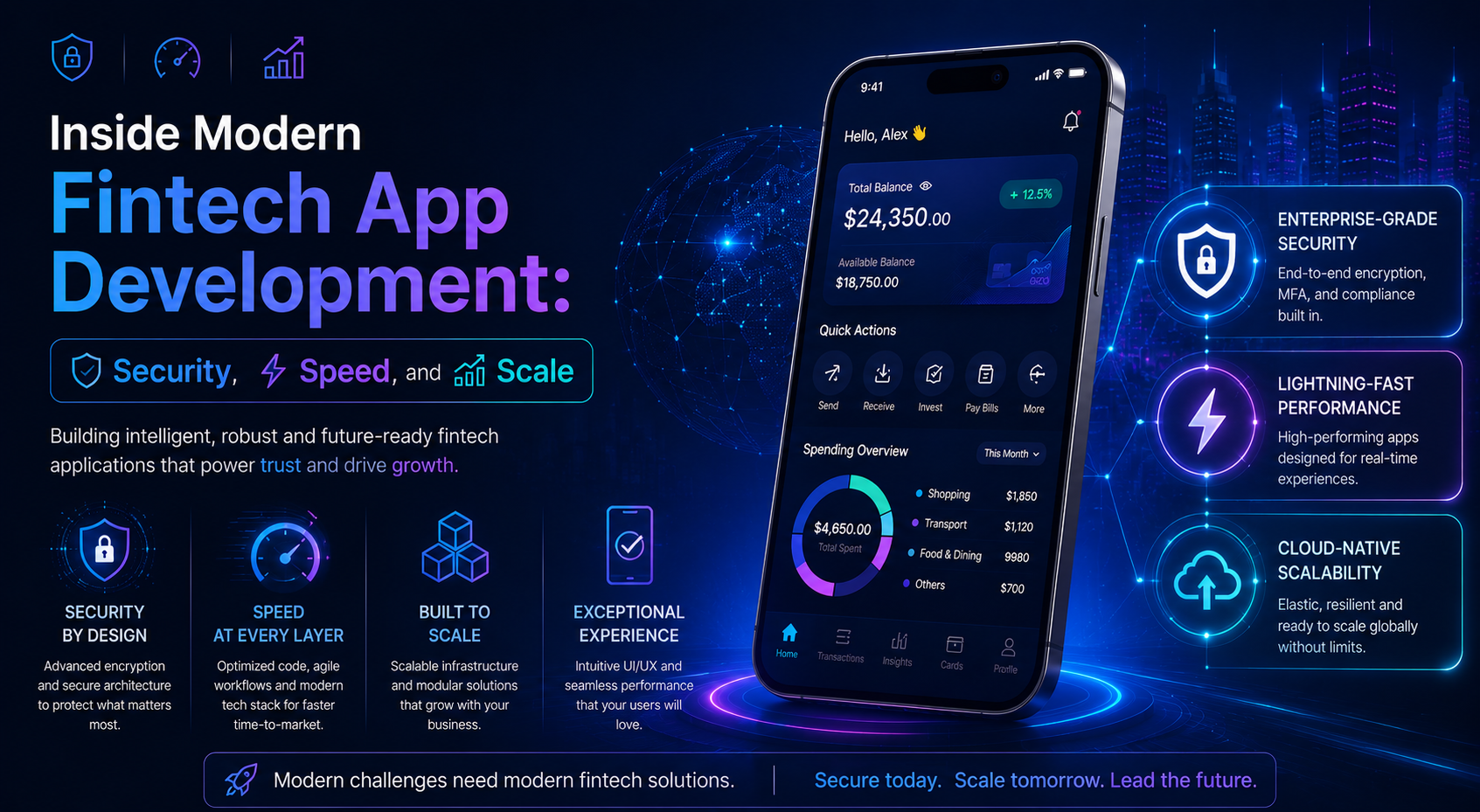
Inside Modern Fintech App Development: Security, Speed, and Scale
Today, the expectation is instant, invisible, and impeccable service.
Whether it is a peer-to-peer (P2P) lending platform, a neo-bank, a stock trading ecosystem, or a digital wallet, building a modern fintech product requires balancing a delicate triad: uncompromising security, lightning-fast speed, and massive scalability.
For any business looking to disrupt this space, partnering with an experienced fintech app development partner or a specialized payment app development company is no longer just a technical choice—it is a strategic blueprint for survival. Let’s pull back the curtain on what it takes to engineer a modern financial application that thrives under the pressure of millions of concurrent transactions.
1. The Architectural Blueprint: Breaking the Monolith
Legacy banking infrastructure failed because it was built on monolithic architectures. In a monolith, the user interface, payment processing, fraud detection, and database management are all tied together in a single, massive codebase. If the payment gateway crashes, the entire app goes down.
Modern payment software development company teams avoid this trap by building on a microservices architecture.
Why Microservices?
In a microservices setup, the application is broken down into loosely coupled, independent services that communicate via lightweight APIs.
-
Isolation: If the currency conversion service experiences a spike, it doesn’t bring down the user authentication service.
-
Independent Scaling: During peak shopping seasons, the ledger and payment processing microservices can scale up automatically without wasting cloud resources on less-demanding parts of the app.
-
Technology Agnostic: Engineers can use Python for data-heavy AI fraud detection, Go for low-latency transaction processing, and Node.js for rapid API routing.
Event-Driven Architecture (EDA)
Fintech demands real-time responsiveness. When a user taps "Send Money," multiple things must happen simultaneously: the ledger must update, a push notification must be sent, fraud detection must analyze the telemetry, and an email receipt must be generated. Modern fintech apps utilize event streaming platforms like Apache Kafka or AWS Kinesis to handle these asynchronous events smoothly, ensuring the user interface remains snappy and unblocked.
2. Security First: Building a Digital Fort Knox
In fintech, security isn't a feature you implement right before launch; it is the foundation upon which every line of code is written. A single data breach can permanently destroy consumer trust and invite catastrophic regulatory fines.
End-to-End Encryption (E2EE)
Data must be fiercely protected both in transit and at rest.
-
In Transit: All communications between the app, servers, and third-party APIs use Transport Layer Security (TLS 1.3) with strict certificate pinning to prevent Man-in-the-Middle (MitM) attacks.
-
At Rest: Sensitive user data, account numbers, and transaction histories are encrypted using advanced algorithms like AES-256. Cryptographic keys are managed via dedicated Hardware Security Modules (HSMs) or cloud equivalents like AWS KMS.
Advanced Authentication & Authorization
Passwords are a security liability. Modern fintech app development heavily prioritizes passwordless authentication, relying on device-level biometrics (FaceID/Fingerprint) tied to secure enclaves.
Furthermore, implementing OAuth 2.0 and OpenID Connect ensuring token-based authorization is critical. This ensures that even if an API request is intercepted, it contains a short-lived, deeply scoped token that cannot be used maliciously elsewhere.
DevSecOps and Real-Time Fraud Prevention
Security must move at the speed of development. Leading development teams implement DevSecOps, meaning automated security scanning (SAST/DAST) is baked directly into the CI/CD pipeline. Every code commit is scanned for vulnerabilities or accidentally exposed secrets before it ever hits production.
On the live application side, rule-based fraud detection is dead. Modern apps leverage machine learning models running at the edge to analyze transaction velocity, behavioral biometrics (how a user holds their phone or types), and geolocation to flag and block anomalous transactions in milliseconds.
3. The Need for Speed: Achieving Sub-Second Latency
When a consumer taps their phone at a grocery checkout, they expect a confirmation checkmark within one or two seconds. Behind that single tap lies a complex web of API calls, database queries, and third-party validation networks. Achieving this level of speed requires radical optimization across the entire tech stack.
Optimizing the Database Layer
Financial applications require strict ACID compliance (Atomicity, Consistency, Isolation, Durability) to guarantee that transactions are processed reliably. However, traditional relational databases (like PostgreSQL or MySQL) can become bottlenecks under heavy load.
To solve this, a specialized payment app development company will implement a polyglot persistence strategy:
-
Relational Databases: Used for the core ledger where consistency is non-negotiable.
-
NoSQL Databases (e.g., MongoDB, Cassandra): Used for non-transactional data like user profiles, app configurations, or activity feeds.
-
In-Memory Caching (e.g., Redis, Memcached): Used to store frequently accessed, slow-moving data (like exchange rates or session tokens) directly in memory, reducing database read loads by up to 80%.
Edge Computing and Content Delivery Networks (CDNs)
By deploying APIs and static assets to edge locations worldwide via providers like Cloudflare or AWS CloudFront, fintech apps dramatically minimize the physical distance data must travel. This ensures that a user opening their app in London experiences the exact same instantaneous load times as a user sitting next to the primary data center in Virginia.
4. Scaling horizontally: Handling Sudden Traffic Surges
Imagine a high-profile stock dropping 15% in ten minutes, or a massive Black Friday flash sale. A fintech application must be engineered to scale effortlessly from handling 500 transactions per second to 50,000 without dropping a single packet.
Containerization and Orchestration
Modern fintech infrastructure is built entirely on containers using Docker and orchestrated using Kubernetes (K8s). Kubernetes monitors system health and resource consumption in real-time. If CPU utilization across the payment services crosses a predetermined threshold, Kubernetes instantly spins up dozens of new container instances to absorb the traffic spike, automatically tearing them down when demand normalizes to save infrastructure costs.
Load Balancing and Rate Limiting
To prevent servers from being overwhelmed, intelligent load balancers distribute incoming traffic evenly across healthy server clusters. Concurrently, strict API rate-limiting protocols are enforced. This prevents both accidental denial-of-service (DoS) scenarios from buggy third-party integrations and malicious Distributed Denial of Service (DDoS) attacks designed to cripple the application.
5. Regulatory Compliance: The Unsung Hero of Fintech
You can build the fastest, most beautiful app in the world, but if it fails to comply with regional financial regulations, it will be shut down before it ever gains traction. Navigating this web is exactly why businesses lean heavily on a mature payment software development company that understands compliance as code.
| Regulation / Standard | Core Focus | Target Geographic Region |
| PCI-DSS (Level 1) | Protecting credit card data and securing transaction pathways. | Global |
| GDPR / CCPA | Striking a balance between user data privacy and financial data retention. | Europe / United States |
| KYC / AML | Automated identity verification and anti-money laundering monitoring. | Global |
| PSD2 / Open Banking | Secure, open API access for third-party financial service integration. | Europe (with global equivalents emerging) |
Building compliance directly into the software architecture—such as isolating cardholder data environments (CDE) or automating the data anonymization process—saves millions of dollars in future auditing and refactoring costs.
6. Choosing Your Tech Stack and Partners
Building a bulletproof financial ecosystem requires a carefully curated stack of modern, enterprise-grade technologies:
-
Frontend: Flutter or React Native for cross-platform efficiency; Swift and Kotlin for high-performance native apps.
-
Backend: Go (Golang) or Java/Spring Boot for high-concurrency payment engines; Node.js or Python for agile API layers.
-
Cloud Infrastructure: AWS, Google Cloud Platform (GCP), or Microsoft Azure with multi-region redundancy.
-
Core Fintech Integrations: Plaid (for bank account linking), Stripe or Adyen (for payment gateways), and Alloy or Persona (for identity verification).
The Strategic Value of the Right Partner
Attempting to assemble a team from scratch to tackle fintech app development can result in costly missteps, extended timelines, and security gaps. An established payment app development company brings pre-built, compliance-vetted frameworks, deep experience with complex API orchestrations, and a clear understanding of financial UX design patterns.
Conclusion: The Imperative of Continuous Evolution
Modern fintech app development is never truly "finished." It is a living, breathing ecosystem that must constantly evolve to fend off emerging cyber threats, integrate with new decentralized protocols, and satisfy a consumer base that continuously demands faster access to their capital.
By building on a scalable microservices foundation, treating security as an absolute prerequisite, optimizing every millisecond of database latency, and partnering with industry experts, your fintech application can transform from a standard digital product into an indispensable, high-performance financial engine.