How AV Is Becoming the Backbone of Smart Environments
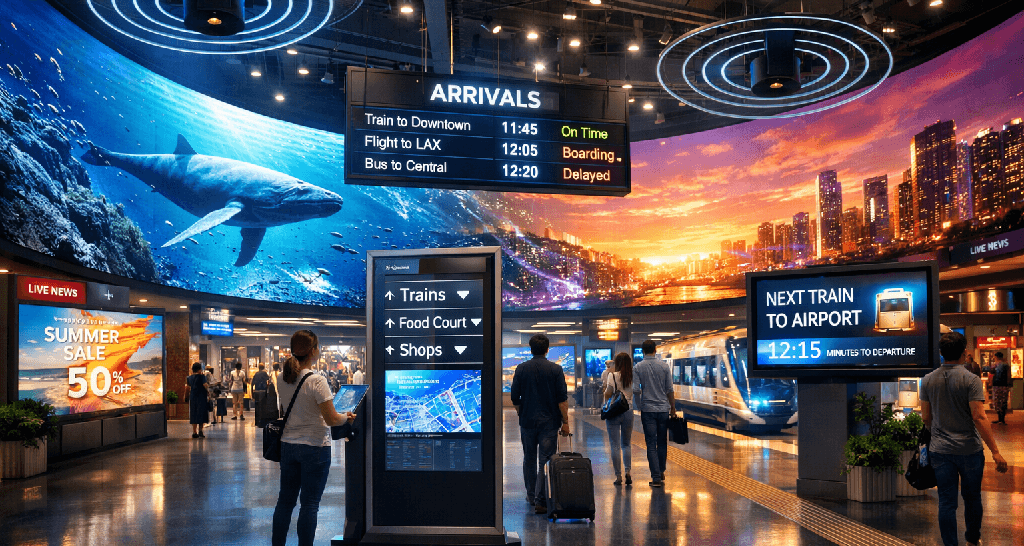
Smart environments are no longer defined solely by automation or connected devices. Today, they represent intelligent, responsive spaces that adapt to users, deliver real time information, and enable seamless interaction between people and technology.
At the centre of this evolution lies audio-visual (AV) technology, which has moved far beyond its traditional role of displays and sound reinforcement. Modern AV systems now act as the experiential and informational backbone of smart environments connecting data, people, and decision making in real time.
This shift is redefining how buildings are designed, operated, and experienced across corporate, education, healthcare, retail, and public sectors.
Understanding Smart Environments in Today’s Context
A smart environment is best described as a digitally enabled space that integrates multiple systems IT networks, building management systems (BMS), IoT platforms, and AV infrastructure to create a cohesive user experience.
Key characteristics include:
-
Real time data visibility
-
Automated responses to environmental or user inputs
-
Centralized monitoring and control
- Experience driven design
In this ecosystem, AV is not an add on. It is the primary interface through which intelligence is seen, heard, and understood.
.png "Audio Visual systems in smart environments")
The Evolution of AV: From Output Device to Intelligent Infrastructure
Historically, AV systems were endpoint technologies used mainly to present content. Today, they function as active infrastructure layers within smart environments.
Modern AV systems now:
-
Visualize operational and environmental data
-
Enable real time collaboration across locations
-
Integrate with enterprise IT and cloud platforms
- Support analytics and decision making workflows
Large format displays, LED video walls, unified communication platforms, and control systems have evolved into digital nervous systems translating complex data into actionable insights.
AV, IT, and IoT: A Converged Ecosystem
One of the most significant shifts shaping smart environments is the convergence of AV, IT, and IoT.
Key enablers include:
-
AV over IP architectures
-
Network based signal distribution
-
API driven integrations
- Cloud managed AV platforms
This convergence allows AV systems to:
-
Share data with building systems
-
Respond dynamically to environmental changes
- Be monitored and managed remotely
As a result, AV is now embedded into enterprise technology strategies rather than treated as a standalone discipline.
.png "Smart environments AV infrastructure")
Role of AV Across Key Smart Environments
Smart Offices and Corporate Campuses
In modern workplaces, AV supports:
-
Hybrid collaboration and unified communications
-
Real time space utilization insights
-
Interactive briefing and command centres
- Consistent user experience across meeting spaces
AV systems help organizations optimize productivity while supporting flexible work models.
Education and Smart Campuses
Educational environments rely on AV to:
-
Enable immersive and hybrid learning
-
Support lecture capture and content distribution
-
Provide campus wide communication systems
- Centralize monitoring of learning spaces
AV has become foundational to scalable, accessible education delivery.
Healthcare and Smart Hospitals
In healthcare settings, AV enables:
-
Clinical collaboration and telemedicine
-
Centralized command and control centres
-
Patient communication and wayfinding
- Training and simulation environments
Here, AV supports both operational efficiency and patient experience.
Retail, Experience Centres, and Public Spaces
In customer facing environments, AV powers:
-
Immersive storytelling and brand engagement
-
Dynamic digital signage
-
Real time content personalization
- Interactive wayfinding and information systems
AV transforms physical spaces into experience driven destinations.
AV as an Experience Enabler
Smart environments are ultimately measured by how people experience them. AV plays a crucial role in shaping:
-
User engagement
-
Accessibility and inclusivity
-
Ease of navigation
- Information clarity
By acting as the primary human technology interface, AV ensures that smart environments are not only intelligent, but also intuitive.
Sustainability and Operational Efficiency
AV systems also contribute significantly to sustainability goals by:
-
Enabling energy efficient display technologies
-
Supporting remote monitoring and predictive maintenance
-
Reducing physical resource dependency through digital communication
- Optimizing space and system usage
When integrated properly, AV becomes a tool for long term operational resilience.
.png "Role of AV in smart spaces")
Challenges and Considerations
Despite its growing importance, deploying AV as a smart environment backbone presents challenges:
-
Integration complexity across disciplines
-
Cybersecurity and network resilience
-
Skill gaps between AV and IT teams
- Need for standardized workflows and training
Addressing these challenges requires cross functional collaboration and a commitment to continuous professional development.
The Future of AV in Smart Environments
Looking ahead, AV systems are expected to become:
-
Context aware and adaptive
-
AI assisted in content delivery and control
-
Predictive rather than reactive
- Central to digital twin and smart city initiatives
As smart environments mature, AV professionals will increasingly serve as experienced architects, shaping how technology communicates with people.
Conclusion
Audio-visual technology has moved from the periphery to the core of smart environment design. By connecting data, systems, and human interaction, AV now forms the backbone of intelligent, responsive spaces.
For organizations and professionals involved in designing the built environment, recognizing AV as strategic infrastructure rather than a final layer solution is essential to delivering truly smart, future ready environments.
Vallect is a pioneer infrastructural technology AV integrator. Since our inception in 2018, we started off as a ProAV system integrator with a vision to create an organisation to deliver finest customer experience from project inception to execution.
With our focused resolute towards providing state of art yet simplified solutions to our customers & to better serve our client base, we pivoted & diversified our offerings to unified communication, lighting management system, building management solutions, led videowall installs, ELV solutions & Active-Passive IT Infrastructure. We are a tech company with a vision to offer smart, immersive & sustainable system integration solutions by designing, integrating and supporting technology solutions with AV, UC,BMS, LMS (Lighting Management and beyond.
In the last 7 years, Vallect has enabled over 800+ customers (including government, corporates, hospitality, educational institutes etc.) to cater to their infrastructural technology challenges while ensuring finest customer experience which has helped us emerge as a leading technology system integration brand in the industry. We have transformed Corporate Offices, Auditoriums, Museums, Classrooms, Boardrooms, stadiums, airports etc with our integrated technology solutions.
Vallect is a turnkey technology solution provider, with focus on being one stop solution from inception to execution to simplify the process & provide top quality services to our customers.