Fintech App Development in 2026: 5 Security Frameworks That Actually Work
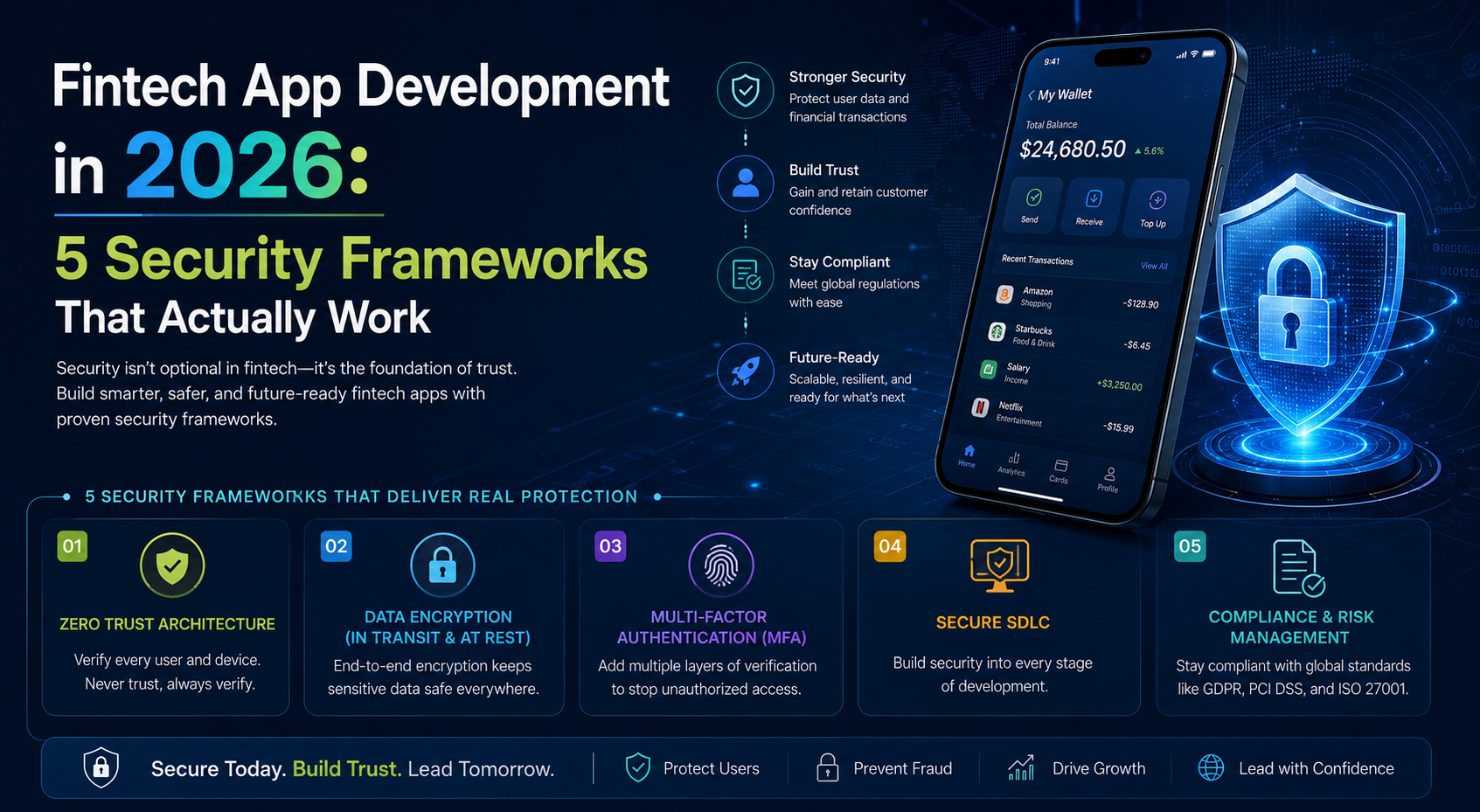
The global fintech market reached $308 billion in 2024, with projections to exceed $650 billion by 2030. Within this explosive growth, a critical vulnerability emerges: fintech app development teams are shipping products with inadequate security frameworks. According to a 2024 Verizon DBIR report on financial services, 86% of breaches in the fintech sector involved compromised credentials or weak authentication. Payment fraud alone cost financial institutions $32 billion in 2023, with compromised mobile applications accounting for 23% of these losses.
The challenge isn't lack of available security frameworks. It's that fintech app development teams often treat security as an afterthought, selecting frameworks that sound comprehensive without understanding their practical application to mobile and API-first architectures. This article examines five proven security frameworks specifically effective for fintech app development and how to implement them correctly.
Why Fintech App Development Security Fails
Before examining frameworks, understanding failure patterns is essential. Fintech applications differ from traditional applications in critical ways. They handle sensitive financial data, execute monetary transactions, and operate under regulatory scrutiny. Yet teams often apply generic application security frameworks without considering fintech's unique requirements.
The 2024 State of Fintech Security report identifies recurring gaps: 67% of fintech apps lack proper API authentication, 54% have insufficient encryption for data in transit, 49% fail to implement rate limiting against brute-force attacks, and 41% have inadequate audit logging. These aren't advanced threat scenarios—they're foundational security controls. Fintech app development teams implementing proven frameworks dramatically reduce these risk categories.
Framework 1: NIST Cybersecurity Framework (CSF)
The National Institute of Standards and Technology's Cybersecurity Framework provides a structured approach to identifying, protecting against, and responding to cyber threats. Unlike prescriptive security standards, NIST CSF is risk-based and flexible, making it ideal for fintech app development where requirements vary by application complexity and user base.
NIST CSF operates across five functions: Identify (understand your assets and risks), Protect (implement safeguards), Detect (identify security events), Respond (contain and remediate), and Recover (restore systems). For fintech app development, the Identify phase is crucial—documenting all data flows, external dependencies, and threat vectors before coding begins.
Implementation: Start with a security inventory. Document every API endpoint, database table, third-party service, and user role. Map data flows—trace how financial data moves through your system. Conduct threat modeling using STRIDE (Spoofing, Tampering, Repudiation, Information Disclosure, Denial of Service, Elevation of Privilege) to identify vulnerabilities. This isn't theoretical; it directly informs your architecture decisions. For example, threat modeling often reveals that mobile apps shouldn't store authentication tokens in app memory, leading to implementation of secure device storage. NIST CSF bridges business and technical teams, ensuring security decisions align with risk tolerance.
Framework 2: PCI DSS (Payment Card Industry Data Security Standard)
If your fintech app handles payment cards, PCI DSS compliance is non-negotiable. Enforced by the major card networks (Visa, Mastercard, American Express), PCI DSS comprises 12 core requirements covering encryption, access control, vulnerability management, and monitoring. Non-compliance can result in fines exceeding $100,000 per month and card network suspension.
The critical mistake fintech app development teams make is attempting to store or process card data directly. PCI DSS compliance requires either tokenization (replacing card data with secure tokens) or outsourcing card processing to a PCI-certified payment processor. Stripe, Square, and similar services handle PCI compliance; your app never touches card data directly.
Implementation: Never store full card numbers, expiration dates, or CVVs in your database. Instead, use a tokenization service. When users enter payment information, send it directly to Stripe, PayPal, or similar providers via secure API. Your backend receives a token representing the card, which you can charge repeatedly without storing sensitive data. Implement strong encryption for all card data in transit (TLS 1.2+). Maintain detailed audit logs of all payment transactions. Conduct quarterly security assessments. This approach simplifies compliance while reducing your security liability.
Framework 3: Zero Trust Architecture
Zero Trust Architecture operates on a fundamental principle: never trust, always verify. Traditional security perimeters (trust everything inside your network) don't work for fintech, where users access apps across networks (mobile, public WiFi, corporate networks) and your infrastructure spans cloud providers. Zero Trust requires verifying every access request, regardless of origin.
For fintech app development, Zero Trust means: every API call requires authentication, every user action is logged, every database query is authorized based on role, and access is revoked immediately when credentials are compromised. This creates friction if implemented poorly (users re-authenticating constantly), but modern implementations use context-aware authentication and short-lived tokens to balance security and usability.
Implementation: Implement OAuth 2.0 with PKCE (Proof Key for Code Exchange) for mobile apps—this prevents authorization code interception attacks common on mobile platforms. Use short-lived access tokens (15 minutes) with refresh tokens stored securely. Implement device fingerprinting to detect compromised devices. Use multi-factor authentication for sensitive operations (transferring funds, changing account settings). Monitor for behavioral anomalies—if a user who typically logs in from India suddenly accesses from Singapore, flag it. Use real-time risk scoring to adjust authentication requirements dynamically. For backend services, implement mutual TLS authentication and service mesh controls (Istio, Linkerd) to verify service-to-service communication.
Framework 4: OWASP Top 10 & API Security
The Open Web Application Security Project (OWASP) Top 10 identifies the most critical application security risks: injection attacks, broken authentication, sensitive data exposure, XML external entities, broken access control, security misconfiguration, XSS, insecure deserialization, using components with known vulnerabilities, and insufficient logging. For fintech app development, these threats are existential—a single SQL injection vulnerability can expose all customer accounts.
Beyond the traditional Top 10, OWASP now emphasizes API Security Top 10, specifically addressing REST and GraphQL vulnerabilities. Fintech apps rely heavily on APIs (mobile app to backend, backend to payment processors, internal microservices), making API security critical.
Implementation: For injection prevention, use parameterized queries and prepared statements—never concatenate user input into SQL. For authentication, implement OAuth 2.0 and OpenID Connect, avoiding custom authentication schemes. For sensitive data (account numbers, transaction details), encrypt at rest using AES-256 and in transit using TLS 1.2+. For access control, implement role-based access control (RBAC) or attribute-based access control (ABAC) at the API layer, not just the database. For known vulnerabilities, use dependency scanning tools (Snyk, Dependabot) to identify outdated libraries. For logging, implement comprehensive audit trails of all financial transactions, user access, and administrative actions. Use Web Application Firewalls (AWS WAF, Cloudflare) to detect and block common attacks.
Framework 5: Incident Response & Disaster Recovery
Even with perfect security implementation, breaches happen. Fintech app development teams must prepare for incident response before a breach occurs. An Incident Response Plan documents who responds to security incidents, how evidence is preserved, how customers are notified, and how to restore normal operations. The difference between a managed incident response and chaos is preparation.
Fintech regulations require notification of breaches within specific timeframes (often 30-60 days). Delayed notification compounds regulatory penalties. Additionally, financial institutions operate under Disaster Recovery and Business Continuity (DRBC) requirements—if your app becomes unavailable, financial transactions cannot process, directly impacting revenue and customer trust.
Implementation: Develop a formal Incident Response Plan covering identification, containment, eradication, and recovery phases. Assign an Incident Commander responsible for coordinating response. Document forensics procedures—preserve logs, database snapshots, and application state without contaminating evidence. Establish communication protocols for notifying regulators, customers, and stakeholders. Conduct tabletop exercises annually to test your plan. For Disaster Recovery, implement automated backups with geographic redundancy—if your primary data center fails, backups in a different region restore operations. Document Recovery Time Objectives (RTO—how quickly systems must be restored) and Recovery Point Objectives (RPO—how much data loss is acceptable). Test your disaster recovery plan quarterly.
Orchestrating Frameworks: Integration and Prioritization
These five frameworks aren't independent—they integrate and reinforce each other. NIST CSF provides the overarching structure; PCI DSS and OWASP Top 10 are specific implementations within that structure; Zero Trust is an architecture pattern implementing those controls; and Incident Response ensures you're prepared when controls fail.
Fintech app development teams should implement frameworks in this order: First, conduct NIST-based threat modeling and risk assessment. Second, implement Zero Trust Architecture as your foundational architecture pattern. Third, apply OWASP Top 10 and API Security controls through secure coding practices and API gateway policies. Fourth, if handling payment cards, implement PCI DSS compliance through tokenization and encryption. Fifth, develop Incident Response and Disaster Recovery plans to manage inevitable failures.
2026 Fintech Security Trends
Looking at fintech app development in 2026, several trends reinforce the importance of these frameworks. AI-powered fraud detection is becoming table stakes—financial institutions expect apps to identify suspicious transactions in real-time. This requires rich transaction logging (Incident Response Framework) and behavioral analysis (Zero Trust Architecture). Regulatory pressure continues increasing; the EU's Digital Operational Resilience Act (DORA) and similar regulations worldwide impose stricter requirements. Cryptocurrency integration is expanding—apps handling digital assets face different threat models than traditional finance. Finally, supply chain security is critical; fintech apps integrating with multiple payment processors, KYC providers, and analytics services must ensure all dependencies follow security frameworks.
Conclusion
Fintech app development requires security frameworks that acknowledge financial data's sensitivity, regulatory requirements, and modern threat landscape. The five frameworks discussed—NIST CSF, PCI DSS, Zero Trust Architecture, OWASP Top 10/API Security, and Incident Response—provide comprehensive coverage when implemented together. Teams that adopt these frameworks gain competitive advantage: faster time to market (security built in, not bolted on), lower breach risk, easier regulatory approval, and customer confidence.
The fintech market's explosive growth creates urgency for fintech app development teams to build security correctly from inception. Frameworks aren't theoretical—they're proven approaches to preventing the breaches, fraud, and regulatory penalties that plague the industry. Implementation requires investment, but the cost of a single breach exponentially exceeds the investment in security frameworks. For fintech companies competing in 2026, security frameworks aren't optional—they're competitive necessity