Care in Code: Why Healthcare Apps Need Special Design
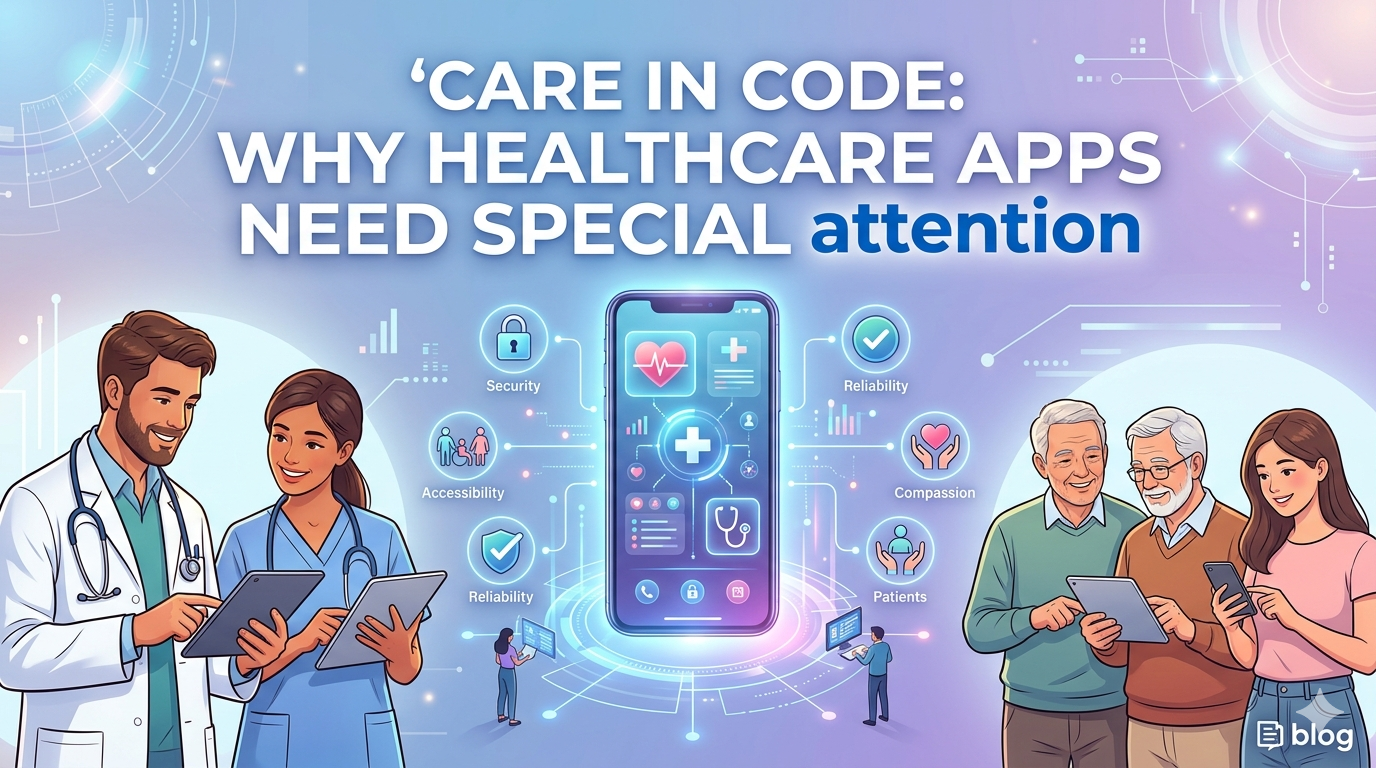
Software design matters everywhere. But in healthcare, design is literally a matter of life and death. Unlike consumer apps where a poor user experience might frustrate users or cost you downloads, healthcare apps operate in a domain where every design decision carries profound consequences. A confusing interface could lead to medication errors. A non-intuitive workflow might delay critical diagnoses. A poorly designed notification system could cause patients to miss appointment reminders or ignore important health alerts.
This is precisely why any credible healthcare app development company understands that designing healthcare applications requires a fundamentally different approach than traditional software development. It's not merely about aesthetics or user satisfaction—it's about embedding care, responsibility, and clinical accuracy into every line of code and every pixel on the screen.
In this guide, we'll explore why healthcare applications demand special design considerations, and how a professional healthcare app development company approaches the challenge of creating software that healers can trust and patients depend on.
The Clinical Context: Design Beyond Aesthetics
Healthcare apps don't exist in isolation. They live within complex clinical workflows where doctors, nurses, pharmacists, and other healthcare professionals are juggling multiple patients, critical decisions, and time-sensitive actions. Unlike a consumer shopping app where users have leisure to explore features, healthcare apps are used by exhausted professionals in high-stress environments making decisions that affect human lives.
A healthcare app development company that understands this context knows that design must prioritize clarity over cleverness. Buttons must be large enough to tap accurately even with trembling hands or surgical gloves. Icons must be universally understood—no ambiguous symbols that require users to guess what they do. Information architecture must reflect how clinicians actually think about patient care, not how developers think about organizing data.
This is why professional healthcare app development companies conduct extensive user research with actual healthcare providers. They observe doctors in exam rooms. They watch nurses managing multiple patient records in emergency departments. They understand that designing for healthcare means designing for a context of complexity, urgency, and stakes that most consumer applications never face.
Safety-First Design Philosophy
In traditional software, a mistake might be recoverable—you can undo an action, refresh the page, or reload from the last save. In healthcare applications, some mistakes can't be undone. If a healthcare app allows a physician to accidentally prescribe a lethal dose of medication without clear confirmation, the consequences are permanent.
This fundamental reality shapes how a professional healthcare app development company designs every interaction. Critical actions require confirmation dialogs that explicitly state what will happen. Destructive operations demand additional verification steps. The app should anticipate common errors and prevent them before they occur. Dose calculations include built-in sanity checks. Patient identifiers are confirmed multiple times before administering treatments.
Progressive disclosure is employed strategically—showing only the information immediately relevant to the current task, but making detailed context readily available without requiring clicks through multiple screens. Color coding helps rapid visual scanning. Status indicators clearly show whether actions have been saved, submitted, or are pending.
An experienced healthcare app development company knows that every design choice is a safety choice. The question isn't just "Will users understand this?" but "Could this design lead to patient harm?" and "What safeguards do we need to build in?"
Accessibility and Inclusivity in Healthcare Applications
Healthcare apps serve an enormously diverse population—elderly patients, patients with vision impairments, patients with cognitive limitations, patients for whom English is not a first language. A truly professional healthcare app development company recognizes that accessibility isn't a "nice to have" feature—it's a fundamental requirement.
This means designing for WCAG compliance, ensuring text is readable at multiple sizes without losing functionality, providing alternative text for all images, supporting keyboard navigation for users who can't use a mouse, and offering multiple ways to complete critical tasks. For patient-facing apps, it means supporting multiple languages and cultural contexts around health and wellness.
Furthermore, healthcare apps often serve patients during vulnerable moments—when they're sick, anxious, or in pain. Compassionate design becomes essential. A healthcare app development company that excels doesn't just create functional applications; it creates experiences that reduce patient anxiety, provide reassurance, and communicate care through every interaction.
Mobile-First Design for Point-of-Care Applications
Increasingly, healthcare happens at the point of care—in exam rooms, hospital corridors, patients' homes, and emergency vehicles. This means healthcare apps must often run on mobile devices in less-than-ideal conditions: poor lighting, unreliable connectivity, gloved fingers on small screens, and interruptions from actual patient care.
A healthcare app development company designing mobile applications must account for these realities. Interfaces must work on small screens without losing critical information. Data synchronization must be intelligent—capturing information even when connectivity drops, then syncing reliably when the connection restores. The app must function with a few taps, not dozens of screen transitions.
Additionally, healthcare professionals often switch between multiple devices throughout their day—tablets in patient rooms, phones for consultations, desktops for administrative tasks. A well-designed healthcare app provides a seamless experience across devices, with data and context following users as they move between them.
Data Visualization and Clinical Decision Support
Healthcare is inherently data-rich. Patient histories span months or years. Lab results, imaging reports, medication records, and clinical notes accumulate quickly. A patient's health status is determined by patterns in this data, not individual data points. This is where sophisticated design becomes truly critical.
A professional healthcare app development company employs data visualization principles that turn overwhelming amounts of information into clear, actionable insights. Trends are emphasized through carefully chosen chart types. Normal values are contextualized against patient baselines, not just population averages. Alert thresholds are highlighted to draw attention to abnormal results that might signal a clinical emergency.
Moreover, clinical decision support requires thoughtful design. If an app flags 50 potential drug interactions for every prescription, physicians will learn to ignore the warnings—a phenomenon called "alert fatigue." Smart healthcare apps implement intelligent filtering, highlighting only the most relevant and critical concerns, with context explaining why an alert was triggered.
The best healthcare app development companies work with clinical informatics specialists to ensure that data visualization doesn't just look beautiful—it communicates clinical truth accurately and helps physicians make better decisions.
Regulatory Compliance Embedded in Design
Healthcare applications don't just have to work well—they have to comply with complex regulations like HIPAA, FDA guidelines for medical devices, and various state and international privacy laws. Many developers treat compliance as something bolted on after development is complete. This is a critical mistake.
A mature healthcare app development company embeds compliance requirements into design from the beginning. Patient data must be encrypted not just in transit but also at rest—and this must be reflected in the app's architecture, visible to users through security indicators. Access controls must be designed such that users only see data they're authorized to access. Audit trails must be automatically generated and presented transparently.
When compliance is built into design rather than bolted on, the result is an application that maintains security and privacy naturally, without friction. Users understand why they're being asked to authenticate. They see confirmation of successful encryption. They understand the data governance principles underlying the system.
Why Partner with a Specialized Healthcare App Development Company
Building healthcare applications isn't like building other software. A general app development company might deliver code that technically works, but that doesn't understand the healthcare context. They don't know why confirmation dialogs matter. They don't appreciate the cascading consequences of poor design choices. They treat compliance as bureaucracy rather than responsibility.
A specialized healthcare app development company brings something different: deep expertise in clinical workflows, regulatory requirements, healthcare security, and the unique pressures that shape healthcare professionals' work. They've made mistakes in healthcare contexts and learned from them. They understand that healthcare design is a discipline unto itself.