AI MVP Development Trends Defining Startup Success in 2026
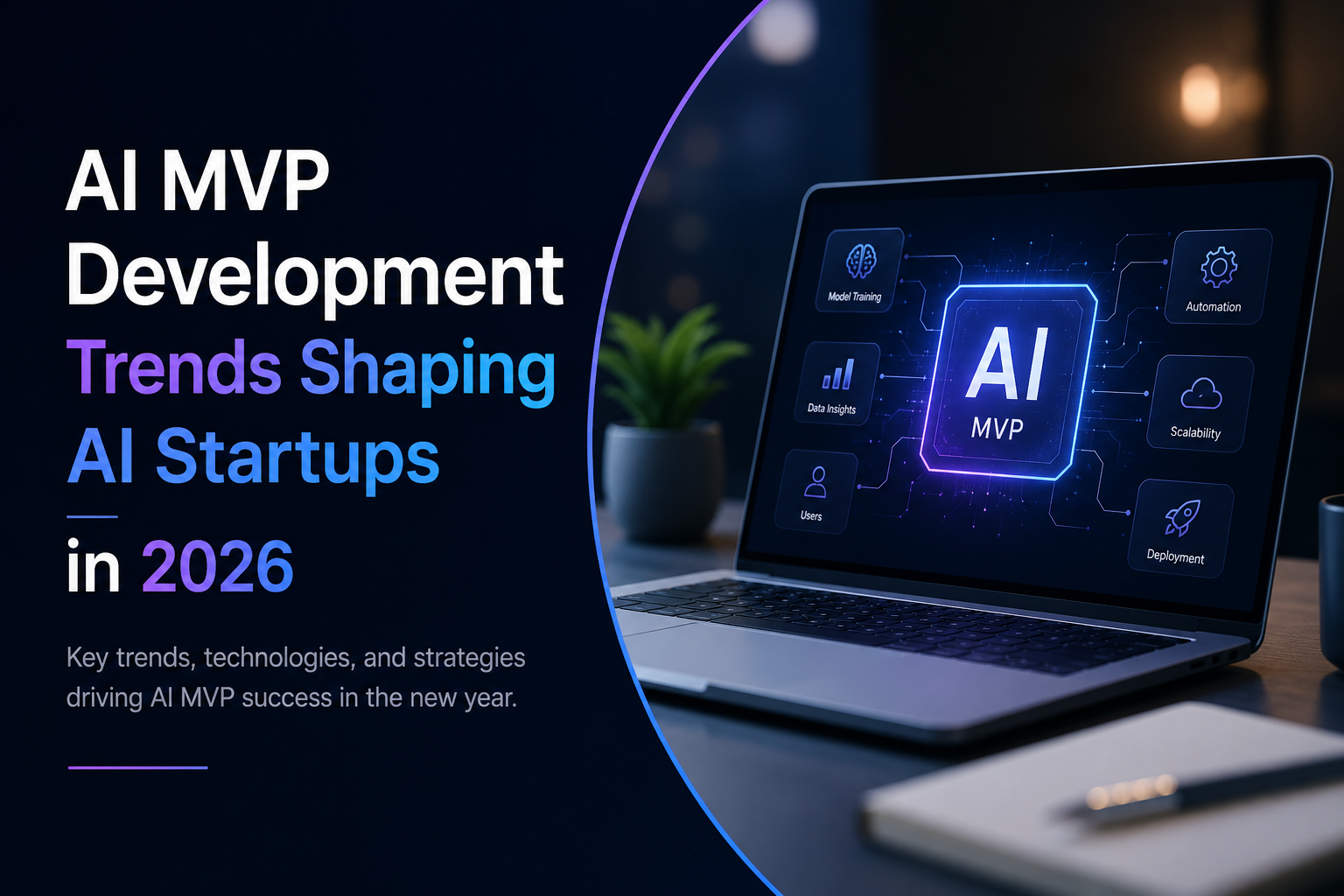
Artificial intelligence has become the foundation of modern startup innovation. Companies entering the market today are no longer asking whether AI should be part of their product they are deciding how quickly they can launch a solution that delivers measurable value. With technology evolving at an unprecedented pace, long development cycles often result in missed opportunities and outdated ideas before a product even reaches users.
That is why AI MVP development services have become a preferred approach for founders aiming to validate concepts, reduce uncertainty and enter competitive markets with confidence. A focused MVP helps businesses collect meaningful customer feedback, test AI capabilities and refine their product roadmap without committing to unnecessary features.
As 2026 unfolds, several emerging trends are changing how AI startups plan, design and scale intelligent products.
Smart MVPs Are Replacing Feature-Heavy Launches
Successful startups are moving away from the mindset of building everything at once. Instead, they concentrate on solving one significant customer problem exceptionally well before expanding their platforms.
Launching a focused AI-powered MVP enables founders to understand real customer expectations, identify adoption patterns and eliminate features that provide little business value. This strategy minimizes development waste while creating a stronger foundation for future growth.
Rather than measuring success through feature count, startups now evaluate:
- User satisfaction with AI responses
- Daily and monthly engagement
- Workflow completion rates
- Customer retention trends
- Revenue generated from early adopters
These metrics provide practical direction for future product enhancements.
Vertical AI Products Continue to Gain Momentum
Generic AI applications remain valuable, but specialized solutions are attracting stronger commercial demand across industries.
Organizations increasingly prefer AI systems that understand their workflows, terminology and operational challenges instead of relying on universal assistants. Healthcare, legal services, manufacturing, logistics, education and finance are among the sectors seeing rapid adoption of purpose-built AI platforms.
Businesses investing in custom AI MVP development are focusing on industry-specific intelligence from the beginning, enabling faster customer acceptance and better long-term scalability.
A specialized product often delivers greater business impact because it addresses problems unique to a particular market rather than offering broad functionality.
Scalable Architecture Is a Priority from Day One
Modern AI startups understand that growth depends on technical flexibility.
Instead of relying on rigid software structures, developers are building modular ecosystems that combine language models, APIs, cloud infrastructure, automation engines, analytics tools and secure databases. This approach makes it easier to expand functionality without disrupting the existing platform.
Elements of a Future-Ready AI MVP
Adaptable AI Models
Applications built with interchangeable model support can adopt newer technologies without extensive redevelopment.
Cloud-Native Infrastructure
Scalable cloud environments ensure consistent performance as user demand increases.
Reliable Data Management
Well-organized data pipelines improve AI accuracy while supporting compliance and long-term model improvement.
Trustworthy AI Is Becoming Essential
Customers expect AI products to deliver reliable outcomes while protecting sensitive information.
Transparency, responsible data usage and explainable AI outputs are becoming standard expectations rather than optional improvements. Businesses are placing greater emphasis on governance because trust directly influences customer adoption and enterprise partnerships.
Working with an experienced AI development company often helps startups establish secure architectures, compliance standards and responsible AI practices early in the development process.
Products that combine innovation with accountability are better positioned for sustainable market growth.
Intelligent Automation Is Expanding Product Capabilities
AI is progressing beyond conversational experiences.
Modern platforms increasingly automate complete business processes, allowing users to accomplish meaningful tasks without switching between multiple applications. AI agents can summarize documents, generate reports, coordinate workflows, retrieve business information and execute repetitive operations with minimal human input.
These capabilities transform MVPs from simple demonstrations into practical business solutions capable of delivering immediate operational value.
Product Improvement Is Driven by Real User Behavior
Continuous learning has become one of the defining characteristics of successful AI startups.
Every interaction offers valuable insights into customer expectations, feature performance and model accuracy. Teams analyze user activity to refine prompts, improve recommendation quality, strengthen automation and eliminate friction throughout the customer journey.
Instead of waiting for large software releases, many startups now improve their AI platforms through smaller, ongoing updates supported by real-world usage data.
Managing AI Costs Is Part of Product Strategy
Operational expenses can increase quickly as AI usage grows.
Forward-thinking startups are designing efficient infrastructures that balance performance with affordability. Decisions regarding model selection, inference costs, API usage, caching mechanisms and cloud resources directly affect long-term profitability.
Cost Optimization Techniques
Several practices help startups control infrastructure expenses while maintaining high-quality AI experiences.
Intelligent Request Routing
Different AI models are assigned according to task complexity, reducing unnecessary processing costs.
Prompt Optimization
Carefully structured prompts improve output quality while lowering computational requirements.
Resource Monitoring
Continuous infrastructure analysis allows teams to identify inefficiencies before operational costs become difficult to manage.
User Experience Has Become a Competitive Differentiator
Powerful AI alone is no longer enough to win customers.
Users expect intuitive interfaces, responsive performance, personalized experiences and straightforward onboarding. Products that reduce complexity often achieve stronger engagement than technically advanced platforms with confusing workflows.
Startups are simplifying interactions, reducing setup time and ensuring users experience measurable value within their earliest sessions.
A seamless customer experience significantly improves product adoption and retention.
Collaborative Development Is Accelerating Product Launches
Many founders prefer to focus on business strategy instead of building large internal engineering teams during the early stages of growth.
Partnering with specialists offering AI-Driven MVP development services enables startups to access experienced AI engineers, product strategists, cloud architects and machine learning experts without lengthy hiring processes.
This collaborative model shortens development cycles while allowing businesses to maintain high technical standards throughout product creation.
Looking Ahead
The startup ecosystem continues evolving as artificial intelligence becomes more accessible, capable and commercially valuable. Products entering the market in 2026 are expected to combine intelligent automation, scalable architecture, responsible AI practices and outstanding user experiences rather than relying solely on advanced algorithms.
Choosing the right approach to AI MVP development gives startups the flexibility to validate ideas, adapt quickly to customer feedback and scale with confidence. Businesses that prioritize practical outcomes over unnecessary complexity are more likely to build AI products capable of sustaining long-term growth in an increasingly competitive landscape.
FAQs
Can AI MVP development services support both startups and established businesses?
Yes. While startups use MVPs to validate new ideas, established organizations often use them to test AI-powered products, automate internal operations or launch new digital services before making larger investments.
What should founders prepare before starting an AI MVP project?
A clear business objective, target audience, core problem statement, available datasets and desired success metrics help streamline development and reduce unnecessary revisions throughout the project.
Is it possible to expand an AI MVP into an enterprise platform?
Absolutely. When scalability is considered during the architecture phase, an MVP can gradually evolve into a full enterprise solution by adding advanced features, integrations and security capabilities.
How do startups measure whether an AI MVP is successful?
Performance is usually evaluated through customer adoption, engagement levels, user retention, AI response quality, operational improvements and business outcomes such as conversions or recurring revenue.