7 Best Service Marketplace Development Solutions for Startups (2026)

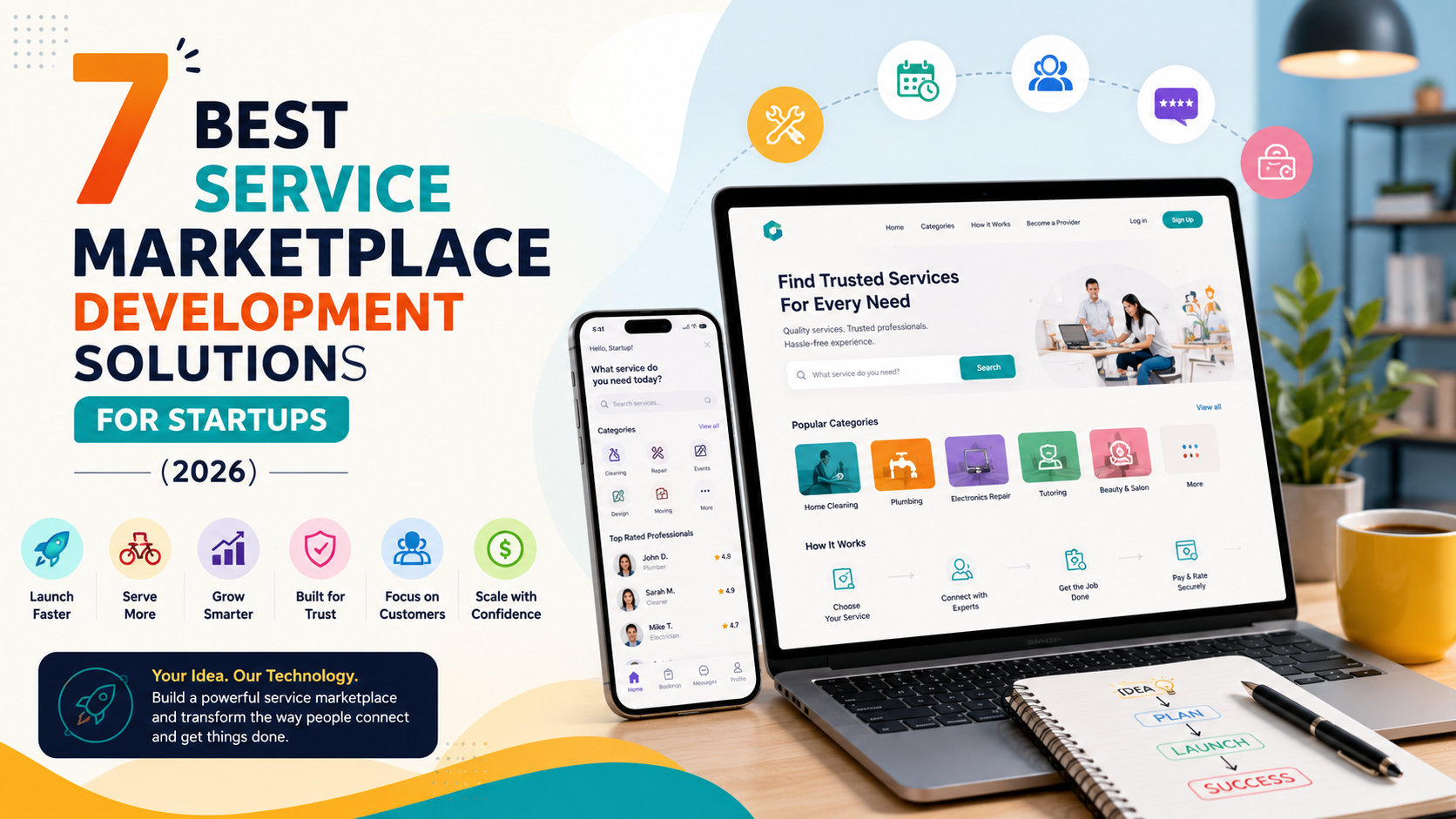
The demand for online service marketplaces continues to grow as consumers increasingly prefer booking services digitally. From freelance platforms and home services to consulting and professional services, startups have numerous opportunities to build successful marketplace businesses. However, developing a marketplace from scratch can be expensive and time-consuming, making ready-made marketplace software an attractive alternative.
Today's service marketplace solutions offer essential features such as user management, service listings, booking systems, payment processing, and mobile compatibility, helping startups launch faster and scale efficiently. The challenge lies in selecting a platform that aligns with your business model, budget, and long-term growth strategy.
To help simplify your decision, we've compiled the 7 best service marketplace development solutions for startups in 2026. Each platform has been evaluated based on its customization capabilities, scalability, ease of deployment, ownership, and overall suitability for startup businesses.
1. Yo!Gigs
Yo!Gigs is a white-label service marketplace software designed to help startups launch platforms for freelancers, home services, professional services, and other on-demand businesses. It offers a self-hosted solution with built-in marketplace features, allowing businesses to customize the platform while retaining full ownership.
Pros
- White-label and self-hosted solution
- Supports multiple service marketplace business models
- Highly customizable with source code ownership
- Includes buyer, seller, and admin dashboards
- Mobile app support available
Cons
- Requires hosting and technical setup
- Advanced customizations may require development expertise
Best For
Startups and SMEs looking for a customizable, self-hosted service marketplace with complete ownership and long-term scalability.
2. Sharetribe
Sharetribe is a cloud-based marketplace platform that enables startups to launch service marketplaces without extensive development. It provides ready-made marketplace functionality along with APIs for businesses that need additional customization as they grow.
Pros
- Quick marketplace deployment
- User-friendly interface
- API support for customization
- Integrated payment processing
- Cloud-hosted infrastructure
Cons
- Limited customization on lower-tier plans
- Ongoing subscription costs
Best For
Entrepreneurs who want to launch a marketplace quickly with minimal technical expertise.
3. Arcadier
Arcadier is a SaaS marketplace builder that supports service, product, rental, and booking marketplaces. Its modular architecture and plugin ecosystem allow startups to extend platform functionality without rebuilding the entire marketplace.
Pros
- Supports multiple marketplace models
- No-code marketplace setup
- Plugin marketplace for additional features
- Cloud hosting included
- Easy vendor management
Cons
- Advanced features may require paid extensions
- Limited flexibility compared to custom-built solutions
Best For
Startups seeking a flexible cloud-based marketplace platform with low technical complexity.
4. CS-Cart Multi-Vendor
CS-Cart Multi-Vendor is a self-hosted marketplace software that enables businesses to create customizable multi-vendor platforms. It offers comprehensive vendor management tools and a large add-on marketplace for extending functionality.
Pros
- Self-hosted with full ownership
- Extensive customization options
- Strong vendor management features
- Large ecosystem of add-ons
- One-time license option
Cons
- Requires hosting and server management
- Premium add-ons can increase overall costs
Best For
Businesses that want full control over their marketplace infrastructure and extensive customization capabilities.
5. Bubble
Bubble is a no-code development platform that enables startups to build custom marketplace applications without traditional programming. It offers visual workflows, database management, and a wide range of plugins for creating unique marketplace experiences.
Pros
- No-code application development
- Highly flexible workflows
- Large plugin ecosystem
- Rapid prototyping
- Supports custom business logic
Cons
- Performance may vary for complex applications
- Requires time to learn the platform
Best For
Startups building custom marketplace concepts without hiring a full development team.
6. Shopify Plus
Shopify Plus is an enterprise ecommerce platform that can support marketplace functionality through third-party applications and integrations. It provides secure cloud hosting, extensive commerce tools, and a mature app ecosystem.
Pros
- Reliable cloud infrastructure
- Easy store management
- Extensive app marketplace
- Strong payment ecosystem
- Multi-channel commerce support
Cons
- Marketplace functionality depends on third-party apps
- Monthly subscription costs can be high
Best For
Growing businesses looking for a cloud-based commerce platform with marketplace capabilities.
7. Mirakl
Mirakl is an enterprise marketplace platform built for large-scale marketplace operations. It provides advanced seller management, automation, and integration capabilities, making it suitable for businesses managing complex digital commerce ecosystems.
Pros
- Enterprise-grade marketplace platform
- Advanced marketplace automation
- Scalable infrastructure
- Strong integration capabilities
- Comprehensive seller management
Cons
- Higher implementation costs
- May be more complex than required for early-stage startups
Best For
Scaling startups and enterprises that need a robust, enterprise-ready marketplace platform with advanced automation and integration features.
Conclusion
Launching a service marketplace is about more than getting to market quickly—it requires choosing a platform that can support your business as it grows. The right solution should provide the flexibility to adapt to changing customer needs, integrate with essential business tools, and scale without major technical limitations.
Each platform featured in this list has its own strengths. Some focus on rapid deployment, while others prioritize enterprise-grade capabilities or extensive customization. By evaluating factors such as ownership, scalability, customization options, integration support, and long-term maintenance, startups can make a more informed decision.
Ultimately, the best service marketplace development solution is the one that aligns with your business objectives, target audience, and future growth plans, providing a solid foundation for building a successful and sustainable marketplace business.