Why Binary Options Platforms Get Shut Down or Frozen After Launch
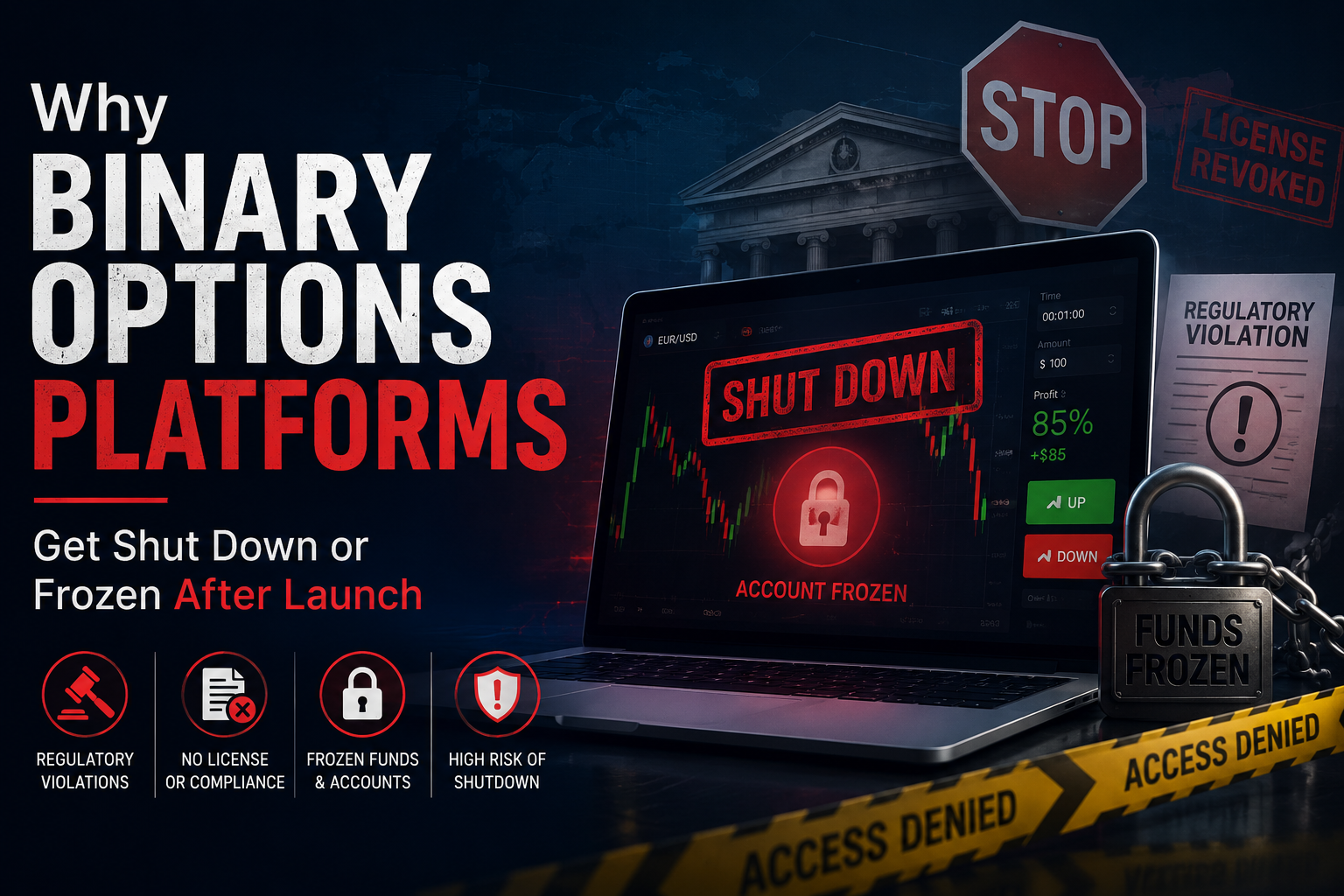
Binary options platforms rarely fail because of the trading engine. They fail because of decisions made before launch that surface as operational crises after it. The five causes we see most often are: operating without a valid license in a restricted jurisdiction, having a payment processor freeze or close the merchant account, running undercapitalized against payout obligations during a volatility spike, losing a liquidity provider relationship over a feed or hedging dispute, and having ad accounts or affiliate traffic cut off by platforms that restrict binary options marketing. Each one is preventable, and each one is a build-stage decision, not a bad-luck event.
The five failure modes, specifically
1. Operating without a license in a restricted jurisdiction Covered in depth in our regulation guide by country, but the short version: marketing to retail traders in the EU, UK, or Australia, or accepting US traders outside a CFTC-registered exchange, invites direct regulatory action. Enforcement in this space is active. Regulatory bodies in these regions have a documented history of public warnings, license revocations, and account freezes directed at unlicensed binary options operators. This isn't a background risk. It's the leading cause of platforms disappearing within their first year.
2. Payment processor freezes and account closures This is the failure mode almost nobody accounts for during the build. Binary options is classified as high-risk by most payment service providers (PSPs), the companies that process card and bank transactions, largely because of its regulatory history and high chargeback rates. A PSP relationship built on a standard merchant account, without disclosure of the actual business model, tends to get flagged during a routine risk review and frozen, sometimes with funds held for 90 to 180 days during investigation. This is common enough that it should be treated as a core technical requirement: build the payment layer around processors that explicitly underwrite binary options or forex-adjacent high-risk categories from day one, not as an afterthought once a standard PSP account gets closed.
3. Undercapitalization against payout obligations A binary options platform's revenue model depends on the spread between trader losses and payouts to winners. During a volatility spike, correlated trader positions can flip this model temporarily, if too many traders win the same directional bet at once. A platform that hasn't modeled this exposure, hasn't set per-asset and per-trader limits, and hasn't kept a capital reserve to cover a bad week can find itself unable to pay out winning traders. That's not a hypothetical edge case. It's a modeled, known risk that a properly built risk management layer accounts for with automated exposure limits and hedging triggers, not manual monitoring.
4. Liquidity provider disputes Binary options platforms depend on a liquidity provider (LP) for real-time, accurate pricing data used to settle trades at expiry. Disputes arise when pricing feeds are manipulated or delayed or when the platform's hedging arrangement with the LP breaks down under high volume. Losing an LP relationship mid-operation can mean a platform can no longer settle trades accurately, which is functionally the same as being unable to operate. This is why LP integration deserves the same due diligence as the licensing decision, not a "pick whoever's cheapest" approach.
5. Marketing and affiliate channel shutdowns Binary options sits in a restricted advertising category on most major ad platforms. An operator who builds an acquisition strategy entirely around a channel that can suspend the account without warning, common with affiliate-driven binary traffic and paid social, is one policy enforcement action away from losing customer acquisition entirely. A platform can be technically flawless and still stall out because the growth channel it depended on was never diversified.
Shutdowns are a build-stage failure, not a launch-stage one
The pattern across all five causes is the same: the failure shows up after launch, but the decision that caused it was made, or skipped, before launch. This is why we treat licensing, payment processing, capital modeling, LP selection, and channel diversification as Phase 1 discovery questions during binary options trading software development, not Phase 4 launch-readiness checks. By the time a platform is in QA, most of these decisions are locked in, for better or worse.
If your platform is already live and already showing signs of one or more of these problems, the fix usually isn't a patch. It's covered in our companion piece on rebuilding a binary options platform after failure or shutdown.
FAQs
Why do payment processors freeze binary options platform accounts?
Most PSPs classify binary options as high-risk due to chargeback rates and regulatory history and will freeze accounts that weren't disclosed and underwritten as high-risk from the start. This is typically an account-level risk review outcome, not a response to any specific incident.
Can a binary options platform run out of money to pay traders?
Yes, if it isn't capitalized against correlated payout exposure during volatility spikes and doesn't have automated per-asset and per-trader exposure limits in place. This is a modelable, preventable risk, not an unpredictable one.
Is it possible to prevent a regulatory shutdown after launch?
The most effective prevention happens before launch, by securing the correct license for the jurisdictions being marketed to. Once a platform is operating without proper licensing, options narrow to remediation rather than prevention.
What's the single most common reason binary options platforms fail in year one?
Based on the pattern above, unlicensed operation in a restricted jurisdiction and unplanned payment processor freezes are the two most frequent, and both are decisions made, or skipped, before a single trade is settled.