What an Ideal EV Charging Station Management Software Should Deliver
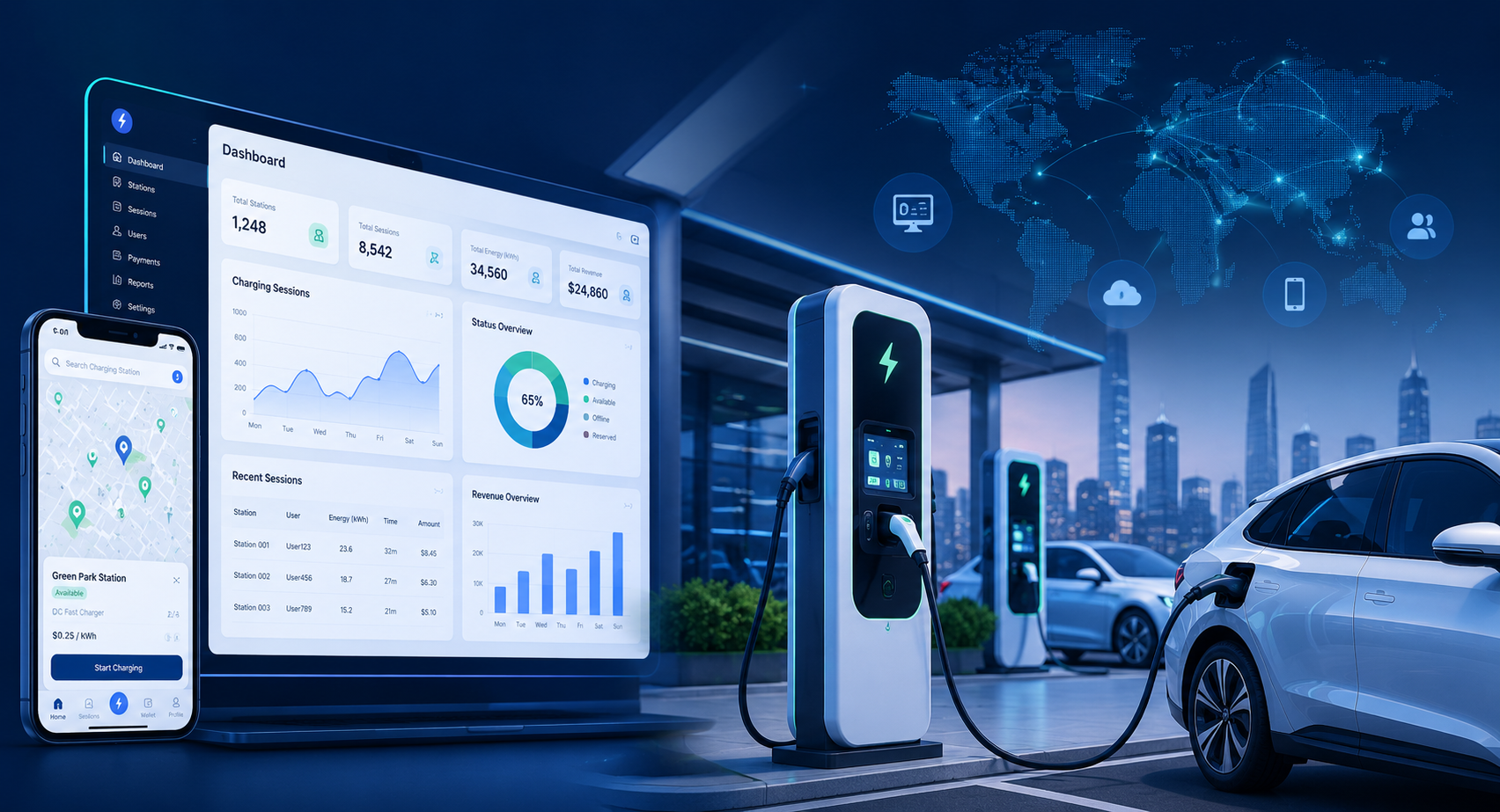
EV charging infrastructure has expanded at a remarkable pace over the past several years, with public charging points now numbering in the millions worldwide and billions of dollars flowing into new site development annually. Yet a striking number of operators, property owners, and fleet managers who have already installed chargers report the same frustration: the hardware is in the ground, but the business isn't actually working the way it should. Sessions fail intermittently. Revenue doesn't reconcile cleanly. Drivers complain about broken chargers that no one noticed were broken. Electrical capacity gets maxed out faster than expected. None of these problems trace back to the chargers themselves — they trace back to the software managing them.
This gap between "we have chargers" and "we have a functioning charging business" is one of the more underappreciated challenges in the EV transition, and it's worth examining closely, because the software layer — often treated as a secondary decision behind hardware procurement — is frequently where the real operational and financial success or failure of a charging network is actually determined.
Why the Pain Points Are Concentrated in the Software Layer
It's a natural assumption that installing quality charging hardware is the hard part of building a charging network, and that everything downstream is comparatively straightforward. In practice, the opposite is often true. Hardware, once installed, is relatively static — it draws power, delivers it to a vehicle, and reports its status. The genuinely complex, ongoing work of running a charging business — authenticating users, processing payment correctly, distributing available power intelligently across multiple simultaneous sessions, detecting and responding to faults, and generating usable financial and operational reporting — all happens in software.
This is precisely why so many of the pain points operators describe aren't hardware failures at all, but symptoms of inadequate, poorly integrated, or under-engineered management software sitting on top of perfectly functional chargers.
The Pain Points Operators Actually Experience
Chargers That Look Fine on Paper but Fail Silently in Practice
One of the most common and most damaging pain points is a charger that's technically online but not actually functioning correctly for the driver trying to use it — a session that won't start, a payment that fails silently, or a charging rate that's far slower than it should be. Without genuinely real-time, granular monitoring, an operator often only discovers this kind of failure after a driver complains, by which point the charger may have been silently broken for days, quietly damaging the network's reputation and turning away repeat users without anyone at the operator level being aware a problem existed at all.
This is compounded by a related issue: dashboards that report a charger as "online" based purely on network connectivity, without any deeper validation of whether the unit is actually completing successful charging sessions. A charger can maintain a stable internet connection while still failing every session a driver attempts — a distinction that matters enormously and that weak monitoring systems routinely miss.
Electrical Capacity Constraints That Cap Growth Unexpectedly
Many charging sites are installed with a fixed electrical service capacity, and operators frequently discover — often after the fact — that adding additional chargers, or even just seeing higher simultaneous usage than anticipated, pushes the site toward or past its electrical limits. Without intelligent, software-driven load management, the available options are limited and expensive: either restrict how many vehicles can charge simultaneously, accept the risk of tripping electrical protections, or fund a costly grid capacity upgrade that could potentially have been avoided or delayed with smarter power allocation across chargers.
This pain point is particularly frustrating because it often isn't apparent during the planning phase. An operator may correctly size electrical infrastructure for expected average usage, only to be caught off guard by legitimate but unanticipated peak demand — a problem that well-designed load management software is specifically built to absorb, but that a basic or poorly configured system simply passes straight through to the site's electrical limits.
Billing, Payment, and Revenue Reconciliation Friction
A recurring complaint among operators running any charging network beyond a handful of stations is the sheer difficulty of getting billing and revenue reconciliation right. Sessions that fail to bill correctly, payment methods that don't process reliably across different regions or currencies, and revenue splits between multiple stakeholders — such as a property owner and a charging network operator sharing income from the same site — that have to be tracked and reconciled manually, all create ongoing administrative burden and, in the worst cases, direct revenue loss.
This friction tends to scale poorly. What might be a manageable manual process across three stations becomes genuinely unworkable across thirty or three hundred, and operators without software built to handle billing complexity at scale often find themselves either underbilling (losing revenue outright) or overbilling (generating disputes and damaging driver trust), sometimes without a clear way to even identify which of the two is actually happening across their network.
Fragmented, Frustrating Driver Experiences
From a driver's perspective, the charging experience is often the most visible symptom of underlying software weakness. Inaccurate real-time availability information that sends a driver to a station only to find it occupied or out of service; payment flows that require juggling multiple apps or cards depending on which network a given charger belongs to; a complete absence of proactive communication when a session completes or a charger malfunctions — these are all pain points that stem directly from software limitations rather than anything wrong with the physical charging equipment itself.
This matters because driver experience directly drives repeat usage, and repeat usage is what makes a charging site commercially viable in the first place. A driver who has one bad experience — a failed payment, a charger that showed as available but wasn't — is measurably less likely to return to that location, regardless of how good the underlying hardware or electricity pricing actually is.
Lack of Interoperability Between Networks
As the charging industry has grown, it has also fragmented, with numerous regional and national networks operating largely independently of one another. For drivers, this often means needing multiple accounts, multiple apps, and multiple payment methods to comfortably travel beyond their home charging network's footprint — a genuinely significant point of friction that operators consistently underestimate the impact of.
For operators specifically, the absence of proper roaming and interoperability support in their management software means missing out on revenue from visiting drivers who would otherwise have used their stations, and it limits the overall attractiveness of their network to any driver whose travel patterns extend beyond a single region. This is a pain point that compounds over time, since networks that fail to build in interoperability early often find retrofitting it later to be a significantly more disruptive and costly undertaking.
Compliance and Security Burden
Charging networks handle payment data and, increasingly, personal information tied to driver accounts and vehicle usage patterns — both of which bring real regulatory obligations that vary by region and continue to evolve. Operators without dedicated compliance expertise frequently find themselves either under-investing in this area, creating genuine legal and security exposure, or over-investing in ad hoc compliance efforts that are expensive and still don't provide the systematic assurance that a properly engineered platform would deliver from the outset.
This pain point is particularly acute for smaller and mid-sized operators who don't have in-house legal or security teams capable of navigating requirements like payment data security standards or regional data protection regulations, and who are often left choosing between expensive external consultants and simply hoping their software vendor has handled it adequately without much visibility into whether that's actually true.
Difficulty Scaling Beyond the Initial Deployment
A pain point that often only becomes apparent well after initial launch is the difficulty of scaling a charging network that was built, whether through custom software or an inadequate off-the-shelf system, without genuine scalability in mind. What functioned reasonably well across five stations begins to strain at fifty, and by several hundred stations, many operators find themselves needing to migrate to an entirely different platform — a process that is expensive, operationally disruptive, and often involves at least some data loss or downtime during the transition.
This scaling pain point is compounded when a network involves multiple types of stakeholders — for instance, an operator managing charging on behalf of several different property owners, each needing their own reporting and revenue visibility — since many simpler platforms aren't architected to support this kind of multi-tenant complexity at all, forcing operators into cumbersome workarounds or, again, a costly platform migration.
Poor Visibility Into What's Actually Happening Across the Network
Many operators report a persistent, low-grade frustration with simply not having clear, trustworthy visibility into how their network is actually performing — which stations are generating meaningful revenue and which are underperforming, where faults are recurring most frequently, how utilization varies by time of day or season, and what their actual margin looks like once maintenance and electricity costs are factored in. Without genuinely useful reporting and analytics, operators are often left making expansion, pricing, and maintenance decisions based on incomplete information or gut instinct rather than solid operational data.
This becomes a particularly serious pain point when an operator needs to report to investors, board members, or, in the case of public sector deployments, government stakeholders — situations where vague or unreliable reporting can directly undermine confidence in the entire operation, regardless of how well the underlying charging infrastructure is actually performing.
What an Ideal EV Charging Station Management Software Should Actually Consist Of
Given the range and depth of these pain points, it's worth being specific about what an ideal EV Charging Station Management Software actually needs to deliver in order to genuinely solve them, rather than simply papering over them with a basic monitoring dashboard.
Deep, verified real-time monitoring that goes beyond simple connectivity status. Rather than reporting a charger as "online" purely because it maintains a network connection, a properly built platform should track actual session success rates, charging speed against expected benchmarks, and specific fault codes — giving operators genuine visibility into whether a charger is actually functioning correctly for drivers, not just technically reachable.
Intelligent, dynamic load management. A strong platform actively distributes available electrical capacity across simultaneous charging sessions in real time, maximizing the number of vehicles that can charge concurrently within a site's existing electrical service, and ideally providing operators with data-driven guidance on when an actual capacity upgrade is genuinely warranted versus when smarter software-driven allocation can absorb growing demand.
Robust, flexible billing architecture built for scale. This means support for multiple pricing models simultaneously, reliable payment processing across relevant currencies and payment methods, and automated, accurate revenue reconciliation — including the ability to correctly split and report revenue across multiple stakeholders sharing income from the same site, without requiring manual intervention as the network grows.
A genuinely seamless, trustworthy driver experience. This includes accurate real-time station availability, reliable payment processing without requiring multiple separate accounts or apps, and proactive communication — notifying drivers when a session completes, when a payment fails, or when a station they were heading toward has gone offline — so that the platform earns driver trust rather than eroding it.
Built-in interoperability and roaming support. Rather than treating cross-network compatibility as an optional add-on, an ideal platform should support industry-standard roaming protocols from the outset, allowing an operator's network to capture revenue from visiting drivers and giving their own users confidence that their access extends meaningfully beyond a single operator's physical footprint.
Comprehensive security and compliance built into the platform's foundation. This means adherence to relevant payment security standards and data protection regulations as a core architectural feature rather than something bolted on after the fact, giving operators genuine assurance — and the ability to demonstrate that assurance to enterprise partners, investors, or regulators — without needing to independently audit or second-guess their software's compliance posture.
A genuinely scalable architecture from day one. An ideal platform should be built to handle significant growth in station count and network complexity without requiring a disruptive migration, and should be capable of supporting multi-tenant scenarios — multiple property owners, multiple operator partners — cleanly, rather than forcing operators into fragile manual workarounds as their business structure grows more complex.
Rich, trustworthy analytics and reporting. Beyond basic uptime and revenue figures, a strong platform should give operators clear visibility into station-level profitability, utilization trends, fault patterns, and the kind of investor- or board-ready reporting that supports confident decision-making rather than guesswork, particularly important as charging networks increasingly need to justify expansion investment or demonstrate return on capital to external stakeholders.
Proactive rather than purely reactive fault management. The strongest platforms don't just report problems after they occur — they use historical performance data to flag likely failures before they happen, allowing maintenance to be scheduled proactively rather than triggered only after a driver has already had a bad experience and a station has already gone offline.
The Cost of Settling for an Inadequate Platform
It's worth being direct about what happens when operators choose — often unknowingly, at the outset — a management platform that falls short of these standards. Revenue leakage from billing errors and unreconciled sessions tends to compound quietly over months, often going unnoticed until a financial review reveals a meaningful gap between expected and actual income. Driver attrition from poor experience directly undermines the utilization rates that determine whether a charging site is actually profitable, since underused stations struggle to justify their installation and ongoing operating costs regardless of how well-located they are. Compliance gaps carry real legal and financial exposure that can surface unexpectedly, often at the worst possible time, such as during a payment security audit or a data protection inquiry. And the eventual need to migrate to a more capable platform, once an operator's network has outgrown an inadequate system, is almost always more expensive, more disruptive, and more risky than choosing appropriately capable software from the outset would have been.
None of this is to suggest that every operator needs the most feature-rich, enterprise-grade platform available from day one — a small residential or single-site deployment has genuinely different requirements than a national public charging network. But it does mean that the software layer deserves the same level of careful evaluation that operators typically apply to hardware selection, site location, and electrical infrastructure planning, rather than being treated as a secondary decision made quickly after the more visible parts of a charging project have already been finalized.
Conclusion
The pain points that plague so many EV charging deployments — unreliable session success, unexpected electrical capacity constraints, billing friction, poor driver experience, lack of interoperability, compliance uncertainty, difficulty scaling, and weak operational visibility — are, almost without exception, symptoms of inadequate software rather than failures of the underlying charging hardware. As the EV charging industry continues its rapid global expansion, the operators who succeed are increasingly the ones who recognize this distinction early and invest accordingly, treating their choice of management software as a foundational business decision rather than an afterthought. An ideal EV Charging Station Management Software isn't defined by any single standout feature, but by how comprehensively it addresses this full range of operational, financial, and driver-facing challenges together — turning a collection of physical chargers into a genuinely reliable, scalable, and profitable charging business.