How to Build a P2P Crypto Exchange: Development Process, Tech Stack & Pricing Explained
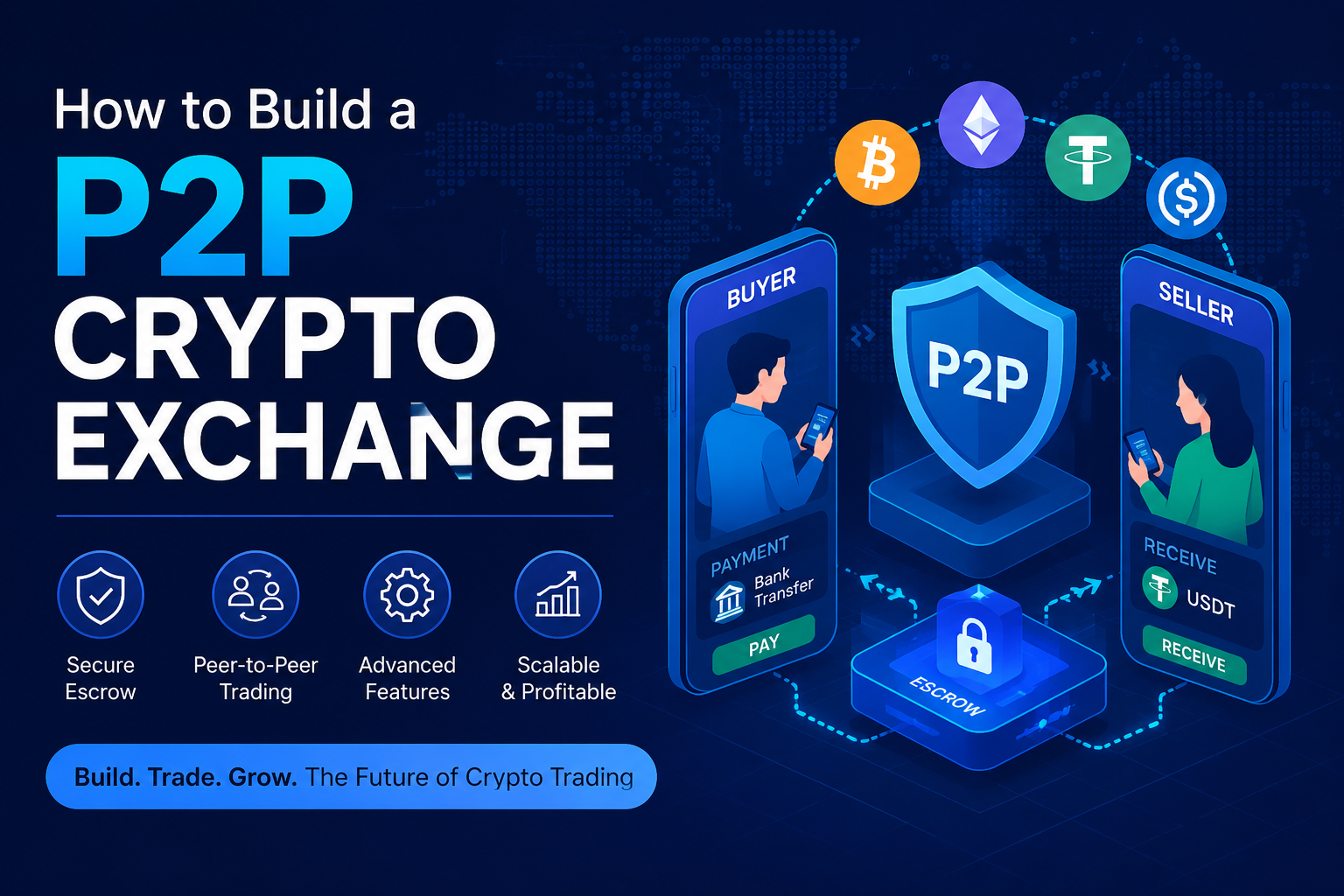
The cryptocurrency industry has evolved far beyond simple buying and selling on centralized exchanges. Today, users demand greater control over their assets, lower transaction fees, enhanced privacy, and direct trading opportunities. This growing demand has made the P2P crypto exchange one of the fastest-growing business models in the blockchain ecosystem. Unlike traditional exchanges that act as intermediaries, a peer-to-peer trading platform allows buyers and sellers to trade digital assets directly while the platform manages escrow, dispute resolution, identity verification, and transaction security.
According to recent industry reports, global cryptocurrency adoption continues to grow across emerging and developed markets, with P2P trading becoming especially popular in regions where banking access is limited or regulations make centralized exchanges less accessible. Businesses entering this market can generate revenue through listing fees, advertisements, premium merchant accounts, transaction commissions, fiat payment integrations, and value-added services.
Whether you're a startup, fintech company, crypto entrepreneur, or enterprise looking to launch your own exchange, understanding the complete P2P crypto exchange development process, technology stack, security requirements, and pricing is essential before investing. This guide explains everything you need to know—from planning and architecture to deployment and maintenance.
What Is a P2P Crypto Exchange?
A P2P crypto exchange is a decentralized marketplace where users trade cryptocurrencies directly with one another instead of relying on a centralized order book. The platform itself doesn't hold users' funds permanently. Instead, it acts as a trusted facilitator by providing escrow services, identity verification, payment settlement support, and dispute management.
Think of it like an online marketplace where buyers and sellers connect directly. Just as platforms like eBay connect buyers and sellers without owning the products, a peer-to-peer trading platform connects crypto traders while ensuring transactions remain secure through smart escrow mechanisms.
The popularity of P2P exchanges has increased because they offer flexibility in payment methods, competitive pricing, lower fees, and greater accessibility across countries with different banking systems. Users can choose from bank transfers, UPI, PayPal, mobile wallets, cash deposits, and many other local payment methods depending on the platform's supported regions.
Businesses also benefit significantly from P2P crypto exchange development because they avoid maintaining large liquidity pools while still earning consistent revenue through transaction fees and premium services.
How Peer-to-Peer Crypto Trading Works
The workflow of a P2P exchange is designed to create trust between two strangers trading online.
A typical transaction follows these steps:
- Seller creates a trade advertisement.
- Buyer selects the offer.
- Cryptocurrency moves into escrow.
- Buyer sends fiat payment.
- Seller confirms payment.
- Escrow releases cryptocurrency.
- Transaction completes.
- Ratings and feedback are updated.
The escrow mechanism is the heart of every successful P2P platform. It ensures neither party can cheat the other during the transaction. If any disagreement arises, administrators can review transaction evidence and resolve disputes fairly.
This trust-based trading model has made P2P exchanges highly attractive in countries with developing financial systems and cross-border payment challenges.
P2P Exchange vs Centralized Exchange
| Feature | P2P Crypto Exchange | Centralized Exchange |
|---|---|---|
| Trading | Direct user-to-user | Platform order matching |
| Custody | Escrow-based | Platform holds funds |
| Liquidity | User-generated | Exchange-managed |
| Payment Methods | Multiple local options | Limited |
| Privacy | Higher | Lower |
| Fees | Usually lower | Often higher |
| Flexibility | High | Moderate |
| Cross-border Support | Excellent | Depends on regulations |
While centralized exchanges remain popular for institutional trading, P2P exchanges continue to dominate regions where localized payment methods and financial inclusion matter most.
Why Businesses Are Investing in P2P Crypto Exchange Development
The demand for P2P crypto exchange development continues to rise because it offers an attractive combination of scalability, recurring revenue, and lower operational costs. Unlike centralized exchanges that require deep liquidity reserves and constant market-making, a P2P platform allows users to provide liquidity by creating buy and sell offers. This significantly reduces the financial burden on platform owners while enabling them to focus on delivering a secure, compliant, and user-friendly trading experience.
Another reason businesses are choosing developing a P2P crypto exchange is the increasing adoption of cryptocurrencies across emerging markets. In many countries, users rely on peer-to-peer trading because traditional banking services may be limited, cross-border payments are expensive, or access to centralized exchanges is restricted. A well-designed P2P platform bridges these gaps by supporting local payment methods such as bank transfers, UPI, digital wallets, and regional payment gateways.
From a business perspective, the monetization opportunities are diverse. Revenue can be generated through transaction commissions, merchant subscriptions, featured listings, advertising, fiat withdrawal fees, token listing charges, and premium verification services. As trading volume grows, these recurring revenue streams can scale significantly without requiring a proportional increase in operating costs.
Businesses also gain flexibility by integrating additional blockchain services into their ecosystem. Many companies combine a P2P exchange with a Crypto payment gateway development solution, allowing merchants to accept cryptocurrency payments directly through the same platform. This creates an all-in-one ecosystem that attracts traders, businesses, and payment providers while increasing customer retention.
Market Growth and Adoption
Several industry trends continue to fuel demand for P2P exchanges:
- Growing global cryptocurrency ownership
- Rising cross-border crypto payments
- Expansion of stablecoin usage
- Increased demand for self-custody
- Growth of decentralized finance (DeFi)
- Wider blockchain adoption among businesses
- Government exploration of digital assets
- Better blockchain infrastructure and scalability
These factors indicate that the P2P trading model will remain a significant part of the digital asset ecosystem for years to come.
Revenue Opportunities
A successful P2P crypto exchange can generate revenue through multiple channels instead of relying solely on transaction fees.
| Revenue Model | Description |
|---|---|
| Trading Fees | Commission charged per completed trade |
| Merchant Accounts | Subscription plans for high-volume traders |
| Featured Ads | Paid promotion of trading offers |
| Withdrawal Fees | Fiat and crypto withdrawal charges |
| Token Listings | Listing fees for new cryptocurrencies |
| Escrow Fees | Premium escrow services |
| Advertising | Sponsored banners and promotions |
| API Access | Paid developer APIs for institutional users |
Having multiple income streams improves long-term profitability and reduces dependence on market volatility.
Top 3 Successful and Profitable P2P Crypto Exchanges
Studying established platforms provides valuable insights into the features, security standards, and business models that users expect. While every platform has its own strengths, the following exchanges have demonstrated how effective P2P marketplaces can attract millions of users worldwide.
1. Binance P2P
Binance P2P is widely recognized as one of the largest peer-to-peer cryptocurrency marketplaces globally. It supports hundreds of payment methods across numerous countries, allowing users to buy and sell digital assets directly using local currencies. Its integrated escrow system, merchant verification process, and user rating mechanism help maintain trust and reduce fraud. The platform also benefits from Binance's broader ecosystem, enabling seamless movement of assets between spot trading, futures, staking, and wallets.
2. Bybit P2P
Bybit P2P has gained popularity by offering a streamlined trading interface, competitive fees, and support for multiple fiat currencies. The platform emphasizes quick trade execution, merchant verification, and secure escrow services. It also integrates seamlessly with Bybit's broader trading products, making it attractive for users who want both peer-to-peer and traditional exchange services in one ecosystem.
3. OKX P2P
OKX P2P is another leading marketplace known for its global reach and support for a wide variety of payment methods. It offers zero-fee P2P trading in many regions, advanced security measures, and an intuitive user experience. Features such as merchant badges, reputation scores, and efficient dispute resolution contribute to a reliable trading environment, making it a preferred choice for many retail and professional traders.
Each of these platforms demonstrates that success in the P2P exchange market depends on more than just facilitating trades. Strong security, intuitive design, responsive customer support, compliance with local regulations, and continuous feature enhancements are all essential for building user trust and sustaining long-term growth.
Essential Features of a Reliable P2P Crypto Exchange
The success of a P2P crypto exchange depends largely on the features it offers. Modern crypto traders expect much more than a simple buy-and-sell interface. They look for speed, security, transparency, multiple payment options, and a seamless user experience across web and mobile platforms. When developing a P2P crypto exchange, businesses should prioritize features that build trust while simplifying the trading process. A platform with limited functionality may attract initial users, but retaining them requires a secure ecosystem that minimizes fraud and provides smooth transactions.
A reliable platform should also be scalable enough to support thousands of concurrent users without compromising performance. As trading volumes increase, features like automated dispute resolution, AI-powered fraud detection, and advanced analytics become increasingly valuable. Businesses planning long-term growth should design their platform with modular architecture, allowing new services such as staking, crypto lending, NFT trading, or fiat payment integrations to be added later. Partnering with an experienced P2P crypto exchange software development company helps ensure these capabilities are built into the platform from the beginning, reducing future redevelopment costs and accelerating time-to-market.
User Features
Every successful peer-to-peer trading platform should include the following user-centric features:
| Feature | Purpose |
|---|---|
| User Registration | Secure signup with email, phone, or social login |
| KYC Verification | Verify user identities and ensure compliance |
| Escrow Wallet | Protect both buyers and sellers during trades |
| Multi-Currency Wallet | Store and manage multiple cryptocurrencies |
| Trade Listings | Create buy and sell advertisements |
| Advanced Search Filters | Filter by payment method, currency, region, and price |
| Real-Time Chat | Secure communication between traders |
| Multiple Payment Methods | Bank transfer, UPI, PayPal, cards, e-wallets, etc. |
| Trade History | Complete transaction records |
| Ratings & Reviews | Build trust among traders |
| Push Notifications | Instant updates on trade activity |
| Two-Factor Authentication | Additional account security |
These features improve usability while encouraging repeat engagement. A simple, intuitive interface combined with robust security measures can significantly increase user retention and trading volume.
Admin Features
The administrative dashboard is equally important because it enables platform operators to manage users, monitor transactions, and maintain compliance. Essential admin capabilities include:
- User and merchant management
- KYC approval workflows
- Trade monitoring
- Escrow management
- Dispute resolution tools
- Commission management
- Payment method configuration
- AML monitoring
- Fraud detection dashboard
- Analytics and reporting
- Content management
- System notifications
- Security logs
- Role-based access control
A centralized admin panel gives operators complete visibility into platform activities, helping them respond quickly to security threats and operational issues while maintaining a smooth trading experience.
P2P Crypto Exchange Development Process
Launching a successful P2P crypto exchange requires much more than writing code. It involves strategic planning, regulatory compliance, secure architecture, user-centric design, and continuous optimization. Every stage of the P2P crypto exchange development process plays a critical role in determining the platform's scalability, security, and profitability. Skipping important steps often results in technical debt, security vulnerabilities, or compliance issues that become expensive to fix later.
A structured development approach also shortens time-to-market and improves product quality. By breaking the project into clearly defined phases, businesses can validate assumptions, gather user feedback, and make informed improvements throughout development. Collaborating with an experienced blockchain app development company ensures that blockchain integration, smart contract development, wallet management, and security best practices are implemented correctly from day one.
Step 1: Business Analysis & Market Research
The first stage focuses on understanding the target audience, competitors, regulations, and revenue model.
Key activities include:
- Market analysis
- Competitor research
- User persona creation
- Compliance assessment
- Feature prioritization
- Revenue planning
A strong business strategy lays the foundation for every technical decision that follows.
Step 2: UI/UX Design
User experience directly influences platform adoption. A clean, intuitive interface encourages users to complete transactions with confidence.
Design deliverables include:
- Wireframes
- User journey mapping
- Interactive prototypes
- Mobile responsiveness
- Accessibility optimization
The design should minimize friction while guiding users smoothly through registration, verification, trading, and withdrawals.
Step 3: Blockchain Architecture
This phase defines the technical foundation of the exchange.
Key decisions include:
- Blockchain selection
- Wallet architecture
- Escrow mechanism
- Smart contract logic
- Asset support
- Transaction flow
Popular blockchain networks include Ethereum, BNB Chain, Polygon, Solana, Tron, Avalanche, and Base, depending on transaction costs, scalability, and ecosystem maturity.
Step 4: Core Platform Development
Developers begin building the platform's essential modules.
This typically includes:
- User authentication
- Wallet integration
- Escrow system
- Trading engine
- Payment integration
- Chat functionality
- Notification system
- Admin dashboard
- Merchant management
- Reporting system
Each module should be independently scalable to support future upgrades.
Step 5: Smart Contract Development
Smart contracts automate critical business logic, including:
- Escrow locking
- Asset release
- Transaction validation
- Settlement automation
- Fee distribution
Every contract should undergo rigorous auditing before deployment to minimize security risks.
Step 6: Payment Gateway Integration
A modern P2P exchange should support multiple fiat payment options to serve users across different regions. Integrating reliable banking systems and digital payment methods makes transactions faster and more convenient. Businesses looking to expand payment capabilities often combine their exchange with Crypto payment gateway development, enabling merchants and traders to send and receive crypto payments seamlessly within the same ecosystem.
Step 7: Security Testing
Security is non-negotiable in crypto applications.
Testing includes:
- Penetration testing
- Smart contract audits
- Load testing
- API testing
- Vulnerability assessments
- Wallet security checks
- DDoS protection validation
Regular security reviews should continue even after launch to address emerging threats.
Step 8: Deployment & Ongoing Maintenance
Once testing is complete, the platform is deployed to production. However, launch is only the beginning.
Post-launch activities include:
- Performance monitoring
- Feature updates
- Bug fixes
- Security patches
- Compliance updates
- Customer support
- Infrastructure scaling
Continuous improvement helps maintain user trust and keeps the platform competitive in a rapidly evolving market.
P2P Crypto Exchange Development Tech Stack
Choosing the right P2P crypto exchange development tech stack is essential for building a secure, scalable, and high-performance platform. The technology stack determines how efficiently the exchange handles user traffic, processes transactions, integrates blockchain networks, and protects sensitive data. A poorly selected stack can lead to slower performance, security vulnerabilities, and increased maintenance costs, while the right combination of technologies ensures long-term scalability and easier feature expansion.
Most modern exchanges follow a microservices architecture, allowing different components such as user management, wallets, escrow services, and payment processing to operate independently. This improves system reliability and makes updates easier without affecting the entire platform. Businesses investing in enterprise-grade crypto exchange development services often choose cloud-native infrastructure to ensure high availability, automatic scaling, and disaster recovery.
| Layer | Technologies |
|---|---|
| Frontend | React.js, Next.js, Vue.js, Angular |
| Mobile | Flutter, React Native, Swift, Kotlin |
| Backend | Node.js, NestJS, Python, Go, Java |
| Database | PostgreSQL, MongoDB, Redis |
| Blockchain | Ethereum, Solana, Polygon, BNB Chain, Tron |
| Smart Contracts | Solidity, Rust |
| Wallet Integration | WalletConnect, MetaMask, Trust Wallet |
| Cloud | AWS, Azure, Google Cloud |
| Containerization | Docker, Kubernetes |
| CI/CD | GitHub Actions, Jenkins, GitLab CI |
| Monitoring | Grafana, Prometheus |
| Messaging | Kafka, RabbitMQ |
| Authentication | OAuth 2.0, JWT, Firebase Auth |
| Storage | IPFS, AWS S3 |
Security Technologies
A secure exchange should also implement:
- AES-256 encryption
- SSL/TLS protocols
- Multi-signature wallets
- Cold wallet storage
- Hardware Security Modules (HSMs)
- Two-Factor Authentication (2FA)
- Anti-phishing protection
- AI-based fraud detection
- Rate limiting
- Web Application Firewall (WAF)
Building a future-ready P2P exchange requires balancing innovation with security and compliance. Selecting proven technologies and working with experienced blockchain engineers significantly reduces development risks while creating a platform capable of handling growing user demand.
Main Challenges in P2P Exchange Development
Building a P2P crypto exchange is far more complex than creating a standard web application. Since the platform facilitates financial transactions involving digital assets, it must operate with the highest standards of security, compliance, reliability, and scalability. Businesses often underestimate the technical and regulatory complexities involved in developing a P2P crypto exchange, leading to delays, increased costs, or operational risks after launch. Understanding these challenges early allows companies to make informed architectural decisions and avoid costly mistakes.
The most successful platforms continuously invest in security upgrades, infrastructure optimization, and regulatory compliance to stay competitive. As the cryptocurrency landscape evolves, exchanges must also adapt to changing user expectations, blockchain innovations, and government regulations. Businesses working with an experienced blockchain app development company gain access to industry expertise that helps overcome these obstacles while accelerating development.
1. Regulatory Compliance
Cryptocurrency regulations differ across countries, making compliance one of the biggest challenges in P2P crypto exchange development.
Businesses should consider:
- KYC (Know Your Customer)
- AML (Anti-Money Laundering)
- GDPR compliance
- Data privacy regulations
- FATF Travel Rule
- Local licensing requirements
- Tax reporting obligations
Building compliance into the platform from the beginning reduces legal risks and improves user confidence.
2. Security Threats
Crypto exchanges remain prime targets for hackers due to the value of digital assets they manage.
Common threats include:
- Wallet attacks
- Phishing attempts
- DDoS attacks
- Smart contract vulnerabilities
- API exploitation
- Credential theft
- Insider threats
Mitigation strategies include multi-factor authentication, cold wallet storage, encryption, regular penetration testing, smart contract audits, and continuous security monitoring.
3. Fraud Prevention
Since P2P trading connects individual buyers and sellers, fraudulent activities such as fake payment confirmations or identity misuse can occur.
Effective fraud prevention measures include:
- AI-powered transaction monitoring
- Merchant verification
- Escrow protection
- Risk scoring
- Behavioral analytics
- Real-time payment verification
- User reputation systems
These tools help create a trustworthy marketplace while reducing operational disputes.
4. Liquidity Management
Unlike centralized exchanges, P2P platforms rely on users to create buy and sell offers. During the early stages, limited trading activity can affect user experience.
Businesses can improve liquidity by:
- Onboarding verified merchants
- Offering trading incentives
- Reducing transaction fees initially
- Supporting multiple fiat currencies
- Expanding payment methods
- Running referral programs
A healthy marketplace encourages more users to participate, creating a positive network effect.
5. Scalability
As trading volumes grow, the platform must handle increased traffic without compromising performance.
Scalable infrastructure should support:
- High transaction throughput
- Real-time messaging
- Fast database queries
- Distributed cloud architecture
- Auto-scaling services
- Load balancing
- Disaster recovery
Planning for scalability from day one prevents expensive infrastructure redesigns later.
How Much Does P2P Crypto Exchange Development Cost?
One of the most common questions businesses ask is, "How much does P2P crypto exchange development cost?" The answer depends on several factors, including platform complexity, supported features, blockchain integrations, compliance requirements, UI/UX design, and ongoing maintenance. A simple minimum viable product (MVP) with essential trading functionality costs significantly less than an enterprise-grade exchange supporting multiple cryptocurrencies, advanced security, AI-driven fraud detection, and global payment integrations.
The cost of P2P crypto exchange development should be viewed as a long-term investment rather than a one-time expense. A scalable and secure platform can generate recurring revenue through transaction fees, premium merchant accounts, token listings, advertisements, and other monetization models. Investing in quality development also reduces future maintenance costs and minimizes security risks.
Estimated Development Cost
| Project Type | Estimated Cost | Timeline |
|---|---|---|
| MVP Platform | $25,000 – $50,000 | 2–4 Months |
| Startup-Level Exchange | $50,000 – $100,000 | 4–6 Months |
| Mid-Scale Exchange | $100,000 – $180,000 | 6–9 Months |
| Enterprise Exchange | $180,000 – $350,000+ | 9–12+ Months |
Cost Breakdown
| Component | Estimated Share |
|---|---|
| UI/UX Design | 10% |
| Frontend Development | 15% |
| Backend Development | 25% |
| Blockchain Integration | 20% |
| Smart Contracts | 10% |
| Security Testing | 8% |
| DevOps & Deployment | 5% |
| Project Management & QA | 7% |
Factors Affecting Development Cost
Several variables influence the final project budget:
- Number of supported cryptocurrencies
- Multi-chain compatibility
- Smart contract complexity
- Wallet integrations
- Number of payment gateways
- KYC/AML implementation
- Admin dashboard functionality
- Mobile application development
- AI-powered fraud detection
- Third-party API integrations
- Cloud infrastructure
- Ongoing maintenance and support
Businesses should prioritize scalability and security over minimizing upfront costs. A robust foundation reduces technical debt and ensures the platform can grow alongside user demand.
Choosing the Right Development Partner
Selecting the right technology partner is one of the most important decisions in the entire development journey. A reliable development company not only builds the platform but also provides strategic guidance on blockchain architecture, compliance, security, and future scalability. The right partner understands industry best practices, follows secure coding standards, and has experience delivering enterprise-grade blockchain applications.
When evaluating vendors, review their portfolio, technical expertise, client testimonials, security practices, and post-launch support offerings. Look for companies with proven experience in cryptocurrency exchanges, wallet development, smart contracts, and blockchain infrastructure. If you're planning a complete crypto ecosystem, choose a partner that offers crypto exchange development services, Crypto payment gateway development, and broader blockchain expertise under one roof. This approach simplifies integration, reduces communication gaps, and accelerates project delivery.
What to Look For
- Proven blockchain development experience
- Expertise in smart contract development
- Strong cybersecurity practices
- Regulatory compliance knowledge
- Scalable cloud architecture
- Transparent development process
- Dedicated QA and testing team
- Ongoing maintenance and support
- Flexible engagement models
- Clear communication and documentation
A trusted P2P crypto exchange software development company can help transform your business idea into a secure, scalable, and revenue-generating trading platform.