How Smart Contracts Eliminate Trust Issues in Prediction Market Platforms
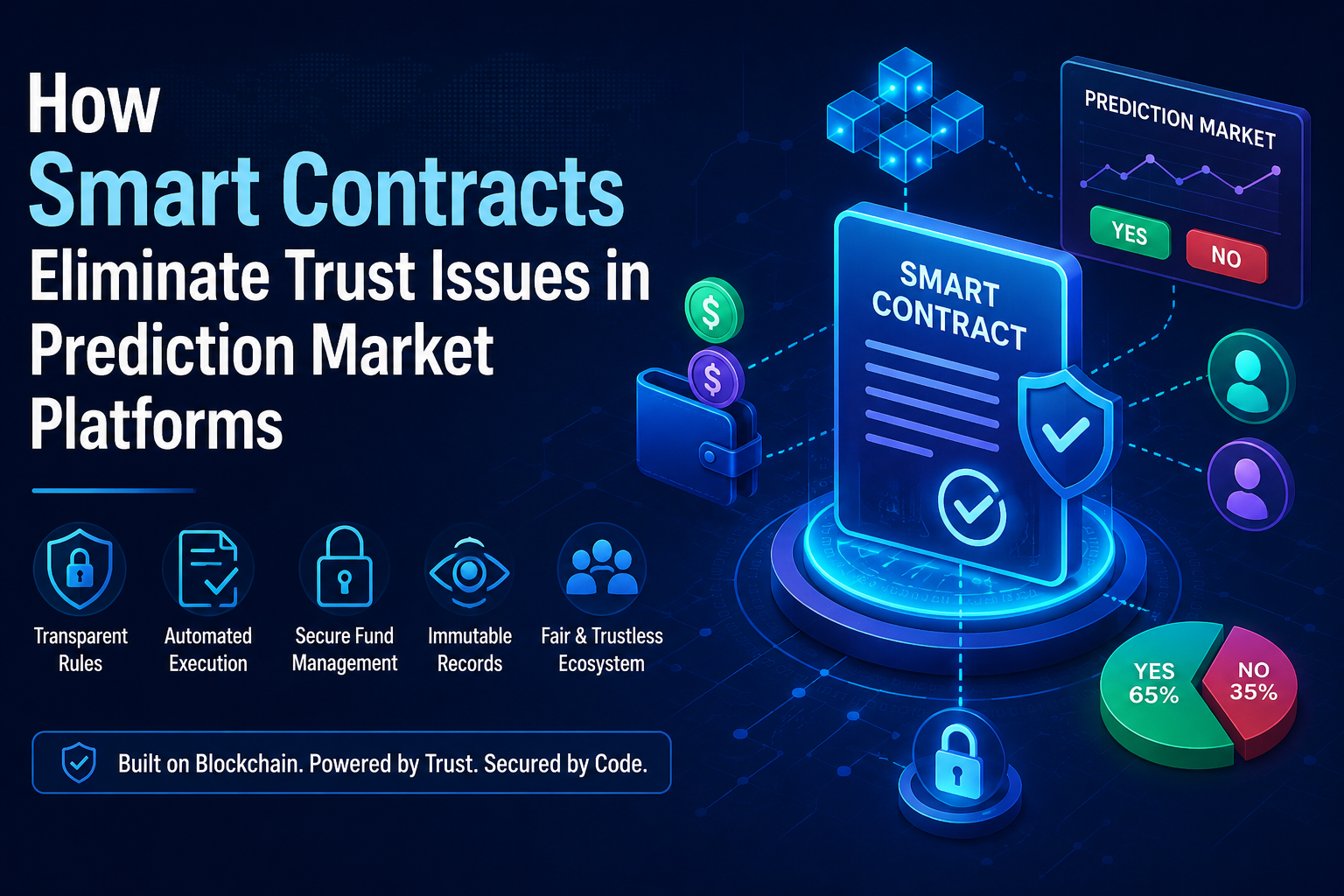
Prediction markets have evolved far beyond simple betting applications. Today, they help people forecast everything from cryptocurrency prices and sports events to elections and financial trends. But one challenge has always remained the same—trust.
When users deposit funds on a centralized platform, they rely on the operator to manage money securely, verify outcomes fairly, and release payouts on time. If any part of that process lacks transparency, user confidence quickly declines.
This is where smart contracts are changing the game. By automating transactions and enforcing predefined rules on the blockchain, they eliminate the need to trust a third party. Every action becomes transparent, verifiable, and tamper-resistant.
In this guide, you'll learn how smart contracts solve trust issues in prediction market platforms, the benefits they offer, and why they have become the foundation of modern decentralized prediction ecosystems.
Understanding Smart Contracts
Smart contracts are digital agreements stored on a blockchain that execute automatically when predefined conditions are met. Instead of depending on a person or organization to complete a transaction, the blockchain handles everything.
Think of a vending machine.
You insert money, choose a product, and the machine instantly delivers it. There is no cashier involved. Smart contracts work in a similar way—they automatically execute the agreed rules without requiring manual approval.
Key Characteristics of Smart Contracts
- Self-executing
- Blockchain-based
- Tamper-resistant
- Transparent
- Secure
- Automated
Because every transaction is recorded on the blockchain, users can independently verify what happened instead of relying solely on platform operators.
How Smart Contracts Work
A smart contract follows a simple logic:
If a predefined condition is met, the programmed action executes automatically.
For example:
- User places a prediction.
- Funds are locked in the smart contract.
- Event outcome is verified.
- Winners receive payouts automatically.
No administrator needs to manually approve payments.
This reduces delays while improving transparency throughout the process.
What Is a Prediction Market Platform?
A prediction market platform allows users to forecast future events by staking digital assets or tokens on their predictions.
Users earn rewards if their predictions are correct.
Prediction markets can cover various categories, including:
- Cryptocurrency prices
- Stock market movements
- Elections
- Sports
- Entertainment awards
- Weather forecasts
- Economic indicators
Instead of relying on a central authority, decentralized prediction markets use blockchain technology and smart contracts to automate transactions and payouts.
Traditional vs Decentralized Prediction Markets
| Feature | Traditional Platform | Decentralized Platform |
|---|---|---|
| Fund Control | Platform | Smart Contract |
| Payout Process | Manual | Automatic |
| Records | Private Database | Public Blockchain |
| Transparency | Limited | High |
| Trust Model | Company | Blockchain |
Why Trust Is the Biggest Challenge
Trust is one of the most valuable assets for any prediction platform.
Users aren't just predicting outcomes—they're also trusting the platform with their money.
Unfortunately, centralized systems often face issues such as:
- Delayed withdrawals
- Manual payout approvals
- Hidden platform rules
- Limited transaction visibility
- Fund management concerns
- Disputed outcomes
Even if a platform is legitimate, users usually cannot verify what happens behind the scenes.
This uncertainty discourages participation and affects long-term growth.
Common Trust Issues in Prediction Platforms
1. Delayed Payouts
Waiting days for rewards creates frustration.
Users begin questioning whether the platform is intentionally holding funds or facing operational problems.
2. Lack of Transparency
Most centralized platforms don't publicly show:
- How results are verified
- How payouts are calculated
- How funds are managed
This creates unnecessary uncertainty.
3. Centralized Control
A single organization usually controls:
- User funds
- Transaction approvals
- Platform policies
- Withdrawals
This introduces a single point of failure.
4. Possibility of Human Error
Manual operations increase the chances of:
- Payment mistakes
- Incorrect settlements
- Processing delays
- Administrative errors
Automation significantly reduces these risks.
Why Blockchain Changes Everything
Blockchain introduces something traditional systems cannot easily provide:
Verifiable trust.
Every transaction becomes:
- Publicly visible
- Cryptographically secured
- Time-stamped
- Immutable
- Independently verifiable
Instead of trusting a company, users trust blockchain consensus.
This creates a much stronger foundation for prediction markets.
How Smart Contracts Solve These Problems
Smart contracts replace manual operations with automated blockchain logic.
Instead of waiting for administrators to process every action, the blockchain follows predefined rules that apply equally to everyone.
Smart contracts automatically handle:
- User deposits
- Prediction entries
- Fund locking
- Event settlement
- Reward distribution
- Transaction recording
Because these actions occur automatically, users gain greater confidence in the platform.
Quick Example
Imagine predicting that Bitcoin will cross $150,000 before a certain date.
Here's what happens:
- You submit your prediction.
- Your funds are locked by a smart contract.
- The platform waits for the event deadline.
- A trusted oracle provides the final market price.
- The smart contract verifies the outcome.
- Winners receive rewards automatically.
No administrator manually approves anything.
How Smart Contracts Eliminate Trust Issues in Prediction Market Platforms
Trust is the biggest reason decentralized prediction markets are gaining popularity. Instead of depending on a company to manage transactions, smart contracts automate the entire process using blockchain technology.
Let's explore the key ways they eliminate trust issues.
1. Transparent Rules From Day One
One of the biggest concerns in traditional prediction platforms is that users don't always know how decisions are made.
Questions like these are common:
- How are winners selected?
- How are payouts calculated?
- Can platform rules change later?
- What happens if there's a dispute?
With smart contracts, these rules are written into blockchain code before the market even opens.
Every participant can verify:
- Prediction conditions
- Market opening and closing time
- Winning criteria
- Payout formula
- Platform fees
- Settlement process
Because these rules are publicly available, users don't have to rely on promises made by the platform.
Why this matters
- Builds transparency
- Prevents hidden rule changes
- Creates equal opportunities for all users
- Reduces disputes
Instead of trusting people, users trust code.
2. Automated Payouts Without Manual Approval
Delayed payouts are one of the fastest ways to lose user trust.
In centralized platforms, payouts often require:
- Manual verification
- Payment approval
- Internal reviews
- Banking processes
These steps can delay rewards by hours or even days.
Smart contracts eliminate these bottlenecks.
Once the event outcome is verified, the contract automatically distributes rewards to the winners.
Benefits of automated payouts
- Instant settlements
- No human intervention
- Fewer payment errors
- Faster user experience
- Greater transparency
This creates a seamless experience where users know exactly when and how they'll receive their winnings.
3. Immutable Records Prevent Manipulation
Traditional databases can be edited by administrators.
Blockchain records cannot.
Every action performed by a smart contract is permanently stored on the blockchain.
This includes:
- Prediction submissions
- Deposits
- Withdrawals
- Payouts
- Settlement history
Once recorded, this information cannot be altered without network consensus.
Why immutable records matter
- Prevent fraud
- Improve transparency
- Simplify audits
- Reduce disputes
- Create permanent proof of transactions
Users can verify every transaction independently using blockchain explorers.
4. Smart Contracts Secure User Funds
Another major trust issue is fund management.
In centralized systems, users transfer money directly to the platform.
This creates concerns such as:
- Is my money safe?
- Can the platform misuse funds?
- What happens if the company shuts down?
Smart contracts solve this through escrow-based fund management.
Instead of being controlled by administrators, funds remain locked inside the smart contract until predefined conditions are met.
Here's how it works
- User joins a prediction market.
- Assets are deposited into the smart contract.
- Funds remain locked securely.
- Event outcome is verified.
- Winners receive payouts automatically.
At no point can platform administrators arbitrarily move user funds.
Advantages
- Better fund security
- Transparent transactions
- Reduced custodial risk
- Greater user confidence
5. Equal Rules for Every Participant
Trust also depends on fairness.
Every participant expects equal treatment regardless of investment size.
Smart contracts make this possible.
They execute identical rules for every transaction.
Whether someone predicts with $10 or $10,000, the contract follows the same predefined logic.
This ensures
- No favoritism
- No manual overrides
- Consistent payouts
- Fair participation
- Transparent execution
Because the blockchain treats every wallet equally, users have greater confidence in the platform.
6. Public Transaction Verification
One major advantage of blockchain is that transactions are publicly verifiable.
Users no longer need to rely solely on platform reports.
Instead, they can verify:
- Transaction hashes
- Wallet transfers
- Market settlements
- Reward distribution
- Contract execution
Everything is available on-chain.
Why public verification matters
- Improves accountability
- Reduces fraud
- Enables independent audits
- Builds long-term trust
This transparency is one of the biggest differences between decentralized and traditional prediction platforms.
7. Reliable Event Verification Through Oracles
Smart contracts can automate transactions, but they cannot access real-world information on their own.
They rely on blockchain oracles to provide verified external data.
For example, an oracle can confirm:
- Bitcoin's closing price
- Election results
- Match outcomes
- Commodity prices
- Weather data
Once the oracle submits verified information, the smart contract automatically settles the market.
- A reliable oracle provides
- Accurate event data
- Faster settlements
- Tamper-resistant reporting
- Improved platform reliability
Using decentralized oracle networks also reduces the risk of relying on a single data source.
Real-World Example
Imagine a prediction market where users forecast whether Ethereum will exceed $6,000 before a specific date.
Here's what happens behind the scenes:
| Step | Smart Contract Action |
|---|---|
| User joins market | Accepts prediction and locks funds |
| Prediction period ends | Stops accepting new entries |
| Oracle submits ETH price | Receives verified market data |
| Contract checks outcome | Compares prediction with actual result |
| Winners identified | Calculates rewards automatically |
| Funds distributed | Sends payouts directly to winners |
Why Businesses Are Adopting Smart Contracts
Businesses are embracing smart contracts because they simplify operations while improving user trust.
Some of the biggest business benefits include:
- Lower operational costs
- Automated settlements
- Reduced fraud risks
- Better transparency
- Easier auditing
- Higher customer confidence
- Improved scalability
For organizations planning to launch decentralized forecasting solutions, partnering with a trusted prediction market platform development company helps ensure secure smart contract architecture, audited blockchain integrations, and scalable platform design from day one.
Key Features of Smart Contracts That Build User Trust
Smart contracts are more than automated payment systems. They provide the core functionality that makes decentralized prediction markets transparent, secure, and reliable.
Here are the features that make them indispensable.
| Feature | How It Improves Trust |
|---|---|
| Automated Execution | Removes manual approvals and human intervention |
| Immutable Records | Prevents data manipulation after transactions are recorded |
| Transparent Rules | Allows users to verify platform logic before participating |
| Escrow-Based Fund Management | Protects user funds until market settlement |
| Oracle Integration | Uses verified real-world data for accurate results |
| Public Audit Trail | Every transaction is visible on the blockchain |
| Decentralized Validation | Reduces dependence on a single authority |
Benefits of Smart Contracts in Prediction Market Platforms
Smart contracts benefit both platform operators and users by making prediction markets more efficient, transparent, and scalable.
Benefits for Users
Participants gain greater confidence because every transaction follows predefined blockchain rules.
Key advantages include:
- Faster payouts
- Transparent transactions
- Secure fund management
- Fair participation
- Lower risk of manipulation
- Better privacy
- Easy transaction verification
Since everything is recorded on-chain, users can independently verify deposits, withdrawals, and reward distributions.
Benefits for Businesses
Businesses also gain significant operational advantages through automation.
Instead of manually handling every transaction, smart contracts streamline platform management and reduce administrative overhead.
Business benefits include:
- Lower operational costs
- Automated settlements
- Reduced human errors
- Better scalability
- Improved customer trust
- Simplified auditing
- Stronger platform reputation
These efficiencies allow businesses to focus more on innovation and user acquisition instead of repetitive administrative tasks.
Conclusion
Trust has always been the biggest obstacle for prediction market platforms. Users want assurance that their funds are secure, results are fair, and payouts happen without unnecessary delays.
Smart contracts solve these challenges by replacing manual processes with transparent blockchain automation. They execute predefined rules, lock funds securely, automate settlements, and maintain immutable transaction records that anyone can verify.
Combined with decentralized oracles and secure blockchain infrastructure, smart contracts create a prediction ecosystem where transparency is built into every transaction. Instead of trusting a central authority, users trust the technology itself.
If you're planning to build prediction market platform solutions, integrating audited smart contracts, reliable oracle networks, and scalable blockchain architecture from the start will help create a secure, transparent, and future-ready platform that users can trust.