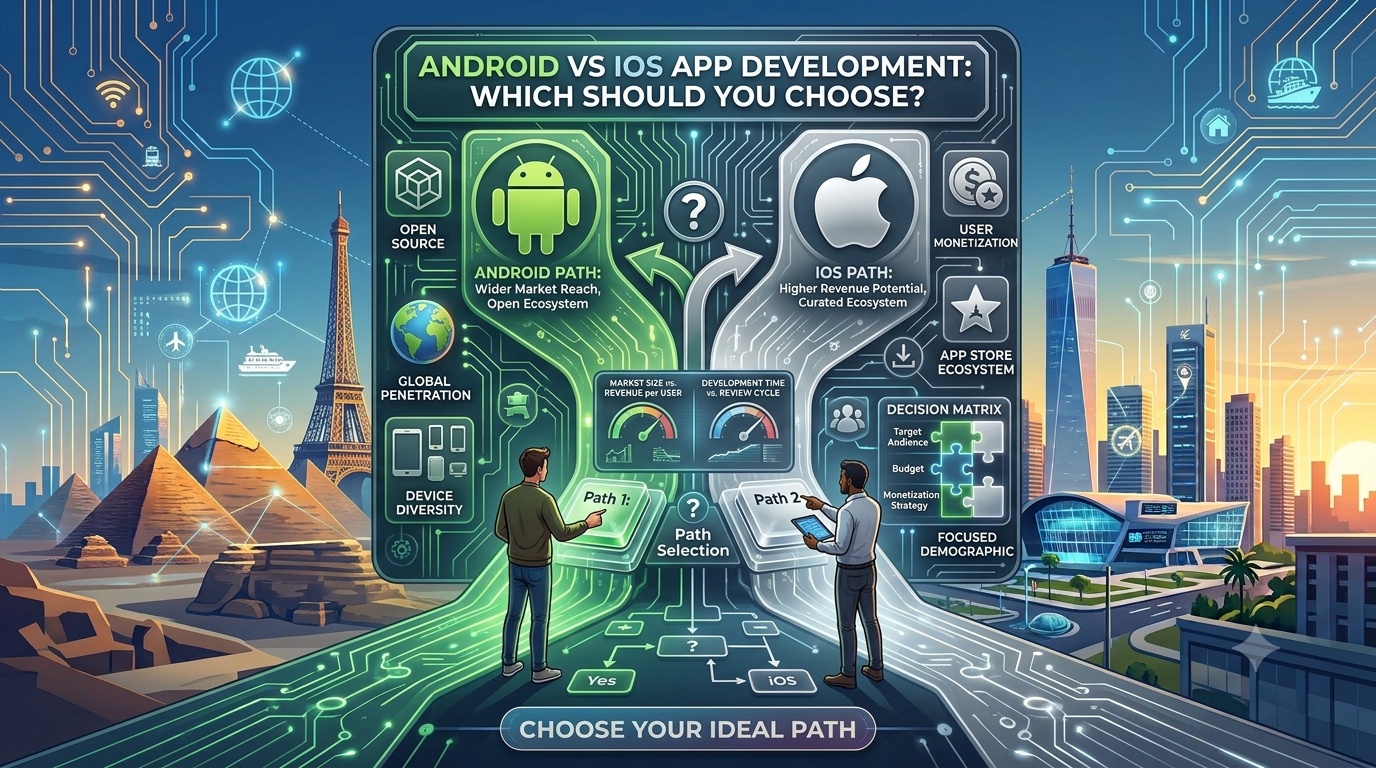
In today's mobile-first world, launching an app is no longer just an option it's a strategic move for businesses looking to improve customer engagement, increase revenue, and stay ahead of the competition. However, one of the first decisions you'll face is choosing between Android and iOS app development.
Both platforms dominate the global smartphone market, but they serve different audiences and offer unique advantages. Your decision should depend on your business goals, target audience, budget, and long-term growth strategy.
In this guide, we'll compare Android and iOS app development in detail to help you determine which platform is the right fit for your business.
Understanding Android and iOS App Development
Android app development involves building applications for devices running Google's Android operating system. These apps are primarily developed using Kotlin or Java and are published on the Google Play Store.
On the other hand, iOS app development focuses on Apple's ecosystem, including iPhones and iPads. Developers typically use Swift or Objective-C to create apps that are distributed through the Apple App Store.
Although both platforms allow businesses to create feature-rich mobile applications, the user experience, development process, and business opportunities differ significantly.
Android vs. iOS App Development: Key Differences
1. Market Share and User Base
Android leads the global smartphone market with a significantly larger user base, especially across Asia, Africa, and South America. Businesses aiming to reach the widest possible audience often prioritize Android development.
Meanwhile, iOS has a strong presence in countries like the United States, Canada, Australia, Japan, and much of Western Europe. Apple users are generally known for higher spending on apps and digital services.
Choose Android if:
- You want maximum global reach.
- Your audience spans multiple countries.
- Your app targets budget-conscious consumers.
Choose iOS if:
- Your customers are located in premium markets.
- You're targeting professionals or high-income users.
- You plan to monetize through subscriptions or in-app purchases.
2. Development Cost
The cost of app development depends on complexity, features, integrations, and maintenance requirements.
Android development often requires additional testing because apps must support hundreds of devices with different screen sizes and hardware specifications. This can increase development time and overall costs.
iOS development is generally more streamlined because Apple offers a limited number of devices with standardized hardware.
If your goal is to launch an MVP quickly, iOS may require slightly less development effort. However, businesses looking for broad device compatibility often invest in custom Android app development services to ensure a seamless user experience across different devices.
3. Development Speed
Since Apple devices have fewer screen sizes and operating system variations, iOS apps are usually faster to build, test, and deploy.
Android developers must ensure compatibility across various manufacturers like Samsung, Google, Xiaomi, OnePlus, Motorola, and many others.
If speed to market is your highest priority, iOS often has a slight advantage.
4. Revenue Potential
Although Android has more users worldwide, iOS users consistently spend more on premium applications, subscriptions, and digital purchases.
Businesses that rely on:
- Subscription models
- Premium applications
- In-app purchases
- Digital products
often generate higher revenue on iOS.
That's one reason many startups seek the best iOS app development company to build high-quality applications designed for premium audiences.
5. App Store Approval
Google Play Store offers a relatively simple publishing process, allowing developers to release updates quickly.
Apple's App Store follows a much stricter review process. Every application is carefully reviewed for quality, security, privacy, and performance before approval.
While Apple's process takes longer, it often results in a more secure and trustworthy app marketplace.
6. Security
Security is becoming increasingly important for businesses handling customer information.
Apple maintains strict security standards through:
- App sandboxing
- Strong privacy policies
- Regular software updates
- Secure hardware integration
Android also provides strong security features but faces additional challenges due to device fragmentation and manufacturer customization.
Businesses dealing with financial transactions, healthcare data, or confidential information often prefer iOS because of its robust security ecosystem.
7. Device Fragmentation
Android powers thousands of devices from multiple manufacturers.
Developers must optimize applications for:
- Different screen sizes
- Various hardware configurations
- Multiple Android versions
- Different processor types
In contrast, Apple controls both hardware and software, making iOS optimization much simpler.
Pros of Android App Development
Android offers several business advantages:
- Largest global user base
- Greater market reach
- Flexible app customization
- Faster app publishing process
- Lower developer account fees
- Easy integration with Google services
Businesses targeting diverse audiences often invest in custom Android app development services to build scalable apps that perform consistently across multiple devices.
Pros of iOS App Development
iOS development provides unique benefits, including:
- Higher customer spending
- Better user engagement
- Strong security standards
- Faster development cycles
- Consistent user experience
- Lower device fragmentation
Partnering with the best iOS app development company can help businesses create polished, high-performance applications that align with Apple's quality standards.
Which Platform Should Startups Choose?
Startups often have limited budgets, making platform selection especially important.
Choose Android if you want:
- Larger audience reach
- Faster user acquisition
- Emerging market penetration
- Advertising-based revenue
Choose iOS if you want:
- Premium customer base that eventually supports both. By aligning your mobile app strategy with your audience, budget, and long-term goals, you'll
- Higher revenue per user
- Faster MVP development
- Subscription-based business model
Some startups begin with one platform and later expand to the other after validating their product.
When Should You Develop for Both Platforms?
Many businesses eventually require both Android and iOS applications.
Developing for both platforms makes sense when:
- Your customers use different devices.
- You're launching a nationwide or global product.
- Brand consistency is important.
- Customer experience is a priority.
- Long-term scalability is part of your strategy.
Many companies also choose cross-platform technologies like Flutter or React Native to reduce development time while maintaining native-like performance.
Factors to Consider Before Making Your Decision
Before choosing Android or iOS, ask yourself:
- Where is my target audience located?
- What devices do my customers use?
- What is my development budget?
- How will my app generate revenue?
- How quickly do I need to launch?
- Will I eventually support both platforms?
Answering these questions will help you make a decision that aligns with your business objectives.
Final Thoughts
There isn't a universal winner in the Android vs. iOS debate because the right choice depends on your business goals.
If your priority is maximum market reach, flexibility, and broad device compatibility, Android is often the better option. Investing in custom Android app development services can help you create an application tailored to diverse users and devices.
If your focus is on premium customers, stronger monetization opportunities, and a streamlined development process, iOS may be the smarter investment. Working with the best iOS app development company can ensure your app meets Apple's high standards while delivering an exceptional user experience.
For many growing businesses, the ideal strategy is not choosing one platform over the other but creating a roadmap that eventually supports both. By aligning your mobile app strategy with your audience, budget, and long-term goals, you'll be better positioned to build an app that drives meaningful business growth.

A results-driven Senior Business Development Manager with extensive experience in technology consulting, strategic partnerships, and client relationship management. Specializing in digital transformation, mobile app development, custom AI integration solutions, and custom software development, he helps startups, SMEs, and enterprises identify growth opportunities and bring innovative ideas to market.
With a strong understanding of emerging technologies and business strategy, he excels at aligning client objectives with scalable digital solutions. His expertise includes lead generation, stakeholder engagement, solution consulting, contract negotiations, and revenue growth. Passionate about delivering value-driven outcomes, he focuses on building long-term partnerships and helping businesses achieve sustainable success through technology.